Stepping Out of Sherlock’s Shadow: Why Enola Holmes Works as a Detective Hero
Enola Holmes might just be the most captivating detective in the Holmes family.

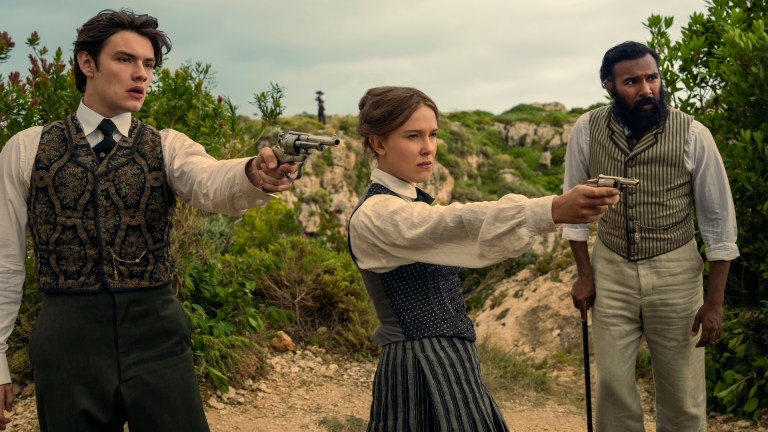
Sherlock Holmes is a name that has dominated the mystery genre since the late 1880s, taking on many new incarnations and seeing many canon changes in the past 140 years. One notable recent change to the Sherlock universe has been the introduction of the rest of the Holmes family. American author Nancy Springer joined in on this Holmes expansion in 2006, with the creation of the book series The Enola Holmes Adventures.
Enola, the rambunctious younger sister of Sherlock and Mycroft Holmes, was raised by their mother Eudoria Holmes in a progressive household that valued independence and intelligence, a rare upbringing for women in the Victorian Era. A captivating character in her own right, Enola’s identity has long been associated with her relation to Sherlock.
With the recent release of Netflix’s Enola Holmes 3, however, the youngest of the Holmes’ tribe has seemingly stepped out of the shadow of her older brother, showing that detectives aren’t defined by only unmatched intellect but also a sense of adaptability, empathy, and the willingness to challenge powers causing harm.
Sherlock Holmes is arguably the most famous detective in fiction. That makes any character connected to him at risk of being sidekicked or pushed to the background in the wake of Sherlock’s analytical genius. When Netflix first introduced the live-action film version of Enola (Millie Bobby Brown) in 2020’s Enola Holmes, there was a risk of that happening to Enola and being marketed as a film about “Sherlock’s teen sister.” Enola’s identity as a Holmes was wrapped in following the footsteps of her older brother, especially with her older brother actually appearing in the film, played by literal Superman Henry Cavill.
In her first film, Enola’s journey is about establishing her place in the real world after her mother’s disappearance. She has her “brother’s wittiness,” and her similarities to Sherlock assist her sleuthing prowess. Yet, Sherlock’s stoic logical nature is not something Enola shares. Enola is emotional, her empathy being the defining trait of her character — this leads to many comparisons of her to Sherlock by characters in the series of films. It can also be added that Enola’s place as a young girl, now young woman, in society inhibits her from having Sherlock’s “non-emotional” mentality.
Throughout the first film, Enola is introduced to the realities of being a woman in Victorian society. Having been raised in an isolated paradise centering freedom, it isn’t until she is away from her mother’s protection that she has to fight to keep that freedom for herself. Her eldest brother, Mycroft Holmes (Sam Claflin), does his best to confine her to the constraints of being a “proper lady” by sending her to Miss Harrison’s Finishing School for Young Ladies — telling a then 16-year-old Enola that her lack of desire for a husband was something that she “needs to have educated out” of her.
This is what makes Enola so distinct from her brothers. Sherlock can operate autonomously, engaging with society as he pleases as an almost neutral body, desiring nothing but a game of intellect. Mycroft engages in society with the goal of gaining privilege and prestige, wanting to gain a place of notability. Enola’s options are not as freely given — being a female detective, and in turn a troublemaker, her identity intersects with the systems of classism and sexism that make her susceptible to unjust and harsh treatment. The role of Victorian women was to keep house; girls didn’t need education as their duty was to learn to be wives and mothers.
This is the antithesis of Enola’s character, yet she uses it as both an advantage and a disguise. She also uses sexism as a cloak. As a woman, she is often underestimated and looked down upon — which allows her to get ahead of many of her male adversaries. This also allows her to navigate in places that Sherlock cannot. Often relying on women and female spaces, Enola has a network of underground radical feminist women that have helped her along her journey. This was a focal point in Enola Holmes 2, as her mother (Helena Bonham Carter) and mentor, cafe and secret women’s dojo owner Edith (Susan Wokoma), introduce her to that network who have each other’s backs.
The second film showcases not only Enola’s grit and determination to get out of Sherlock’s shadow, but her willingness to help people simply because they need help. In the third film, Enola even marks the difference between her brother and her as Sherlock helping “those with means” while she helps “those with needs.” Enola prioritizes understanding people — her comprehension of social dynamics, emotional patterns, and personal motivations being the way in which she solves her cases.
She helped the Matchstick girls, which tied into the real-life Matchgirls’ strike of 1888, when no one else would define her place in detective work. These girls were being poisoned by the chemicals used to make the matches, resulting in the deaths of hundreds of young girls working in these factories. She helps those whose lives are seen as disposable. She understands what it means to have no one defend you, to fight for your own freedom, and to keep going when you think no one believes in you. She knows what it feels like to be alone, yet understands the moral responsibility of persevering when you are the only person in the room who represents more than your own desires.
Sherlock is a vastly different character. He is anti-social, profoundly introverted, and unapologetically himself. That personality has understandably captivated readers for over a hundred years now. However, Enola’s opposingly earnest yet complimentary nature has been a breath of fresh air.
While Sherlock is chasing the thrill of solving complex mysteries, Enola is fighting against systems of inequality; sexism, classism, elitism, and racism are all cultivated into her greatest antagonists. In Enola Holmes 3, Enola is battling against herself, her desire to marry Tewksberry (Louis Partridge), whom she loves, and her hesitance to enter the confines of being a lady, having now officially “joined the pantheon of great Victorian detectives.” Simultaneously, Enola is faced with the prospect of saving a kidnapped Sherlock, who is the distraction for a mystery surrounding the people of Malta and the incredible suffering and wrongdoing they have faced at the hands of the British crown. Enola takes on this challenge, not only to save her brother, but to find out the truth that the people of Malta deserve as they remain under the oppression of the British monarchy.
Enola isn’t perfect in her methods, but she works harder than anyone else to get the desired result. Enola feels scrappy in nature. She takes risks. She makes emotional decisions, while fighting first and asking questions later. She is occasionally kidnapped, relies on the allies and connections she makes along the way, and she isn’t the loner superhuman deductionist that her brother is. Yet every win feels earned — watching Enola evolve and grow throughout the films, learning lessons and seldom making the same mistake twice. Enola works hard and embraces her circumstances while doing everything in her power to change them.
Enola’s nature and navigation of life is so strikingly different from her brother’s, but it just works.
She represents the amazing storytelling that comes with changing the angle inside of a popular story. Focusing on the “underexplored” (using that term extremely loosely) or creating new characters to examine perspectives that weren’t previously considered can birth amazing films and inspirational characters.
Enola Holmes 3 is now streaming on Netflix.