Supergirl Review: Milly Alcock Rocks in Uneven Space Western Mashup
Milly Alcock soars in Craig Gillespie’s Supergirl, however the cosmic adventure around her never quite reaches the same heights.

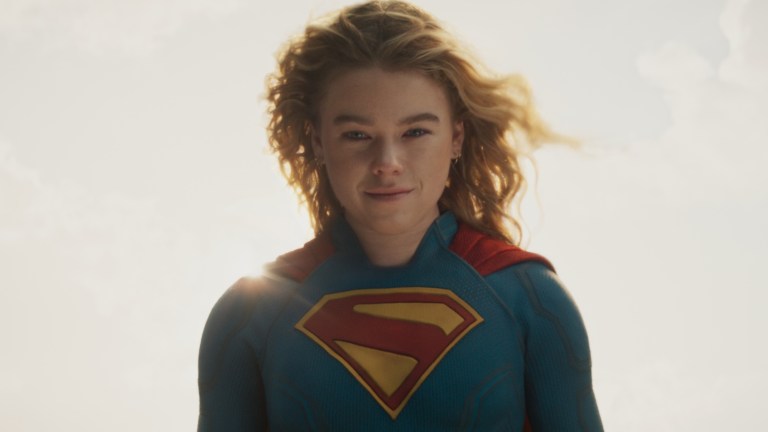
Director Craig Gillespie, known for I, Tonya (2017) and Cruella (2021), ventures into superhero territory for the first time with the second film in the revamped DC Universe, Supergirl. Written by Ana Nogueira and drawing heavily on Tom King and Bilquis Evely’s Woman of Tomorrow graphic novel, the film makes for an engaging if ultimately shallow intergalactic adventure, and something of a disappointment after last year’s Superman.
There are definitely aspects to admire about Gillespie’s approach to Supergirl, and chief amongst them is Milly Alcock’s casting as Kara Zor-El. The Australian actress, in her first lead film role, completely owns the screen, delivering a charismatic, punk rock take on the Last Daughter of Krypton. From the moment she first appears, nursing a hangover and cosmic regrets, Alock commands a perfect balance of natural vulnerability and a gritty, fierce edge. She brings a badass, cute, girly‑pop energy that’s lightyears away from David Corenswet’s squeaky clean Superman.
The film around her, however, plays like a speed run through King and Evely’s universally praised book. It isn’t exactly a reinterpretation, nor a direct adaptation, but something in between: it captures the aesthetic, a few major plot beats, and the overall attitude, yet loses much of the emotional depth, worldbuilding, and thematic weight that made the comic such a defining storyline for Kara.
Like that book, the film opens with a rougher and more reckless version of Supergirl than audiences might be accustomed to. While Clark embodies optimistic, nerdy idealism, Kara comes across as a grumpy Kryptonian with prickly emotional scars. Beneath her sarcasm, attitude, and bravado, Alcock authentically captures the trauma that defines the character, keeping the heart as visible as the anger.
Celebrating her 23rd birthday—a curious change from the character’s 21st birthday in the book, perhaps to wallpaper over all that drinking?—Kara begins the story by traveling through space with her dog Krypto. They leave Earth often for these interstellar bar crawls because planets with a red sun suppress their powers. In other words, it lets her get drunk! It also allows her to cross paths with Ruthye (Eve Ridley), a young girl seeking revenge against Krem of the Yellow Hills (Matthias Schoenaerts) for murdering her family. Reluctantly agreeing to help, Kara embarks with Ruthye on a galaxy‑spanning quest filled with bounty hunters, outlaws, and difficult moral dilemmas.
The strongest element is the central performances of Alcock and Ridley, as well as how they’re framed in moments of intense spotlight. During one of the film’s most striking vignettes, Kara escapes into space, hovering in the orbit above an alien planet. By herself in negative space, Alcock erupts in a silent scream that no one could literally hear. All the while, the film remains fixated on a single tear Kara leaves floating across the aether. It’s one of the film’s most powerful sequences, hinging on Alcock’ tightening expression and capturing the suppressed grief and rage beneath her stubborn exterior.
Another strength of the film is its worldbuilding and creature design, which is anchored by DP Rob Hardy, production designer Neil Lamont, costume designers Anna B. Sheppard and Michael Mooney, and VFX supervisor Geoffrey Baumann. The film’s blend of practical and visual effects, substantial physical sets, striking costumes, trippy and tactile alien creatures, and intricate makeup, creates a visually rich space Western aesthetic that feels far larger and more diverse than Superman’s Earthbound narrative.
The film spans Krypton, ruined cities, intergalactic bus stops, and numerous alien frontiers, each with its own identity. Furthermore, the costumes are both grounded yet faithful to the comics. Shepherd and Mooney elected to emphasize movement, flexibility, and performance, with their signature key design choice being to keep Supergirl’s iconic skirt and the character’s unmistakable silhouette.
However, much of this worldbuilding and artistry is in service of a film that still feels uneven at times and tonally discordant. Many of the supporting characters are jobbers, lifeless figures with little depth, and the visual effects can be inconsistent. While the practical locations and designs are often impressive, some CGI‑heavy sequences look unfinished or overly artificial, diluting the poetic beauty of Evely’s imagery on the page.
The most noticeable CGI element proves to be Krypto the Superdog, a fully animated character. The visual effects team used motion and emotional references from James Gunn’s own rescue dog Ozu to bring Krypto to life in both this film and Superman, but while the design prioritizes realistic canine anatomy and movement, the character sometimes slips into less convincing territory during faster or more complex scenes. Krypto, like the film, can at times get caught in an uncanny valley caught between two suns.
The fact Supergirl actually has those two suns of different hues in the third act shows that the film understands the comic’s imagery, but not always its heart. While it recreates some plot points from Woman of Tomorrow, it often strips away the elements that gave those moments emotional weight, reducing them to surface‑level sequences defined by exposition instead of empathy. Core thematic ideas such as grief, vengeance, mercy, and moral growth are present in outline, but they rarely develop with the same nuance.
A major part of what’s lost is the richness of the journey itself. The comic is a true galaxy-spanning odyssey in which Kara and Ruthye travel from world to world, encountering dragons, centaurs, strange civilizations, and surreal alien cultures, such as the segregated blue or purple people‑skinned societies. These encounters aren’t filler but essential to the themes, reinforcing the brutality of the universe and deepening the story’s ideas about grief and forgiveness. In contrast, the film condenses this journey into a literal three-day race against the clock, removing much of the fantastical poetry of the book. Instead of fully engaging with its themes of prejudice and genocide and the horrifying actions of Krem’s villainous Brigands, it glosses over a hinted‑at human-trafficking subplot, specifically involving young girls, which is never fully unpacked.
This condensing also weakens the character dynamics and moral stakes. Kara’s arc on the page is shaped through repeated choices toward compassion as she tries to steer Ruthye away from revenge, culminating in devastating realizations. Without that pacing and scope, the film struggles to replicate the richness of the book.
Even so, Ruthye remains one of the film’s strongest elements, thanks to Ridley’s performance and clear chemistry with Alcock. However, her emotional arc is significantly weakened by its brevity. The movie speeds through Ruthye’s family life, her relationship with her parents, and the inciting murder, whereas the comic spends time establishing her bond with her parents and the depth of her grief. As a result, the stakes feel thinner, and even her fighting abilities come across as inconsistent rather than carefully developed.
A similar issue affects Kara’s backstory and the portrayal of Argo City, the last outpost of Krypton that spent years floating through space after the rest of the planet evaporated. This backstory is crucial to understanding why Supergirl differs so sharply from Superman. Although the film depicts Argo City, Kara’s father, radiation poisoning, and Krypton’s destruction, it rarely lingers long enough for these elements to fully resonate. Key aspects such as Argo’s forcefield, the city’s slow decline, and Kara witnessing the death of her people amount to only a handful of scenes. These flashback sequences are striking, but are almost dumped in montage on the viewer instead of being deeply woven into the narrative.
The film’s villains are further underdeveloped. Krem is framed as the central antagonist, but Schoenaerts’ performance is generic and the character underwritten. Krem functions more like a henchman than a truly formidable threat. By diluting the heinous, genocidal elements of the Brigands on the page, the villains as a whole lose their sense of danger. Meanwhile Jason Momoa’s cameoing Lobo, a space biker bounty hunter, plays as largely unnecessary fan service. He’s entertaining to watch, but ultimately distracting from the core Kara‑and‑Ruthye journey.
Tonally, the film plays it safe. It leans on cookiecutter storytelling beats, avoids risk, and lacks the imagination and visual splendor of the source material. The comic’s strange, mythic, and sometimes horrifying universe is traded for a more PG‑friendly structure that flattens. Even the humor and music don’t consistently land, with the jokes often feeling mistimed while the stylized girly‑pop soundtrack and slow‑motion sequences sometimes seem more interested in “cool moments” than meaningful ones.
If it sounds like we’re being overly harsh, there are again many individually strong elements to enjoy: Alcock’s consistently magnetic performance, how it’s implemented in scenes reflecting on Kara’s trauma, every time Ruthye looks up at her unlikely role model in awe, and plenty of Krypto’s usual charm. But Supergirl is an adaptation that seems more interested in recreating the highlights of Woman of Tomorrow rather than understanding why they mattered. The world is beautiful, the cast is excellent, and there are flashes of genuine emotion, but beneath the style lies a surprisingly shallow take on one of DC’s most heartfelt stories.
Supergirl is in theaters on Friday, June 26.