Backrooms: Why Is Gen Z So Scared of the ’80s?
Backrooms is just the latest horror story from a generation that never experienced the 1980s.

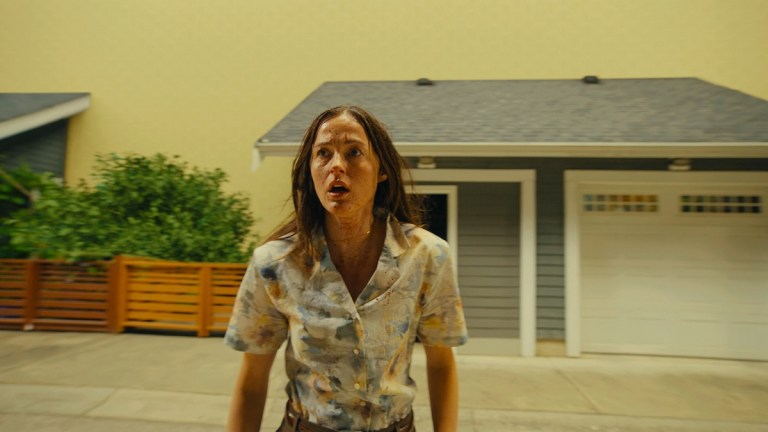
A cursory glance at this weekend’s box office makes one thing clear: the future of cinema is here. Obsession and Backrooms dominated theaters, two films not just made by Gen Z directors, but also appealing primarily to Gen Z audiences. Without taking anything away from the achievement of Curry Barker’s Obsession, the success of Kane Parsons’s Backrooms raises an even bigger question: why is Gen Z so scared of the ’80s?
A24‘s Backrooms may take place in 1990, but it derives horror from imagery from the 1980s, from its general yellow and beige aesthetic to specific details, such as an anti-apartheid T-shirt that contributes to a key scare. When combined with the killer animatronics of Five Nights at Freddy’s and even the monsters in the generally more comforting Stranger Things, it’s clear that teens and 20-somethings fear the ’80s, a decade that none of them actually experienced.
Behind the Bright Lights and Big Smiles
Ask someone in the core audience for these works about the appeal, and you’ll hear an interesting term: “liminal spaces.” For them, images of a furniture store in Oshkosh, Wisconsin, which initially spawned Backrooms, or of Chuck E. Cheese after hours invokes an ineffable sense of dread. These images display something that the audience shouldn’t be seeing, the transformation of an aggressively playful and welcoming area into something cold and foreboding.
However, most Gen Z kids didn’t even experience these places at their most normal and welcoming. Shopping malls had long since died by mid-2000s, as had all but a few furniture stores like the one in Backrooms. In most cases, today’s 20-somethings and teens would not have gone with their parents to a much smaller furniture store to shop for goods, or perhaps a clean, specialized place like IKEA. Even more likely, they wouldn’t have participated in the shopping process at all, as their parents would have bought the furniture online.
Likewise, while Chuck E. Cheese (and even some Showbiz Pizza Places) still exist, animatronics were used less frequently in the late 2000s and early-2010s before being officially phased out in 2017. And by that point, the Chuck E. Cheese and Showbiz clones that were more common in the ’80s and ’90s had long gone.
So why would these audiences be unnerved by something they know, but never actually experienced? Perhaps it’s precisely because they never experienced it.
Generational Copies
We may find part of the answer in two other movies that appear in Backrooms. Just before he starts actually exploring the Backrooms, furniture salesman Clark (Chiwetel Ejiofor) winds down by watching Santa Claus Conquers the Martians on TV. Later, after he and his therapist Mary (Renate Reinsve) get further entangled in the space, the movie cuts to the home of scientist Phil (Mark Duplass), who is watching The NeverEnding Story with his family.
Released in 1964 and starring a young Pia Zadora, Santa Claus Conquers the Martians was a goofy children’s oddity about a Martian soldier who kidnaps Santa and brings him to Mars, in the hopes that he’ll make Martian children happy again. The NeverEnding Story released in 1984 and immediately became a favorite among ’80s kids, thanks to its fantastic creature effects and to the dreamy title song by Giorgio Moroder and singer Limahl.
The substance of the two movies have very little in common. But they both have become objects of nostalgia, especially for Gen X and Xennials. Santa Claus Conquers the Martians was rediscovered in the late ’80s, when Baby Boomers started showing it to their children. The cheap production and hokey story appealed the the younger generation’s sense of irony, resulting in recreations such as a 1987 punk take on the theme song “Hooray for Santa Claus” by Sloppy Seconds and a 1991 episode of Mystery Science Theater 3000.
Today, those same Gen Xers and Xennials treat The NeverEnding Story like their parents treated Santa Claus Conquers the Martians, not just showing it to their kids (or, in the case of Stranger Things, making the theme song a key plot point in season 3) but comparing modern children’s entertainment to the movie they liked when they were kids.
Linked together by the 1990 setting of Backrooms, those two movies show another side of the memory trap the film explores thematically. In the same way ’80s kids had Santa Claus Conquers the Martians foisted up on them, they will foist The NeverEnding Story upon their children, not so much because of the film’s inherent qualities (which certainly do exist, at least in the case of The NeverEnding Story), but because the parents want to vicariously return to the feelings they once had via their children.
Cultural Backrooms
Backrooms is explicitly about how memories can become grotesque and stultifying. We may meet Clark as a bitter man who resents his wife for divorcing him and resents the fact that he’s a salesman instead of an architect. Mary seems better adjusted, but she too cannot move past memories of her childhood home, signified by the handprint from the driveway that she keeps in her office.
By themselves, there’s nothing wrong with remembering a romantic relationship or one’s childhood. But as Backrooms illustrates, the memories can become unending, inescapable. As the Backrooms themselves remember things it encounters, there becomes nothing outside of the memory. The memories just become more rooms and hallways and false doors, with no real exit.
Worse, the memories become not memories of the thing itself, but memories of the memories. With each memory of a memory, it grows more distorted and strange and grotesque, farther from the actual feeling that initially evoked it.
The liminal spaces that inspired Backrooms are exactly those distorted memories of memories. By the time Gen Z kids saw pictures of shopping malls and Chuck E. Cheese, they weren’t seeing the places where their parents would hang out with friends or go to birthday parties. They saw places that signified the joy felt by previous generations, but felt no joy themselves.
That distancing effect is obvious even in Gen Z pop culture. Gen X and Millennials also had their parents’ culture foisted upon them, in the form of sitcom reruns, Hollywood remakes, and revival series. But as pop culture becomes more homogenous and limited, today’s generation don’t even have the valves of escape offered to their predecessors. They don’t have the ironic distance that allowed Gen Xers who watched The Brady Bunch in syndication to make the snarky 1995 The Brady Bunch Movie. They don’t have Gen Xers completely rejecting The Phantom Menace, allowing Millennials to remake Star Wars in their own image instead of having it passed down to them.
Instead, Gen Z just has copies of copies, distortions of pop culture from the past that is supposed to be fun, and instead feels hollow. Why wouldn’t they be scared of it?
Beyond the Nostalgia Trap
The success of Backrooms and Obsession is particularly notable in contrast to The Mandalorian and Grogu. Instead of accepting a film continuation of a television series that’s a spinoff of a movie series that started in the late ’70s, teens and 20-somethings are going to original movies by new filmmakers, movies that speak to their experiences. Even better, they’re making these movies in a way that translates those experiences for people beyond their generation, making films that will stand the test of time.
Gen Z may have been thrown into a world dominated by nostalgia, but it looks like they’ve found a way out, making some remarkable movies at the same time.
Backrooms is now playing in theaters worldwide.