The West Wing’s Cheesiness Is Needed Now More Than Ever
The West Wing is silly, unrealistic, and exactly the kind of hopecore we need today.

Like all television pilots, the first episode of The West Wing has to introduce all of its characters, both their names and personalities. So the cold open of The West Wing‘s pilot gives us handsome Sam Seaborn (Rob Lowe) picking up a woman in a bar, motormouth press secretary C.J. Cregg (Allison Janney) jabbering about work/life balance while on a treadmill, crotchety Leo McGarry (John Spencer) crabbing about an error in the New York Times crossword, oddball Josh Lyman (Bradley Whitford) asleep at his desk at the office, and know-it-all Toby Ziegler (Richard Schiff) explaining to flight attendants why he should be able to use his cell phone on the plane.
The one thing that connects them is the word “POTUS,” specifically the message, “POTUS in a bicycle accident.” Each vignette treats the term like a special secret, building up to the point that Sam explains that it’s not a name, but an acronym: President of the United States. The pomp and circumstance, the smarty-pants approach to a fairly common term is just one example of the ways that The West Wing has aged poorly. But these days, when cynicism about the American government could not be higher, The West Wing‘s self-satisfied cheesiness isn’t just tolerable; it’s necessary.
In That White House
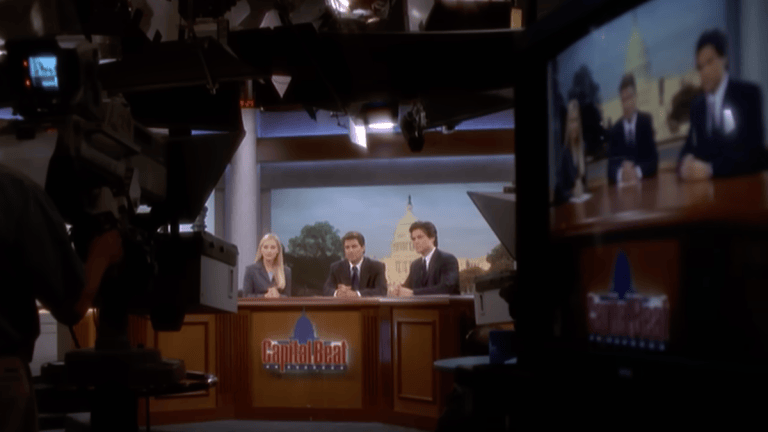
Nothing demonstrates the problems and promise of The West Wing better than the season 2 episode, “In This White House” (first aired, October 25, 2000), which introduces ongoing character Ainsley Hayes. Played by Emily Procter, Ainsley Hayes is a variation of what modern viewers recognize as a standard Fox News type, an attractive young blonde conservative who makes a splash on a Meet The Press-style roundtable show.
In the cold open to the episode, written by creator Aaron Sorkin and directed by Ken Olin, the show host condescends to Ainsley, urging her not to overreach when going up against a powerhouse like Sam. And then, as soon as the show begins, she proceeds to pummel Sam on substantive issues, much to the delight of the rest of the main cast, who watch from the Oval Office. “Did I overreach?” asks a satisfied and victorious Ainsley, bringing us into the main theme.
The rest of the episode sees President Bartlet (Martin Sheen) ordering his Chief of Staff Leo to offer Ainsley a job, precisely because he, as Leo puts it when he extends the offer to Ainsley, “the president likes smart people who disagree with him.” The rest of the staff doesn’t quite share the president’s ethos of reaching across the aisle, leading to comic moments in which C.J. has an outburst in front of her coworkers and Josh’s needling of Sam turns into genuine anger against Ainsley. For her part, Ainsley insists she won’t take the job, expressing her distaste for the “smug” Bartlet administration, a point her fellow conservatives bring up with not a few smirks of their own.
However, Ainsley’s trepidation fades via the episode’s B- and C-plots. In the former, President Nimbala (Zakes Mokae), of the fictional African country Equatorial Kundu, visits the White House to broker a deal for lower-cost AIDS drugs for his people. Thanks to Toby’s efforts, the president is able to convince pharmaceutical companies to lower their prices, provided that Nimbala’s administration agrees to certain economic rules. However, before Nimbala can go home to enact the deal, Bartlet learns that a coup has occurred in Equatorial Kundu, overthrowing Nimbala and killing his brother and two sons. Finally, in the C-plot, C.J. misspeaks to someone in the press corps, making her fear that she’s going to be called in front of a grand jury.
The C-plot mostly serves as an excuse for comedic bits of C.J. stressing out. Thus, it resolves fairly easy, when a compassionate Ainsley sees a stressed-out C.J. and offers some kind advice, relieving her worries. The Nimbala plot doesn’t resolve easily, with the President choosing to refuse the president’s offer of asylum and return to his country, despite the fact that he’ll likely be executed on the spot. However, the president’s compassion and leadership during the crisis wins over Ainsley, who not only accepts the job, but tells off her conservative colleagues for mocking the administration.
All and all, it’s top-level dramatic entertainment. The characters have easy chemistry, and Sorkin’s dialogue still sparkles today. And, in a vacuum, the stakes of the various plots have weight, all expertly acted by the cast. But once you view the episode in light of today’s politics, the episode plays much differently than it did in 2000.
Not Our White House
Watching “In This White House” today, it’s hard to not roll your eyes, if not outright wretch at some of the plot points. Throughout the episode, Ainsley takes exception to the very idea that she would choose a cushy commentator job on a news channel over the real work of politics. Yet, we have seen politicians do that very thing time and again, perhaps most famously when Sarah Palin parleyed her surprise vice presidential nomination in 2008 to appearances on Fox News and a show on TLC. Whether selling supplements or building their online brand, figures such as Glen Beck, Milo Yiannopoulos, and Alex Jones stoke right-wing anger for financial profit, hurting real people.
On the other end, the B-plot stinks of Western arrogance, portraying African countries as unstable and chaotic, especially compared to the relative stability of the US. Yes, Democrats and Republicans disagree, sometimes virulently, but they don’t murder one another. Even worse, the introduction to President Nimbala comes via one of the series’ patented walk and talks, with Leo and Bartlet discussing with irritation real South African president Thabo Mbeki’s comments about HIV, reducing a complicated issue to an opportunity to show off the intelligence of the main characters.
But easily the most grating part of the episode involves the treatment of the two parties. Ainsley believes in small government, low taxes, and economic initiatives for businesses. She disagrees with the Bartlet administration on significant issues, but she can be swayed by the force of a better argument. Throughout the episode, and Ainsley’s entire time on the show, conservatives are simply good, reasonable people with a different point of view, as are liberals. If they could just stop and hear one another out, everyone would get along.
Which is, of course, ridiculous to anyone who has been paying attention to American politics for the past 26 years. And that’s why The West Wing matters.
A Fantasy of Service
The West Wing wasn’t realistic in 2000, and it certainly isn’t realistic now. Sure, they’ll reference real-world positions in government, and will name-drop real leaders. But the show always existed more in the realm of fantasy than gritty realism. President Bartlet exists in the same way that Superman exists, a reflection of our aspirations and desires, not of people we actually know and see.
As aspirational fantasy, The West Wing shows what we wish from our government. From the president to aide Charlie Young (Dulé Hill) to the opposition, everyone on The West Wing is extremely smart and devoted. They know the ins and outs of their job, and they want nothing more than to execute it to the best of their abilities. At a moment’s notice, they’re ready to deliver impassioned speeches on even arcane topics. Toby runs himself ragged trying to convince drug companies to aid Nambala’s people, shouting down anyone who downplays the human suffering involved. President Bartlet expresses both compassion and leadership when informing President Nambala about what has happened.
But the best moment occurs when Leo completes his recruitment pitch to Ainsley. After listening to all of her concerns, Leo puts the matter bluntly. “The President is asking you to serve your country,” he tells her, and even without the music sting and camera push that follows, we understand the weight of his words, as does Ainsley.
Unrealistic? Yes. Cheesy? Indisputably. But as we trudge to the polls and watch the results in trepidation, we’ll be hit with reminders of the world as it is. The West Wing points us to a better world. Not a perfect world, but one in which people consider public service an unquestionable good, where the president acts with dignity, and where smart people are in charge. Until we can make it happen in the real world, The West Wing is a useful, if cheesy, reminder that things can, and should, be better.