The 100 Series Finale: What is Transcendence?
In The 100 series finale, the question of Transcendence came to a head. We break down what it is, how it works, and what it means for our characters.

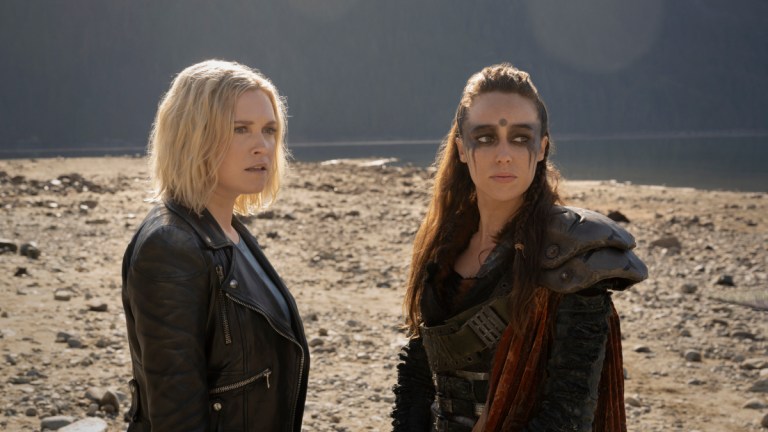
So much of the final season of The 100 pivoted around the concept of Transcendence. Indeed, Bellamy Blake died for it, as did many others. So what is it, and what did it mean for the series finale of The 100? We break down what we know and what we wish we understood better, as mere lower level entities, AKA human beings.
What is Transcendence?
After spending most of its final season on the concept of Transcendence, we’re still not entirely sure. Ostensibly, it means that an entire species casts off their physical form and joins with the consciousness of an alien race, who are considered a higher form of beings, as well as any other species that have been deemed worthy before them. They cannot die and feel no pain.
There are some rules, of course. As Levitt explained to Octavia, the dead don’t transcend. That means no Bellamy, no Gabriel, not even Anders. This isn’t the City of Light redux.
Unfortunately, we didn’t actually see what the characters see on the other side, so we’re making our best guess here. The higher consciousness being, which inhabited the forms of Callie, Lexa, and Abby described it as, “the next step,” and an “evolutionary leap,” which is in line with the way Cadogan described it during the back half of the season. As the Callie version says, “Your consciousness and that of your entire species will become one with ours. You will transcend your human form and become infinite.”
At the moment of transcendence, the characters were engulfed in a gold, glowing light that broke into particles and gathered into a small glowing orb before heading skyward. Call it a reverse-Snapture, from Avengers. Once they transcended, people left behind some golden glowing trees – or teenage Groots, or wacky wavy inflatable arm men, depending on your preferred pop culture reference.
At one point, the being, referring to humanity, says “they have added so much to us already,” showing she is pleased that humanity has joined their consciousness, but it’s unclear what, exactly, they added. (Not that I’m using “she” because the consciousness took the form of three women characters, even though it’s unlikely an alien consciousness considers gender in a binary fashion.)
How do you Transcend?
That really was the million-dollar question of season 7, wasn’t it? Well, at least until it wasn’t. Cult leader extraordinaire Bill Cadogan believed “The Last War” would determine transcendence, while Jordan believed it was a test. Jordan’s concept, which was introduced several episodes before the finale, made so much sense that it didn’t register as a surprise – not even to Cadogan himself! – when it turned out to be a test instead of war.
For the test, a representative of the higher beings takes the corporeal form of someone familiar to the test-taker. It could be their greatest love, greatest teacher, or even their greatest failure. Then, they pose questions to the test taker, who must answer truthfully. The judge can feel everything they’re feeling and will know if they’re telling the truth. Based on some criteria they don’t disclose, they will decide if the species can transcend.
Becca was the last human being before Cadogan to show up and possibly take the test. That’s what she apparently saw during “Anaconda” that scared her so badly and made her hide everything from Cadogan. It isn’t examined much in the episode, but perhaps she saw the crystalized Bardoans and thought the risk was too great? Certainly she would know that Cadogan should not take the test but his ego would drive him to do so, hence her evasive maneuvers that eventually cost her life.
Of course Clarke Griffin got in the way of Cadogan’s test, shooting him repeatedly before he could give a single answer. She then had to take the test herself, because the process had already started. For higher beings, it’s entirely unclear why they’re so beholden to arbitrary rules like “once a test is started it must be completed” and “a species must transcend or go extinct.”
Clarke did her best but also her Clarkest, and so she failed on account of the continual murder and genocide. It’s interesting to wonder if a Clarke from another time (say, Shadow Valley with Madi, the early days of Sanctum, or even her more optimistic days in the early seasons) may have done a better job. After all, beyond her Madi-or-bust ethos, her unrepentant attitude seemed to be almost a bigger problem than the actual body count.
Raven Reyes, always a wildcard who won’t go down with a fight, added a wrinkle to what seemed to be the usual format of the test, going back in and lobbying for humanity. This version of the test looked a bit more like something out of A Christmas Carol (Ghost of Christmas Present only edition), with Raven able to see the impending war on Bardo, but no one able to see or hear her.
Why didn’t Clarke transcend?
From a story perspective, Clarke not getting to transcend is a Biblical or Talmudic allusion to Moses, who led his people to the Promised Land but was never allowed to enter. Or, in the more cynical The 100-style reading Clarke gave, “I bear it so they don’t have to. Again.”
Of course, all of that falls apart when we consider that her friends rejected transcendence to be with her, but we’ll get to that in a minute.
As the Lexified higher being told Clarke at the end of the episode, Clarke’s actions had to have consequences. Apparently, she (they?) didn’t mean Clarke’s lifetime’s worth of dubious choices, but rather her killing Cadogan while he was taking the test. As she said, “In the entire universe, since the beginning of time, no other entity has killed someone while taking the test. Ever.”
Clarke may also want to ask if there have ever been multiple entities present during a test, thereby shrinking that deliberately misleading sample size considerably, but let’s be honest: Clarke was never going to ascend. It was just a matter of how the writers chose to justify it.
Transcendence is a choice
According to the Lexified version of the higher being, transcendence is a choice. This was first foreshadowed when Madi started and stopped her transcendence a couple of times. Clarke correctly guessed that her daughter didn’t want to leave her and told her to go without her.
In the end, Clarkes friends all came back to be with her. None of them will be able to have children, and when they die it will be a true death, no transcendence – an especially fraught choice for Murphy, given the way he wrestled with his past sins and his fear of the afterlife throughout the season. But without other humans, suddenly Earth seems a lot more idyllic, more like what the 100 delinquents had first hoped for back in season 1. It’s reminiscent of the best years on Sky Ring, because instead of waiting, their loved ones are all there.
Taking a step back, however, it feels strange to invest so much of a show’s final season in a concept that almost the entire main cast opts out of. In the end, it functions more as a cure-all for Emori, Echo, and Levitt, and a way of reuniting everyone tidily (remember how they left Gaia on Earth with only Indra giving her a second thought?) Madi also gets something of an upgrade, and Clarke is suddenly free of a narrative albatross she’s borne for three seasons, who the writers only sought to remove once she became disabled.
Given that the dead don’t transcend, season seven’s earlier deaths pack an even bigger punch. Those who died but transcended or were restored by their own choice lose the emotional weight of a real death. Meanwhile, the earlier deaths take on a steelier glint in retrospect, knowing they were so close to some form of narrative absolution.
Examining the larger meaning behind transcendence, it’s truly hard to assign it one, when almost no characters we care about ended up transcending. It’s some sort of unseen mystical forever. So even if, as some characters said, the cult version of Bellamy was right, in the end, none of them chose transcendence. If Clarke hadn’t killed him, would he have been up there with Madi, or on the shore with his friends? For our leads, the most important part of this “final evolutionary step,” is incidental to transcendence itself, a byproduct: the end of violence between humans. Finally, everyone that’s left is safe and together.