Star Trek: Strange New Worlds Season 4 Premiere Review — Valles Marineris
Star Trek: Strange New Worlds returns with a premiere that sends its crew back to the past in order to preserve the present.

The following contains spoilers for the Star Trek: Strange New Worlds season 4 premiere.
Fans have spent years discussing the many similarities and overlaps between the sci-fi elder statesmen Star Trek and Doctor Who, and both franchises have delighted in slipping in references to the other at various points in their recent canon. Last season of Star Trek: Strange New Worlds even snuck a literal TARDIS into “The Sehlat Who Ate Its Tail.” And while Strange New Worlds’ season 4 premiere doesn’t include a Time Lord or a mysterious police box, it does tell a story that involves precisely the sort of timey-wimey narrative displacement that its iconic cousin loves. (Not to mention it confirms that Commander Pelia was probably a companion at some point.)
Sure, its logic makes almost zero sense if you think about its specifics for more than five seconds at a stretch. But its emotional beats are strong enough that it’s not difficult to overlook the fact that the hour’s ending really shouldn’t be possible at all.
To the likely relief of those who didn’t enjoy some of the more out-there episodes of Strange New Worlds’ third season, “Valles Marineris” is a determined return to basics. An hour that takes us to one strange and one not-so-strange (in the end) new world and features the sort of morally thorny central conflict that this franchise does best, it’s a story that’s as much a philosophical debate as it is a space adventure, even though there are literal dinosaurs involved. From familiar arguments about the value of diplomacy and the idea that might doesn’t always make right to questions about temporal interference and allowing objectively terrible things to happen for good reasons, the episode grapples with many of the themes that have long dominated Star Trek even as it rewrites a chunk of Earth’s history in the process.
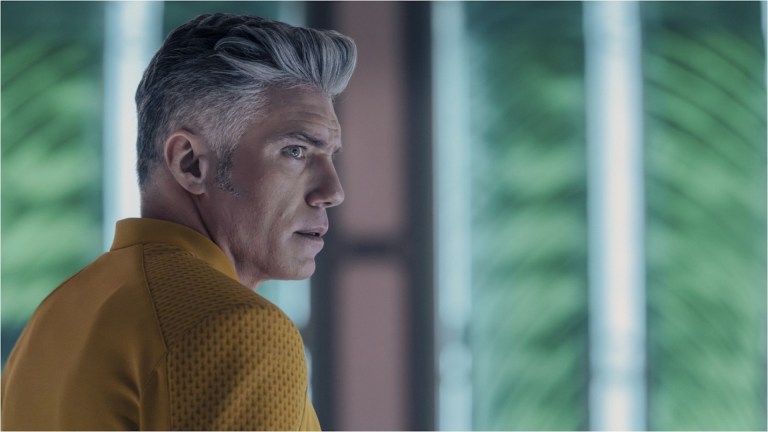
Picking up from the events of season 3, the Enterprise has been on what sounds like a generational run of adventures. Their missions have seemingly been non-stop over the six months since Captain Batel’s death/transformation into an eternal guardian. And while we all love to see Anson Mount play cowboy as often as possible, it’s very obvious that Pike is using the crew’s directive of seeking out new life and new civilizations to paper over the grief he’s clearly still carrying.
Setting off on another assignment to avoid thinking about the possibility of a promotion he doesn’t particularly want, things take a bizarre turn when the Enterprise is sucked into an interstellar squall they’re meant to be observing and flung 65 million years into the past to our own prehistoric solar system. Only, it’s not entirely the way our history books depicted it. Because while there are dinosaurs, there are also actual Martians, who appear out of nowhere to claim the badly disabled Enterprise as salvage. (At least their uniforms are green-tinted.)
Led by the surprisingly reasonable Captain Cassel (Saffron Burrows), the Martians don’t want to harm Pike and his crew. They’re also surprisingly willing to listen to his arguments about why they should seek a peaceful resolution to their seemingly never-ending war with the Dol’drm, an invasive and highly destructive species that seems more like voracious locusts with advanced technology than anything else. But for all her genuine interest in Pike and the Federation’s mantra of friendship and cooperation, Cassel is a realist at heart. Particularly when she figures out the truth that the Enterprise crew is from the future — and learns that its computers only have a record of her home world as a dusty wasteland devoid of life.
Yes, stealing an antimatter bomb is not exactly great diplomacy. But can you blame her for seizing the moment to try and save her people now, when it’s obvious that a future isn’t guaranteed for them beyond this moment anyway? Christopher Pike sure can’t.
Yes, his last-minute decision to let her essentially nuke her worst enemies and sacrifice herself and her crew in the process is as much about preserving our solar system — which doesn’t have a fifth planet, Dol’drm on Earth, or life on Mars — as it is about the fact that he clearly sees her as something of a kindred spirit. But given that he’s a man who has been forced to repeatedly confront the irreversible nature of his own tragic future many times before, no one is more qualified to make the hard call about whether to sacrifice a crew of perfectly nice Martians in the name of preserving humanity. (Sometimes Pike’s sunny and optimistic disposition makes it easy to forget how genuinely difficult it must be to be him on a day-to-day basis.)
Here, the Martians have to die, because they always have. Because their choice not only ends their endless war, but ultimately kills the dinosaurs, cools the Earth, and ushers in the destruction of their own planet. These things have to happen, because they have already happened, because otherwise humans won’t exist. Yes, the Enterprise’s presence in the past is the sort of bootstrap paradox that’s built on the same logic that powers Bill and Ted’s Excellent Adventure. But as Star Trek: Voyager’s Captain Janeway once told us, the best way to make sense of temporal paradoxes is simply not to try. Still, it’s difficult — for both Pike and the viewers watching at home — to square such an uncomfortable circle. Yes, the Dol’drm seem kind of awful, but does that mean their entire species deserves to be wiped out?
As premieres go, this hour is pricklier and more bittersweet than most. Pike’s quick thinking keeps humanity’s future on track, but at the cost of facing down yet another predetermined future he can’t change, even if he wanted to. Una, La’an, and Ortegas get to see the wonder of dinosaurs, even as they know they’re personally part of the reason they no longer exist. And even as Pike doubles down on his plans to live in the moment rather than think of all he has lost and all he still has left to lose, the show he stars in hints that such a choice may not actually be possible. No matter how much we’d all like it to be.
New episodes of Star Trek: Strange New Worlds premiere Thursdays on Paramount+ through September 24.