Star Trek: Strange New Worlds Season 4 Episode 8 Review — Orders of Magnitude
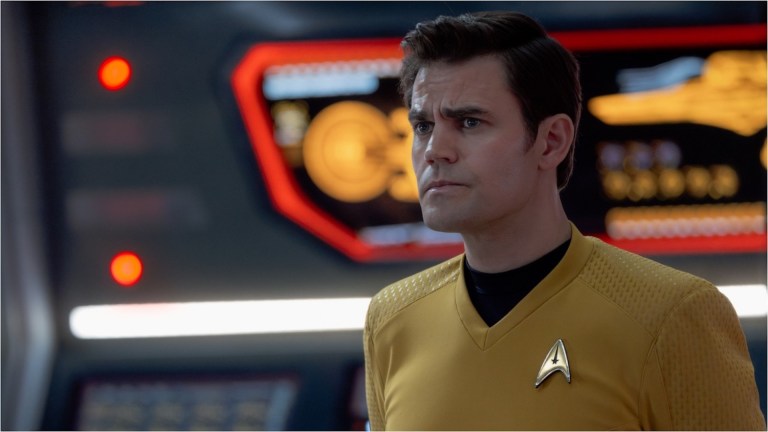
Strange New Worlds puts James Kirk center stage in an hour about how far anyone can be expected to go in following orders.

The following contains spoilers for Star Trek: Strange New Worlds season 4, episode 8.
Bad admirals appear throughout Star Trek, from The Original Series (“The Doomsday Machine”) and The Next Generation (“The Pegasus”) to Deep Space Nine (the “Homefront”/”Paradise Lost” two-parter). It was probably well past time for Strange New Worlds to do something similar and, as such things go, “Orders of Magnitude” is a solid entry into the canon of such installments even if its conclusion pulls its punches more than some of us (read: me) might like.
A tense episode that wrestles with some of the big philosophical questions that this franchise is best known for, “Magnitude” puts James Kirk squarely in the middle of a leadership crisis on the bridge of the ship he’ll one day command and adds some intriguing new layers to our understanding of his family. As Strange New Worlds moves toward its final season, the show is deliberately highlighting the ways that the characters we see now are growing into the people we know from The Original Series.
This hour also revisits some of the thematic issues raised by season 3’s “The Sehlat Who Ate Its Tail,” particularly how Kirk was irrevocably altered by the consequences of the choices he made during that episode. Though he saved the Enterprise and a planet full of innocents, his decision to destroy the Scavenger ship killed over 7,000 people. His behavior throughout this hour indicates that he isn’t—and likely never will be—over the trauma, and that experience is guiding many of his actions here. It is one of the first examples we’ve seen of Kirk’s famed insistence on beating seemingly no-win scenarios by finding an unconsidered third option that somehow allows him to succeed. Here, it involves drugging one of his superiors and bluffing that he’s about to destroy the ship, but, hey, everybody has to start somewhere!
Joe Morton is excellent in a delightfully unbalanced guest turn as Admiral Simon Reeger, a legendary Starfleet captain from the Klingon War that half the crew is immediately starstruck by, and that everyone watching at home probably immediately realized that we couldn’t exactly trust. He arrives on board while Captain Pike is off-ship, investigating a distress signal on an M-class planet below with Una, Chapel, Uhura, and Ensign A’Sha, who’s on her very first away mission. (And being predictably unpleasant about it.)
Though Pike and team are out of comms range, Reegar pulls rank and immediately commandeers the Enterprise to help him chase down a mysterious ship he claims is responsible for the infamous Vaardan Massacre, an attack on a Federation colony that led to five million casualties. This ship remains unidentified throughout the episode and is not shown onscreen. But references to a new type of cloaking device—as well as the attack’s proximity to the Romulan Star Empire, laid out in a map full of gloriously nerdy Easter eggs—certainly seem to point toward a specific culprit. Though the show obviously has to tread carefully when it comes to confirming it one way or the other, since the “official” first interaction between Starfleet and the Romulans takes place in The Original Series episode “Balance of Terror.”
Kirk falls into all of this almost by accident, having come aboard the Enterprise to see La’an after the whole unfortunate stabbing incident from a few episodes back. But since he’s the highest-ranking person remaining onboard, he becomes Reeger’s first officer, which, in case it wasn’t clear, ends up being a frankly terrible job. The two almost immediately start butting heads about almost everything, a situation that is made exponentially worse when the crew tracks the ship to Argus 2, a small non-Federation planet, which he immediately assumes is the enemy’s home base. Determined to eliminate the threat at all costs, he invokes General Order 24, which translates to “destroy the entire surface of the planet and every living thing on it”. That’s at least 5,000 inhabitants, maybe more. And it’s not even entirely clear that the ship they’re chasing has even landed on the planet at all. Reeger doesn’t care. The possibility that it might have is apparently enough.
Lots of Star Trek stories (and subsequent debates about them) revolve around Spock’s famous quote that “the needs of the many outweigh the needs of the few”. True, many of those stories are also about people finding ways to flout that conventional wisdom, including this one. But the debate is worth having: if a ship that killed five million people can be destroyed by sacrificing five thousand? Whose lives are worth more in this scenario, the people living on the planet they’re about to raze, or an unnamed future group who may or may not be endangered by this deadly ship? Kirk’s position is simple: “Killing an entire planet is wrong.” But is it always? Those are precisely the kind of stories that science fiction like Star Trek is meant to explore.
By removing Pike from the equation (we all know how he would have reacted), Strange New Worlds gives Kirk a real test and a chance to step up in an intriguing new way. After all, Reegar is seen as a hero throughout Starfleet. What does it cost him to be the man who tries to say no to that? (Is this the source of his love for challenging Federation authority? Maybe.)
It’s unfortunate that “Orders of Magnitude” takes a bit of an easy way out, in the end. Sure, Kirk’s largely one-man mutiny makes for compelling TV, and allows the show to explore how his father, George Kirk, knew of Reeger’s issues, but kept them to himself for the good of Starfleet. (There’s always something moving about a young man realizing that most of his unkind assumptions about his father were probably wrong.)
But the episode tips Reeger a bit too far into mad king territory, giving him a tragic personal connection to the Vaardan Massacre (his wife and daughters were killed there!) and sending him into the kind of unhinged rage that not only sees him strike Kirk several times but also point a phaser in his face. Yes, he did all of this under the influence of drugs meant to make him lash out so that M’Benga could declare him unfit, but none of his behavior under the influence feels like a terrible stretch for the man he’s revealed himself to be.
Still, in the end, his collapse is an awfully neat and convenient solution for the complicated questions this episode raises. M’Benga’s sacrifice, taking the blame for drugging the admiral and sparing Kirk’s future while undoubtedly getting himself demoted into the position we meet him in on The Original Series, feels like the only thing that’s going to have a real long-tail impact. (Chapel, at least, looks pissed.) Hey, at least Uhura got to fight a squad of Andorian smugglers all by herself. Win some, lose some, I suppose.