Star Trek: Starfleet Academy Episode 4 Review – Vox in Excelso
Star Trek: Starfleet Academy puts Jay-Den front and center as it reimagines the future of the Klingons following The Burn

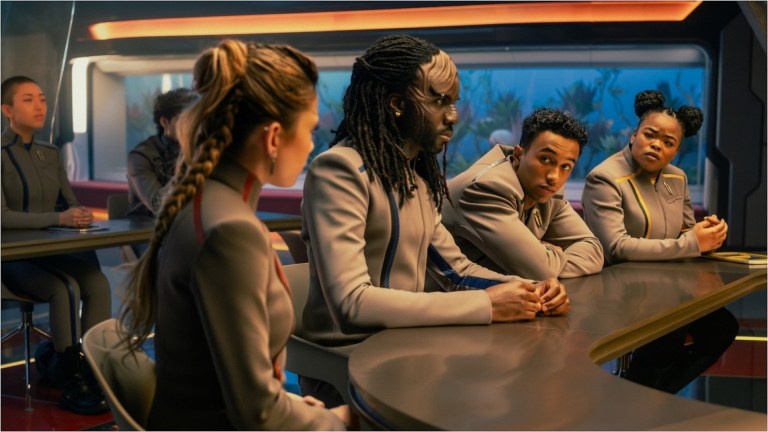
The following contains spoilers for Star Trek: Starfleet Academy episode 4.
Fourth time’s the charm, or so it appears forStar Trek: Starfleet Academy. While the franchise’s latest series has certainly struggled a bit out of the gate — its first three episodes have, thus far, ranged from largely forgettable to painfully frustrating — it finally finds something that feels like solid ground in “Vox in Excelso”. An hour that deftly connects to the world of Star Trek’s past and hints at the promise of its future, the episode is one part character study, one part post-Burn lore dump, and one ode to the power of friendship. In short, exactly the kind of story this show is uniquely equipped to be telling and, hopefully, a sign of where it’s heading in the weeks to come.
An installment that focuses on young Klingon cadet Jay-Den Kraag, this week sees the Academy kids learning about debate techniques, which at least has a more direct real-world application than that weird laser tag game from last week. Caleb, to the shock of absolutely no one at this point, is a stunningly good debater, because of course he is! Who could have foreseen that prison would not only make him physically ripped but also teach him the finer points of constructing arguments and force him to memorize Federation bylaws? (Sigh.) Anyway, he demolishes his classmates because we’re simply not allowed to see him fail at something yet, and poor Jay-Den has a panic attack at the podium, because it turns out he fears public speaking and seems to associate arguing with conflict, a thing he has sworn to avoid. Not a particularly Klingon-esque character trait, but Jay-Den is not what one might call a typical example of his species.
But what does that even mean at the moment, anyway? Probably not what most of us expect. It turns out that, in the years following The Burn, the Klingons essentially have been decimated as a species and are close to extinction. Their homeworld of Qonos has been destroyed — conspiracy theorists insist the Klingons did it themselves for unexplained (and inexplicable) reasons — and the surviving clans haven’t been on what you might call great terms with the newly reconstituted Federation. (For the nerds among you: None of this does anything to clear up the ongoing question of whether the Klingons ever actually joined the Federation at any point) As a people, they’d rather die than accept anything they see as charity or help from others, and they’re willing to stand on that principle even if it means that their entire race is wiped out.
Lacking a true homeland of their own, the Klingons have doubled down on the sanctity of their culture and traditions, which offers an important insight into why Jay-Den’s chosen path, one that eschews violence in favor of healing, is so shocking at this particular moment. He grew up with his family on a refugee planet, where his brother encouraged his interest in Starfleet and didn’t judge him for his dislike of the warrior ethos their father insisted he follow. His death — a tragedy that could have been prevented by access to the same sort of Federation tech the Klingons have rejected since the Burn – shapes much of Jay-Den’s life, solidifying his decision to embrace pacifism and seemingly driving a wedge between him and his parents. Now, those same parents are aboard a missing transport ship that has suffered a catastrophic mechanical failure, and neither Jay-Den nor the Federation knows if they, or the other members of eight of the other surviving Klingon houses, are alive.
It’s a lot for poor Jay-Den to process, as the only member of his species currently enrolled at the Academy, which means that, of course, it’s time for his debate class to take up the subject of the Klingon diaspora. Should Klingons be forced to accept asylum from the Federation? Should they be allowed to live in whatever way seems best to them, even if their choices essentially ensure the death of their species when given a long enough timeline? Who gets to make these choices for them? Suddenly, everyone has opinions! It’s more than a bit uncomfortable to watch these kids treat the right to self-determination of Jay-Den’s people into a thought experiment. Still, almost everyone comes prepared with what appear to be generally cogent and thoughtful arguments, so it could be a lot worse.
New friendship alert: After Jay-Den’s debate with Caleb gets both heated and surprisingly personal — the boys don’t come to blows, but it feels like a near thing — the Klingon gets some advice from a surprising quarter: Darem. A character who started the series off as a self-centered rich kid, he’s nevertheless managed to display some real growth and vulnerability, and his reaching out to Jay-Den is both unexpected and strangely meaningful. He teaches him some Khionian breathing techniques to help him focus, and the two have some intriguing chemistry with one another. (Maybe shared breathing techniques just almost always make me think of romance, but they’re more interesting together than Darem and Genesis are, I said what I said.) It ultimately helps Jay-Den and Caleb find a way to a better understanding together.
Compromise is the lesson of the day in more ways than one. Thanks to a surprisingly warm pep talk from Cadet Master Thok, Jay-Den comes to a deeper understanding of his father, who just may have pushed his son away to set him free from a culture that would otherwise not respect his choice of a peaceful future in the only way he knew how. Similarly, Jay-Den, Ake, and Admiral Vance must come up with a way to meet the surviving Klingon clans on their own terms to gift them the homeworld their people need. The ruse — that the Klingons somehow defeat the Athena and several other Starfleet ships to claim and conquer the Qonos-like planet the Federation was planning to just hand them in the first place — is laughably thin. But it allows the Klingons to save face and the Federation to show it’s capable of humbling itself in a way we haven’t really seen all that much of in post-Burn society. But, hey, we definitely got confirmation that Ake has for sure hooked up with a Klingon warlord, so here’s hoping that an episode that dives into her backstory is coming sooner rather than later.
New episodes of Star Trek: Starfleet Academy premiere Thursdays on Paramount+, culminating with the finale on March 12.