House of the Dragon Season 3 Episode 6 Review: Butcher’s Work
The North throws a ball for Criston Cole in an episode that examines the distance between our wants and our realities—perhaps including for those who desire a faithful interpretation of the Dance of the Dragons.

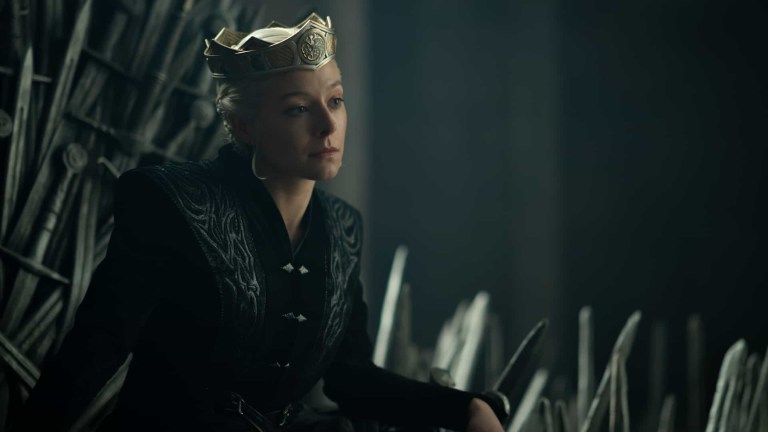
*Editor’s note: This article contains House of the Dragon Season 3 episode 6 spoilers. Also Lord Commander Alec Bojalad is out this week, so brother David Crow is taking the watch.
Promise magic but then deliver horror and pain. This not-so-secret recipe has always made the fantasy worlds of George R.R. Martin taste simultaneously bitter and exciting. Whereas most high-fantasy since the days of Tolkien and Baum has leaned into wonderment, and an often childlike sense of escapism, the minor-key appeal of A Song of Ice and Fire is it resembles the reality we run from.
There’s a kind of comfort in that, too, if in a cold, Winterfell fashion. Most of us understand that our lives, or our simple aspirations for it, can be deeply estranged from the complexities we find out there in the world. This vast chasm between what we wish to be, and who we become, was on full display throughout all of tonight’s episode of House of the Dragon, but most especially during the battle-cum-slaughter right at the top of the hour. Aye, we’ve come at last to what the maesters tell us was the Butcher’s Ball, the battle where Fabien Frankel’s poor, loveless Cristol Cole—a scoundrel who to his last breath dreamed of an honor and chivalric destiny he never earned or deserved—met a muted, unsung end.
As our dear absent Alec Bojalad mused last week, Cole is one of the most unlikable characters in the Dance of the Dragons saga, be it in Martin’s Fire & Blood or in the often revisionist stylings of House of the Dragon (where I should stress Frankel is great at playing a self-pitying prick). He is a man who betrayed one love because Princess Rhaenyra allegedly stole his honor by tempting him to break his vows of chastity, but who then spent another 20 years scheming to break every other oath he swore to his king, the king’s chosen heir, and his Kingsguard brotherhood, all in service of another queen he would take to bed.
On a certain level in the last two episodes, the House of the Dragon writer’s room came closer to reconciling the hypocrisies of Ser Criston than the fragmented histories of Martin’s Archmaester Gyldayn (the in-universe author of Fire & Blood) ever could. The show’s Criston is at least dimly aware and accepting of his moral discrepancies. Last week he all but confessed he traded one prospective queen in the night for another, and that he’s spent his whole life as a broken tool for high houses. He wants to, finally, die on his own terms and be his own man, rather than the useful kingsman (or kept man) of another great castle. Criston claims he is done with being Team Black or Team Green.
And yet, in his dying breath, Cole cannot help but hope for one more great honor, a climax as noble and beatific as any act of self-sacrifice written down in the Kingsguard’s little white book. In his final moments, he literally clings still to Queen Alicent’s favor, a token of supposed affection that viewers might, like Cole, have forgotten she gave with some reluctance because he begged for it. It does him little good, however, because there will be no grand death worthy of the bards and singers that will echo through the halls of the Red Keep, nor will the dowager queen have much to remark on when learning that, rather than being granted a last stand in glorious battle, the men of the North and Riverrun cut Cole down from afar like a rabid dog.
The abject surprise of a final, bitter disappointment—one last fantasy torn asunder—in Frankel’s eyes is enough to almost make me pity this pathetic man. Almost. Truthfully though, I mostly just wish we had Pate of Longleaf’s final judgment in Fire & Blood: “I’ll have no songs about how brave you died, Kingmaker. There’s tens o’ thousands dead on your account.”
Episode six began thusly, faithfully capturing one of the Dance of the Dragons’ many ignoble orgies of carnage and mayhem. But the whole episode, really, seems to live in that no man’s land between the fantasies that characters, audience members, and even jaded TV critics like myself latch onto, and the deliberately beleaguering discomforts we eventually must face. In fact, Queen Rhaenyra is making something of a career of it in her so-far brief and evermore frayed rule over King’s Landing.
There are many reasons to pity the hand that Rhaenyra was dealt. If she had inherited an uncontested throne, as the lords of the realm swore they’d abide in her girlhood, she would not face a fractured Seven Kingdoms or, perhaps more troublingly, empty coffers in the vault downstairs. She also might not needs rely on what is intriguingly the same bad advice her distant descendent Daenerys Targaryen would receive when mounting her own hostile takeover of Westeros: do not rule like a conqueror as Aegon did in his time, they say, be patient and prove you’re a qualified woman who can show compassion, they say. You must be humane, cognizant of your public perceptions. Or: weak, as Ormund Hightower rightly surmises later in the episode when betting on her being unable or unwilling to fire on his stronghold in Tumbleton.
Only Daemon, the demon on the queen’s shoulder who whispers strangely good advice in a world as demonic as Westeros, tells his wife otherwise. Rhaenyra is right to point out to her husband that to set fire to Tumbleton would probably be worse than what Aegon the Conqueror did to opposing armies on the Field of Fire, and beneath the melted stone dripping from Harrenhal’s ruins. However, so much of this episode is about Rhaenyra being set up by both her enemies to appear weak that her inability to refute them… makes her just so. And not all that conspires against her is the fault of the Hightowers.
Several weeks ago, at Mysaria’s urging, Rhaenyra made what amounted to a great PR move when she fed the starving smallfolk of King’s Landing for a day. But left to her own devices this week, the rightful queen is so distracted, dithering, or fearful to shoulder responsibility that she forgets to even at least feign benevolence to a population slipping through her fingers. When told of septas kidnapped off her street, Rhaenyra can only say, “I’ll light a candle for her when next I attend the Sept;” and upon hearing her citizens are scared to walk the street, she fecklessly points fingers at Hightower mischief and then shrugs her shoulders. She is under the belief that her subjects must simply accept her ineffectualness, which is a dangerous folly for any ruler.
Rhaenyra would like to see herself as a just and kind queen, much as she likes to tell Daemon her father was. But anyone who watched the first season of House of the Dragon knew Viserys’ kindness walked alongside his weakness, and a willful blindness so overpowering he waited until he was on his deathbed to even attempt to fix the growing, murderous divide within his own house. It was too little, too late then, and he at least had the advantage of ruling during peacetime. Rhaenyra is at the center of the greatest maelstrom Westeros has seen since the Conquest and thinks turning her literal back on her reeling subjects in a time of crisis will not mar her reputation in her own city walls. She probably even thinks she’s not missing crucial time with young Prince Joffrey while hiding from him and her grief over Jace and Luke.
It’s a delicate thing Ryan Condal, Sarah Hess, and this episode’s writers David Hancock and Shyam Poppet are attempting with Rhaenyra’s arc. Without venturing into spoilers, Rhaenyra’s reign is… complicated and shaded by the biased historical sources of all-male maesters framing it in Fire & Blood. Still, it’s safe to say her ascension to the Iron Throne can be no storybook happily ever after or millennial-girlboss wish fulfillment. And the seeds being sown in the last two episodes for that acrimony tease a complicated portrait of a mostly good woman who is not only failing to meet the moment, but is pretending she doesn’t know what time it is. Or how late in the day it’s quickly becoming. Emma D’Arcy plays this version of Rhaenyra as deeply sympathetic, but in tonight’s episode in particular, they’re coloring the queen with the blindness of privilege and elitism. She really is her father’s daughter; a monarch who cocoons herself in a space of moral relativism.
It’s one of the better changes in an episode that, before it’s over, makes some drastically bizarre departures from the source material that do not work at all. But before getting to that ending, first House of the Dragon continues some of its shrewder innovations, such as Rhaenyra’s unpopularity being intentionally stage-managed by Ormund Hightower. Love or hate James Norton’s broad performance as the Lord of Oldtown (I’m mixed), there is a narrative cunning in suggesting the discontent of King’s Landing is not the fault of happenstance or fanaticism, but a methodical political campaign.
Akin to something like bloody, medieval influencers or Fox News personalities, the anti-Targaryen sentiment growing in King’s Landing isn’t (at least at first) a spontaneous reaction of religious fervor, but an astroturfed phenomenon spread by Hightower agents fanning resentment through whispers and murders, including among the Gold Cloaks. Even proud, boastful Prince Daemon Targaryen, the Lord of Flea Bottom himself, is seeing his reality distortion field collapse. Matt Smith was in fine form last week when he showed he can still conjure the Rogue Prince’s devious charisma while pep-talking the local police force. This week, the actor was even better threading a sense of aging disconnect in the same rogue’s pleas as he begs more men to die for him and his wife. For free.
He yaps about duty and machismo, but the effect is more the aging politician whose hunch lowers when trying to climb atop a firetruck. Gone is the BDE scoundrel Daemon/Smith excel at. Albeit, Daemon at least attempts to recover that swagger by going undercover in the city, and even manages to kill one of Ormund’s agents, but in the long run, he may just further alienate the smallfolk when he similarly beats and derides poor, dim Ulf of White, who was caught playing hooky in Flea Bottom. Is Daemon right to chastise a dragonrider shirking his duties? Absolutely. But to do so in such a humiliating and demeaning way, when Ulf nor Hugh the Hammer have been rewarded with actual lands or security is… mayhaps unwise.
Like everyone else, Ulf and Hugh the Hammer are discovering privileged Targaryen power isn’t everything they dreamed about. They have the fire of dragons but, as Ulf whinges to Hugh, are their lives any better than a year ago? I’d wager so for Ulf in spite of his whining, but Hugh at least had the love of his wife back then. Now she’d rather die a hostage in Tumbleton than leave with her husband to live in a castle—which honestly smacks of modernity values encroaching on Martin’s riff of medieval society. Surely, a more human response to discovering your husband has actually succeeded in seemingly inheriting great wealth and power would be to ask for him to find a way to smuggle you and the rest of your family out of town with him? Instead she storms away from the guy who just revealed he now has the keys to a life free from starvation and poverty. It’s all a bit ham-fisted, much like every sequence involving Rhaena Targaryen’s bizarre subplot with the arrested-development dragon.
What lands much better is the Hightower scheming and backbiting across town. I know some Fire & Blood purists take issue with Ormund being drawn so archly as a villain, but the truth is that with the exception of old Ser Otto and Alicent, none of the Hightowers ever had much characterization or depth at all on the page, which leaves plenty of wiggle room. Ormund’s megalomania can err on caricature at times, but his cunning is genuinely appreciated after the haplessness of Aegon and Aemond’s inept Team Green reigns last season. And his dynamic with Prince Daeron and the newly returned Ser Gwayne Hightower is deeply rewarding.
As previously mentioned, the growing anti-Targaryen fervor in King’s Landing being a Hightower smear tactic is clever, but then so much of what Ormund is passing to Dareon in his own noxious high-handed way is wise. Even through a cloud of misogynistic condescension, he knows when to credit Rhaenyra with wisdom for selecting someone like Corlys Velaryon as her Hand, and is astute to suggest Daeron be as judicious when the time comes to pick his own second-in-command. “What of my grandsire?” the young prince enthuses. “Otto? Where do I begin?” Ormund scoffs while saying everything with his little giggle about the danger of selecting the ambitious man as your servant.
The bad blood and grudges between all three central Hightower parties serves the episode well, culminating in another interesting innovation when Rhaenyra’s bold attempt to assassinate Ormund is undone, not because of Ormund’s cleverness—in fact, one wonders if the assassins being cloaked in mud was intended to deliberately distract the famously fastidious Ormund—but because Gwayne knows his Baratheon men well enough to spot a counterfeit.
Generally, I’ve enjoyed the Education of a Usurper sequences all season in our new Team Green: The Hightower Expansion Pack, but the payoff at the end of this episode might have just thrown it all away. Indeed, the final moments of tonight conclude with the greatest deviations we’ve seen in all of House of the Dragon. And if I had to guess, this is the exact episode script that could have led to George R.R. Martin’s public break with the series.
It’s time to talk about the assassination of Lord Corlys Valeryon.
In terms of Hightower strategy, it’s a sound move, assuming that assassins could find the Sea Snake so quickly and so far from King’s Landing. If a monarch you’re trying to overthrow attempts to murder you, go after her. Or at least her most useful and dangerous of retainers. There is a certain cruel humor that Martin should approve of, too, in the line “Kick this dog, and it’ll bite your hand,” smeared in blood on the fake-Baratheon’s tunic.
However, in terms of an adaptation it is almost disastrous to think of the ripple effects that will stem from killing off the Sea Snake—a character I might add lived to old age in the books and histories—at this point in the story. There was still so much left for him to do in the great Dance, from the events in Tumbleton to the final movements and resolutions of the civil war that are looking increasingly doomed to being ignored or massively rewritten.
But putting fan quibbles of “but actually” aside, and judging this purely as a narrative culmination to Corlys’ arc on the television, it is depressingly anticlimactic. Corlys spent much of the first two seasons grieving first his wife Rhaenys’ claim on power and then his wife herself. Corlys and Rhaenys as Westeros’ overlooked power couple is lovely, but the Sea Snake living up to his reputation and making good on his debts to both Rhaenyra and especially his sons Addam and Alyn has gone largely overlooked and perpetually underwritten.
So to now take him off the chessboard entirely after leaving him largely neglected for much of seasons two and three is a huge disservice to actor Steve Toussaint and viewers. Rhaenys got her moments, the Sea Snake never really did though. And now his death tastes neither heartbreaking or shocking. It arrives with a whimper.
I cannot help but be taken back to the chasm mentioned earlier: the distance between my continuing hopes for this series and the ultimate reality about it I must face. The truth is that I have genuinely liked season 3 of House of the Dragon, even with its occasional eccentricities or odd flourishes. The first two episodes are among the best hours of any set in Westeros. But in the one season 3 episode I find myself reviewing, I am reminded of the apprehension—and disappointment—I felt in season 2 when one of the most chilling and unforgettable sequences of the Dance of the Dragons—the cruel Blood and Cheese affair—was haphazardly substituted with something far lesser.
With Blood and Cheese, I could at least pick out the thematic logic of revealing one of the most sinister sequences Martin ever wrote was Green propaganda, and the reality was as messy and clumsy as real people are (much like the far cleverer amendment that Aemond’s murder of his nephew was a quasi-accident). But the removal of Corlys just feels like a rushed concession to wrapping up the series as quickly as possible.
Similarly, the choice to send Alicent to Harrenhal is baffling. Alicent realizing she does not love, or at least know, any of her three children is one of the best elements of this season, and every scene between Olivia Cooke and Phil Saban has been a joy. Alicent is the woman who as the dutiful daughter, wife, and mother does everything she can think of for her family. So to realize relatively late in life she knows none of her three children has been a fascinating development, if a deviating one. The willful servant of a medieval patriarchy must come to recognize that in reality, she might not even like her family. Yet she will still die for them.
Even so, being sent by Rhaenyra as her second son’s literal assassin—and as a high-prized hostage away from King’s Landing—is forced to the point of hackneyed. I can already imagine how Alicent’s arc might be further amended so she can be witness to several pivotal scenes in the future featuring other Targaryens and dragons. It strains credulity, with the narrative of the show now being bent in service of its characters’ popularity, as opposed to the other way around.
I’ve been a defender of season 3 up to this episode, but this week I find myself in the same No Man’s Land as the lambs led to the Butcher’s Ball Slaughter. And like a certain white knight, it’s leaving me exhausted.
Stray Dragon Thoughts:
-Alyn and Baela hooking up so soon came a little out of left field, especially since Bethany Antonia had so much chemistry with Clinton Liberty’s Addam of Hull last week. But good for these “kids” since the Velaryons are going to need some new anchors fast.
-Aemond and Alys Waters’ twisted courtship is a lot more fun. One upshot of Alicent being needlessly shoehorned into the Gods Eye is she will get to meet Replacement Mommy next week!
-Mysaria lying to Rhaenyra about not knowing Helaena was pregnant? That will almost surely come back to bite the White Worm later.
-Leave it to Aegon II, the most detestable of rulers in the series, to be the first to accept his lot in life. Only when he has two-step verification that he is indeed an awful man from Tyland Lannister does Aegon realize he deserves nothing better than to be an exiled despot in Pentos. That’s progress, Your Grace! And it might be a flicker of promise for future redemption for OG Team Green boosters…