House of the Dragon Season 3 Episode 5 Review: The Stranger Offers Us Rest
A cold presentiment falls over House of the Dragon as everyone confronts their mortality (with varying levels of enthusiasm)

This review for House of the Dragon season 3 episode 5 contains spoilers.
What does Criston Cole want?
That’s the question that Westerosi nobles and House of the Dragon viewers alike have pondered ever since the Dornish marcher knight arrived on the scene by unhorsing the great Daemon Targaryen at a King’s Landing tourney.
At first it seemed as though Ser Criston (Fabien Frankel) wanted the usual things that one would expect a member of a lowly vassal house to want: fame, respect, glory – you know, the full Ser Duncan the Tall package. Then, immediately upon achieving some semblance of prestige through his elevation to King Viserys I’s Kingsguard, Criston was prepared to throw it all away for love, begging a young Princess Rhaenyra to renounce her royal birthright and run away with him to Essos for a lifetime of kisses and pomegranates. When Rhaenyra turned down this generous offer, Criston fucked her best friend, killed her fiancé’s lover, and crowned her half-brother king.
Now we’re roughly a year into the civil war that Criston’s actions helped spurn and are no closer to the answer of what drives him. Or at least we weren’t until House of the Dragon season 3 episode 5. It turns out that Ser Criston Cole wants a lot of things – honor, fame, love, power, autonomy – but above all else, Ser Criston Cole wants to die.
Welcome to Game of Thrones, everyone! We like to have fun here.
The fifth episode of House of the Dragon‘s third season isn’t especially bleak as far as this franchise goes. There are no “Red Wedding” or “Blood and Cheese” level atrocities and the body count of named characters isn’t even unusually high for the Seven Kingdoms (in fact, we actually gain two bodies here with the returns of Ser Tyland Lannister and Prince Joffrey Velaryon). But by focusing on arcs like Criston’s doomed insurgency in the Riverlands, Prince Aemond’s internment in a spooky haunted castle, and a banquet for the dead, this hour goes further in articulating the bleak nature of life at war than the show’s previous depictions of war itself.
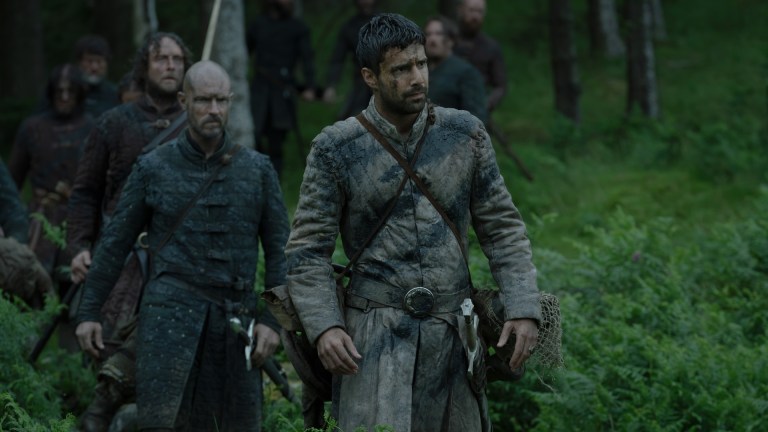
At the center of it all, of course, is the man history will come to know as “The Kingmaker.” While Criston initially seemed excited at the prospect of deploying guerrilla tactics to slow down Lord Oscar Tully and Roddy the Ruin’s massive armies, it quickly becomes apparent that guerrilla warfare can go both ways. Criston, Ser Gwayne Hightower (Freddie Fox), and their increasingly disheveled soldiers are left stranded between rivers, their dams destroyed and their warhorses fallen to Medieval landmines. Gwayne, accustomed to a life of luxury and privilege running up the Hightower to see the dawning sun with his brother in Oldtown, wonders what Criston has up his sleeve now. Surely, there is one weird trick this Kingmaker… this Great Man of History, has cooked up to overcome the reality that Roddy and Oscar have 200 men for every one of theirs.
Criston has no such answer but to die. And he’s not particularly bummed about it. As he tells Gwayne, dying beats the hell out of serving. “You have offered me service to your House and I’m grateful. But I’ve been a servant all my life. To Green or to Black. I have defined myself by oaths, through unyielding devotion. The high born have made much of me while it pleased them to do so. But I will not let them diminish me now. I will not return, spurned, rejected. I am the realm’s greatest warrior and I will die as such. Clear-eyed, unbent, glorious in battle. And not in their service… finally.”
As a member of a noble house, Criston is not “low born” per se. But the stewards of House Cole are closer in experience to the “smallfolk” of Westeros than the Hightowers. He understands better than most that the real currency of Westeros – more so than money, secrets, or dragons – is service. It wasn’t just witnessing the biblical destruction wrought by dragons that turned Ser Criston the Kingmaker into Ser Criston the Emo; he was always more concerned with the human beings riding those dragons. A dragon can merely swallow you whole and put your whole city to flame. A human being can compel you to kneel… to serve.
There’s a reason why the Faceless Men of Braavos utter “valar doeharis (all men must serve)” in response to “valar morghulis (all men must die).” Those are the only two possible states of existence for a man in this world. If you’re not servin’, you’re dyin’, and many indeed prefer the latter. The Faceless Men serve (there’s that word again) “The Many-Faced God,” an amalgamation of every god of death from every culture across Westeros and Essos. Criston himself invokes one of those deathly gods in the episode’s haunting final line “The Stranger offers us rest.”
Moreso than the Father, the Mother, the Crone, or any other face of the Seven, the Stranger has always offered the most respite for poor wretches like Criston. Over in Harrenhal, Alys Rivers (Gayle Rankin) even pays tribute to those the Stranger has whisked away when some schmucks arrive to kill her, enticed by Queen Rhaenyra’s sizable bounty on Prince Aemond’s head.
“Seems you’ve not learned your history of this place – of the laborers who built it, who died here in chains, in service to Harren the Cruel,” she says. (He’s more commonly known as “Harren the Black” but point taken.)
Alys understands the principles of valar doeharis and valar morghulis as well as anyone and her magical mastery over the bones of Harrenhal has made her quite the formidable figure. It’s no wonder that an injured and ailing Aemond (Ewan Mitchell) is helpless in her presence, having found yet another mommy to latch onto. One might say he’s even ready to serve.
If only Aegon (Tom Glynn-Carney) could see Aemond now. Sure, Aegon has every reason to hate his younger brother since he, you know, tried to kill him at Rook’s Rest. But phrasing like “poor darling Aemond and his scabby little eye” betrays that his animus all still boils down to petty childhood grievances. Larys Strong (Matthew Needham), ever cast as the servant to more powerful men, finally reads the Brat King the riot act, describing him as a terrible king and an even worse man. Later on when Larys and Aegon stumble upon a disfigured but very much alive Ser Tyland Lannister (Jefferson Hall), Aegon seems properly chastened by the dressing down, or at least he becomes more useful as he swiftly and silently kills an urchin who discovers his secret crown.
House of the Dragon is making little attempt to hide where it’s going with Aegon and Larys’ journey on the road. “The king secretly spends time among his subjects and learns to better empathize with their plight” is a common enough fantasy trope that its also forms the dramatic backbone of the show’s sister series A Knight of the Seven Kingdoms. Though it’s all a bit obvious, it works. And intended or not, the storyline also operates as a Team Green mea culpa from a show accused of (at times not unfairly) “favoring” one side of this war over the other.
While Rhaenyra (Emma D’Arcy) was always the Realm’s Delight and Aegon its annoying pain in the ass, the two characters’ arcs make clear that they’re on diverging upwards and downwards moral trajectories, seemingly destined to meet somewhere in the middle. In the episode’s best non-Criston scene, Rhaenyra and Daemon (Matt Smith) meet in the sept where the former is praying to the Seven, or more accurately: berating the gods for their inability to get the High Septon and smallfolk in line despite so graciously hoisting her up onto the Iron Throne. The pair’s extended conversation in High Valyrian is some of the best fictional foreign language acting this franchise has produced yet and goes a long way towards establishing Rhaenyra’s deteriorating mental state and paranoia.
That’s not to say some paranoia isn’t warranted. As if it weren’t bad enough that Lord Ormund (James Norton) is now printing his own King Daeron coinage, someone in the capital is killing gold cloaks. What starts as the odd homicide here or there progresses into a gruesome tableau of dead cops with their eyes gouged out and “A FEAST FOR TRAITORS” message scrawled in blood on a wall of the Red Keep. Less theatrical but no less traitorous are the actions of Alicent (Olivia Cooke), who tries to spirit Helaena (Phia Saban) away from their confinement upon finding out she’s pregnant. Mysaria (Sonoya Mizuno) puts a stop to that, receives a half-earnest “IOU,” and then just…lets it happen again?
As is the case with many episodes in House of the Dragon season 3, this hour is filled with interesting ideas executed imperfectly. The heart is there in Philippa Goslett’s script but the eye doesn’t always follow through in Nina Lopez-Corrado’s direction. Even the largely successful Criston plotline doesn’t feel quite as visually striking as it should. Criston and Gwayne’s host is believably battered and broken from its time in the woods but it has not gone through the appropriately Dante-level hell that a production with more time, money, and creativity might have achieved. “The Stranger offers us rest” hits hard because how could it not? But it could have hit harder.
Still, it’s hard to complain too much about an episode this thematically on point. Even the quieter, seemingly more disposable scenes like Ormund and Daeron playing cyvasse feel indispensable in light of Criston’s plight. Not only does Ormund continue to justify social media’s Dennis Reynolds comparisons of him by melting down after losing a board game to a child, his subsequent lesson to Daeron (Benjamin Evan Ainsworth) about what really kept Dorne independent is surprisingly insightful, even if accidentally so.
Ormund may think that the parable of Meria Martell a.k.a. the Yellow Toad of Dorne is all about one woman’s cunning military mind being able to outwit and outlast the might of Aegon the Conqueror, his sisters, and their dragons. But it wasn’t merely Meria’s aptitude for strategy that kept Dorne unbowed, unbent, and unbroken; it was her stubborn insistence on being unbowed, unbent, and unbroken in the first place that so stymied House Targaryen.
It’s amazing what someone can accomplish when they politely say “not today” to the god of death. The Stranger’s offer of rest to Ser Criston is just that: an offer. The fact that he’s so eager to accept it says more about him than the supposed inevitability of his situation. Yeah, going out in blaze of glory bright enough for the singers to remember would be nice. But so too would be simply rebuilding the stupid dam and retiring to Oldtown.
New episodes of House of the Dragon season 3 premiere Sundays at 9 p.m. ET on HBO and HBO Max, culminating with the finale on August 9.