The 20 Greatest Cop Shows of All Time
You have the right to read our ranking of the best TV shows about American police.

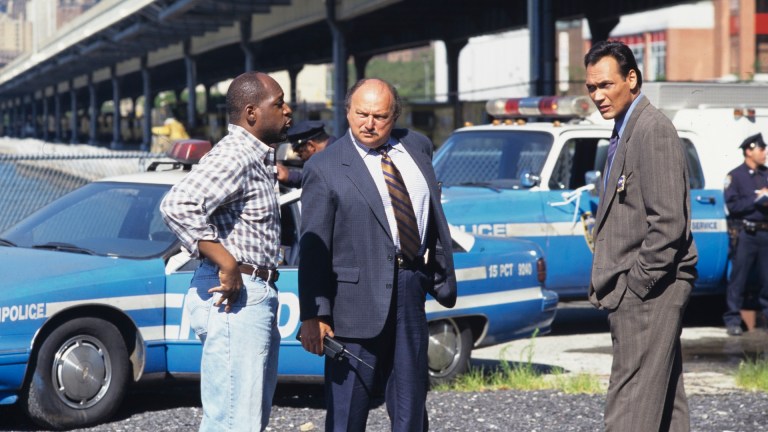
Even in these days of endless entertainment options, it’s hard to turn on a TV and not see a cop. Police have been a mainstay of the medium since the now-lost series The Plainclothesman debuted in 1949, and especially when Dragnet made the jump from radio to television two years later. Yet, as omnipresent as they are on television, professional police are a relatively recent part of American life, only coming into being after the first departments were established in Boston and New York in 1838 and 1844, respectively. Yet, television helped normalize policing in the American consciousness, just as much as police stories helped make TV the preferred home for episodic adventures and drama.
That combination can make it difficult to enjoy TV shows about police, and yet even the most ardent defunding advocate can admire the artistry of a tense thrill sequence or enjoy a workplace comedy joke. So it’s through that lens that we look back at the history of television to rank the best cop shows of all time.
But first, just the facts: we’re dealing with only American shows about police on the state or local level. So you won’t find Cracker or Prime Suspect here, nor will you find shows about FBI agents, sheriffs, or marshals; sorry Dale Cooper, Andy Taylor, and Raylan Givens. But with that out of the way, let’s examine this line-up of compelling shows about those who enforce law and order.
20. T.J. Hooker (1982–1986)
If you know T.J. Hooker at all, you probably think of it as the show that William Shatner did after Star Trek, co-starring heartthrobs Adrian Zmed and Heather Locklear, as well as future Star Trek: Voyager and Deep Space Nine actors Richard Herd and James Darren. In your memory, T.J. Hooker is probably a quaint, if kind of corny, show about a veteran officer who delivers hammy speeches to cop and criminal alike.
Certainly, a lot of T.J. Hooker is exactly that, with the star going full Shatner when not grinning in bewilderment at the wholesome shenanigans of Zmed’s Vincent Romano and Locklear’s Stacy Sheridan. Everything else in the show is a gritty crime drama in the vein of Dirty Harry—the second episode even rips off the school bus scene from that movie. The show presents Southern California as a place of constant danger, with murderers and rapists at every turn. Furthermore, most of Hooker’s melodramatic speeches are about how lawyers, psychologists, and reporters show too much sympathy for criminals, and keep cops from stopping the bad guys by any means necessary. It’s a weird juxtaposition, one that results in a show that isn’t good, really, but is fascinating to watch.
19. Homicide: Life on the Street (1993–1999)
The cop show landscape of the 1990s was ruled by two series: the gritty, boundary-pushing NYPD Blue and the reliable Law & Order. Homicide: Life on the Street came in distant third place, as it does on this list, a fact that irritates its fans. It’s easy to see why people love Homicide so much. It has an incredible pedigree, created by two-time Oscar nominee Paul Attanasio and based on the book Homicide: A Year on the Killing Streets by David Simon. Its ensemble cast included Andre Braugher, Yaphet Kotto, Melissa Leo, and Richard Belzer, who debuted his character John Munch on the show. Film legends such as Barry Levinson, Whit Stillman, Barbara Koppell, and Kathryn Bigelow directed episodes.
So why is Homicide still falling so far down the list, even in 2026? Because the show never figured out what it wanted to be. Despite drawing inspiration from Simon’s true crime reporting, Homicide borrowed heavily from independent cinema to highlight its artifice. Hard cuts would show multiple takes of a single line reading, and interactions in “the Box,” the precinct’s interrogation room, became opportunities for theatrical scenery-chewing. Worse, NBC began toying with the show after season 3, culminating with a disastrous and unrecognizable seventh season. In the end, Homicide had nothing more than potential, potential that would be realized by the second series based on Simon’s book.
18. Dragnet (1951–1959)
It is impossible to overstate the importance of Dragnet, the series created by and starring Jack Webb as Sgt. Joe Friday. Originally a popular radio show that became a sensation when it went to TV, Dragnet realized the ambitions of reformers who sought to change the public’s perception of police. Where most Americans thought of police as inconveniences, if not the very type of standing army warned against in the Declaration of Independence, Dragnet presented its officers as professional, dispassionate, and effective. And, thanks to Webb’s cooperation with the LAPD, Dragnet got to present its episodes as realistic, a strategy countless other shows would emulate.
That said, influence isn’t the same as quality, and Dragnet‘s a tough watch in 2026. Each episode follows the same basic formula, in which Friday and his partner (most often Frank Smith, played by Ben Alexander) arrive to investigate a crime, talk to some witnesses and suspects, and solve the case. While the cases do have their flamboyant moments, as demonstrated by the stunts in premiere episode “The Human Bomb,” the show played it safe, something the public craved at the time, but has aged poorly.
17. The Rookie (2018–Present)
In a lot of ways, The Rookie feels like an update on T.J. Hooker. Once again, we have a charismatic actor known for playing a space traveller, now playing a man who becomes a beat cop later in life. And, as with T. J. Hooker, the star’s considerable charm helps to smooth over some of the more unsavory parts of the series.
In this case, that star is Nathan Fillion as John Nolan, a 45-year-old builder who moves from Pennsylvania to Los Angeles after his divorce to become a police officer. Despite the unlikely premise, The Rookie sticks to the standard police procedural formula: a new case every week, tough chiefs and fresh-faced newcomers, character actors as vibrant villains. But Fillion’s natural charisma allows The Rookie to laugh itself, softening the self-importance that plagues so many modern cop shows.
16. Sledge Hammer! (1986–1988)
Everything you need to know about Sledge Hammer! can be learned by watching the finale of the first season. Believing that the show’s low ratings meant it was bound for cancellation, creator Alan Spencer had his reactionary hero Inspector Sledge Hammer (David Rasche, better known today for Succession) fail to stop a terrorist’s nuclear bomb. As a result, the season ends with not just the death of every character, but also the destruction of Los Angeles. When the show returned for a surprise second season, Spencer just began the first episode “five years before that nuclear explosion” and carried on.
The ridiculous storytelling choice works because Sledge Hammer! is a ridiculous show, intentionally so. Inspector Hammer follows in the footsteps of Inspector Harry Callahan of Dirty Harry fame, albeit in the shiny, overheated form that violent cop movies took in the 1980s. Carrying a .44 Magnum with his namesake engraved on the handle, Hammer must not only deal with the criminal scum of San Francisco, but also his sensitive new partner Dori Doreau (Anne-Marie Martin) and his oft-apoplectic boss, Captain Trunk (Harrison Page). Fortunately, he can just shoot the criminals, which Sledge Hammer! plays for absurd comedy.
15. Car 54 Where Are You? (1961–1963)
Much milder than Sledge Hammer! but no less funny, Car 54, Where Are You? was the first sitcom about police, and still one of the best. The series paired the short, excitable Gunther Toody (Joe E. Ross) with the tall and taciturn Frances Muldoon (Fred Gwynne) as partners in the New York police department. The easy chemistry between the two, combined with sharp comedy writing of the era, make Car 54, Where Are You? incredibly fun, even today.
For example of what the show does best, see season one episode “Something Nice for Sol,” in which Toody convinces the precinct to get some new shoes for their desk sergeant, Sol Abrams (Nathaniel Frey). Toody and Muldoon spend the entire episode trying to discretely measure Sol’s shoe size, shenanigans made all the more heightened because they happen in a police department. The show’s style might be outdated, but the gags are as funny as ever.
14. Cagney & Lacey (1982–1988)
While actual policing is inherently conservative and works to maintain the status quo, police shows tend to be quite progressive. Thus, you get Nipsey Russell on Car 54, Where Are You?, and gay characters portrayed in a positive light in Barney Miller and NYPD Blue. Cagney & Lacey is one of the best examples of the phenomenon, a series that stars Sharon Gless and Tyne Daly as Detectives Mary Beth Lacey and Christine Cagney.
Certainly, Cagney & Lacey dealt with sexism on the force, but no more so than The Mary Tyler Moore Show or any other series about working women. Gless played Cagney as a no-nonsense career woman, who wanted on-the-job success more than a husband or children. Daly’s Lacey had to balance her police work with her duties as a wife and mother, often creating tension. While those dynamics could make episodes didactic, Gless and Daly brought a lightness and humanity to the part that made even the preachiest moments feel human.
13. The Shield (2002–2008)
Obviously, The Shield isn’t a bad a show, or it wouldn’t be on this list at all. But now, nearly two decades after its conclusion, it’s clear that The Shield was never the show it pretended to be. During its original run on FX, The Shield purported to be a study about the grey morality of policing, the compromises we have to make in order to feel safe. Inspired by the Rampart Scandal, creator Shawn Ryan cast Michael Chiklis (who formerly played a cuddly officer on The Commish) as Detective Vic Mackey, whose Strike Team has broad leeway to deal with exceptional crimes, and yet he still crosses line after line.
Looking back, we can see that The Shield never took its question seriously. From the moment that Mackey tortures a suspect to find a missing girl in the pilot, its clear that The Shield believes that we unquestionably need guys like Mackey to deal with the increasingly terrifying villains introduced each new season. That belief makes The Shield morally reprehensible pulp, but the show’s cast and big-time guest stars, including heralded turns by Glenn Close and Forest Whitaker, make it high-quality, morally reprehensible pulp.
12. Starsky & Hutch (1975–1979)
In the same way that cop shows made policing look progressive, they also make it look cool. Before that approach reached its apex with Miami Vice, there was Starsky & Hutch, which brought to television the buddy cop formula being developed by Freebie and the Bean and Thunderbolt and Lightfoot. Paul Michael Glaser and David Soul play David Starsky and Kenneth “Hutch” Hutchison, a mismatched pair of detectives working in Southern California.
While the series definitely addressed antagonisms between the leads, most episodes emphasized their friendship. The camaraderie and chemistry that Glaser and Soul brought to the part paired well the with the show’s action, especially in the first two seasons. Moreover, the friendship made Starsky & Hutch feel like two of the coolest dudes on television, even if they were stopping trouble instead of causing it.
11. CSI: Crime Scene Investigation (2000–2015)
Cop shows don’t just portray officers as moral and efficient defenders of the weak. They also depict policing as cutting-edge technology, positioning the forces of law and order as advanced and civilized, in contrast to the barbarian criminal element. Such has been the case since August Vollmer, “the father of modern policing,” advocated for the science of criminology in the 1920s and integrated it into his interactions with the media, but rarely has the technological side been as foregrounded as it was on the CBS series CSI.
CSI starred Manhunter‘s William Petersen as Dr. Gil Grissom, leader of a team of forensic scientists in the Las Vegas Metropolitan Police Department. Along with Catherine Willows (Marg Helgenberger), Grissom and his unit analyze blood-splatter, run fingerprints through databases, and decode DNA to find ironclad proof of guilt, even in the most unlikely of cases. The series was a true phenomenon throughout the 2000s, making fans of Quentin Tarantino (who directed the season five finale “Grave Danger”) and convincing the public that human police may be fallible, but police science is not.
10. True Detective (2014–Present)
Few television shows are harder to rank than True Detective. Had the series ended after its electric first season, then it would easily be in the top five. Had it ceased after its disastrous second season, it wouldn’t make this list at all. Thankfully, the solid third and fourth seasons are enough to not just secure its position in our rankings, but to make the top 10.
Created by Nic Pizzolatto, True Detective takes an anthology approach inspired by the pulp magazines that give the show its name. Pizzolatto and director Cary Joji Fukunaga caught lightning in a bottle for its first season, which paired Woody Harrelson‘s straight-laced hypocrite with Matthew McConaughey‘s burn-out weirdo as detectives on a case with supernatural overtones. Pizzolatto’s style became a liability with season two, but the additions of filmmakers such as Jeremy Saulnier and Issa López helped return True Detective to some of its former glory.
9. Brooklyn Nine-Nine (2013–2021)
A spiritual successor to co-creator Michael Schur’s workplace comedies The Office and Parks and Recreation, Brooklyn Nine-Nine wisely eschewed the documentary conceit of those series and committed itself to being a workplace comedy. Schur and co-creator/showrunner Dan Goor took what could have been just an Andy Samberg vehicle and turned it into one of the most delightful ensemble shows on television, one that used its police precinct setting as a reliable story engine.
Joining Samberg’s lovable slacker Jake Peralta is a cast of well-drawn characters that include Melissa Fumero as overachiever Amy Santiago, Stephanie Beatriz as the tough Rosa Diaz, and Terry Crews as soft-hearted muscleman Terry Jeffords. The true standout is Andre Braugher as Captain Raymond Holt, who retains all the gravitas of his days on Homicide: Life on the Street, but adds a layer of comedic precision that no one would have expected.
8. NYPD Blue (1993–2005)
Some will certainly see this low ranking and immediately get angry, so let’s get this out of the way first: NYPD Blue is excellent. Not only does the series achieve the rare feat of surviving the loss of multiple handsome male leads, elevating Dennis Franz’ Andy Sipowicz to the position of prime-time mainstay, but it tells compelling, boundary-pushing stories on network TV. It’s no understatement to say that NYPD Blue paved the way for the Golden Age of Television. And yet, NYPD Blue remains in the shadow of the show that paved its way, a series that holds up even better and will be discussed a few entries higher.
But let’s set that aside to praise NYPD Blue for what it does well. Shot on gritty film and employing a day-in-the-life format, the series focused largely on Sipowicz and his colleagues through the daily grind of their jobs. Although just as supportive of policing as any other show on this list, NYPD Blue creators Steven Bochco and David Milch do turn their attention to the unsavory parts of the institution. The results don’t always work (see Gordon Clapp’s Medavoy, perhaps the most irritating character in television history), but they also allow Franz to make Sipowicz into a three-dimensional figure rarely seen before on a cop show.
7. Miami Vice (1984–1989)
All of the shows on this list endeavor to make police look competent and effective. But Miami Vice takes it one more step to make police officers look cool. Created by television veteran Anthony Yerkovich, Miami Vice made Don Johnson‘s Sonny Crockett and Philip Michael Thomas’ Rico Tubbs two of the hippest figures of the ’80s, despite the show’s reactionary War on Drugs politics.
The story of undercover detectives working the drug trade of Southern Florida, Miami Vice still holds to standard police procedural conventions. Yet, it coats them with a hip aesthetic, from its neon color palette to its Jan Hammer theme to the visual contributions of filmmaker Michael Mann, who also served as executive producer. So dominant was Miami Vice in the ’80s that no attempt to revive the franchise, including a 2006 movie directed by Mann, could replicate the success of the original series.
6. Law & Order: Special Victims Unit (1999–Present)
Created in 1990 by Dick Wolf, Law & Order was the purest update of the Dragnet model. Each episode purported to be “ripped from the headlines,” promising realistic cases, investigated by dedicated professionals and prosecuted by lawyers with a passion for justice. Law & Order forever changed the way we think about the criminal justice system, and spawning a host of spinoffs, none more successful than Special Victims Unit.
SVU did away with the high-minded pretensions of the original series and embraced its nasty pulp heart. Focusing on a division dedicated to sexual crimes allowed the show to deal with only the most sensational stories, and while the series has a pleasing supporting cast—including John Munch, imported from Homicide, and Ice-T’s Fin Tutuola—the show’s anchor has always been Mariska Hargitay’s dedicated but haunted Olivia Benson, who worked best when partnered with Christopher Meloni’s violent family man Elliot Stabler. Flawed heroes for a nasty show, SVU gives the masses the dark pleasures of noir and exploitation works, while staying safely within the police procedural genre.
5. Police Squad! (1982)
Police Squad! aired just six episodes. But it was so funny, so packed with jokes, that it became an immediate cult hit, soon spawning three Naked Gun films with original star Leslie Nielsen and a recent legacy sequel with Liam Neeson. Creators David Zucker, Jim Abrahams, and Jerry Zucker applied the same formula that brought them great success with 1980’s Airplane!, riffing on straight-laced material (specifically the Lee Marvin series M Squad) by amping up the absurdity around Nielsen’s stoic Frank Drebin.
Each of Police Squad!‘s six episodes are packed with jokes, starting with the opening credits, in which see each character introduced by returning fire at an unseen gunman (including Abraham Lincoln, who survives his assassination attempt to shoot back at John Wilkes Booth). The gags range from the subtle (a stretcher from a crime scene persists in the background of several shots) to the corny (“I told you, no sax before the fight,” Frank tells a boxer) to the sublime (when a gangster asks, “Who are you? How did you get in here?” Frank answers, “I’m a locksmith, and I’m a locksmith”). With such quality jokes, six episodes is enough to make Police Squad! one of the best police shows of all time.
4. Columbo (1971–1979, 1989–2003)
By 1971, the New Hollywood movement was well underway. But television audiences were not necessarily ready to welcome gritty male heroes like Harry Callahan and Popeye Doyle into their living rooms. So they got the softer, kinder vision in Peter Falk as the titular detective of Columbo, and the results were spectacular. Originally created by Richard Levinson and William Link in their short story “Enough Rope,” which they then turned into a successful stage play, Columbo first hit the screen in a TV movie, played by Bert Freed. But when the story was remade in 1968 as “Prescription: Murder” with Falk in the part, the stage was set for television history.
Neither “Prescription: Murder” nor its 1971 follow-up “Ransom for a Dead Man” featured the fully-formed Columbo. But by the time the premiere episode “Murder By the Book” (directed by a young Steven Spielberg!) hit the airwaves in 1971, all the hallmarks were there: the dirty raincoat, the references to his wife, the stopping criminals for just one more thing. Combined with a host of great guest stars that included William Shatner, Dick Van Dyke, and Janet Leigh, Columbo is cozy comfort viewing at its finest.
3. Hill Street Blues (1981–1987)
Remember how we said that NYPD Blue is good, but still in the shadow of its predecessor? Here is the predecessor, Hill Street Blues, created by Steven Bochco and Michael Kozoll. Inspired (unofficially) by writer Ed McBain’s 87th Precinct novels, Hill Street Blues was the first cop show to foreground the work of policing. The series takes an ensemble approach, with characters with a range of roles in the department each pursuing their own storylines, which occur between morning roll call (concluded by Sgt. Phil Esterhaus’s admonition, “Let’s be safe out there”) and the evening, when Captain Frank Furillo convenes with his girlfriend, defense attorney Joyce Davenport.
In addition to Esterhaus (Michael Conrad), Furillo (Daniel J. Travanti), and Davenport (Veronica Hamel), most episodes also check in on beat cops Bobby Hill (Michael Warren) and Andy Renko (Charles Haid), detective Henry Goldblume (Joe Spano), and undercover officers Washington (Taurean Blacque) and LaRue (Kiel Martin). Although often messy, Hill Street Blues adds a level of realism that breaks the cop show out of the confines of the procedural and opens new dramatic avenues.
2. Barney Miller (1975–1982)
Most of the shows on this list have pretty great theme songs. But none, absolutely none, go as unnecessarily hard as the theme to Barney Miller. Despite the promise of action by the rocking opening credits, Barney Miller is an unfailingly gentle show. Early on, the series establishes a formula that works, with each episode featuring an A-plot built around a suspect brought into the precinct and a B-plot following a cast member’s personal issue. Violence rarely occurs, only a handful of episodes leave the central precinct set, and nearly every conflict resolves through Barney’s level-headed intercession.
Such a low-stakes approach might get boring, but Barney Miller works because of its fantastic cast. As the paternalistic and endlessly patient Barney, Hal Linden is the ideal straight man, always ready with a perfect reaction shot. Max Gail’s lovable himbo Wojciehowicz (it’s spelled like it sounds) and Ron Glass’ sophisticated Harris may be the only characters to remain in all seven seasons, but the others who come in and out, especially Abe Vigoda’s old-timer Fish and Nick Soo’s sardonic Yemana, make the most of their stays. Although often cited as the most realistic depiction of actual police work, Barney Miller presents the ultimate fantasy of policing, that the departments consist of understanding people who solve problems through empathetic debate, never force.
1. The Wire (2002–2008)
In the very first scene of The Wire, Baltimore homicide detective Jimmy McNulty (Dominic West) listens to the story of a recent murder victim, nicknamed Snot Boogey. After a witness (Jamal Bostic-Smith) recounts how Snot would constantly steal from crap games, despite threats of violence, McNulty asks why they would let him play. “You got to, man,” answers the incredulous friend. “This is America.”
That one scene captures everything great about The Wire, created by journalist and Homicide author David Simon. It’s not just that the scene looks directly at the way economic disparity and the criminal justice system create suffering in America. It’s the deft way the show turns realistic, street-level dialogue into the stuff of poetry, a feat surpassed later when McNulty and his partner Bunk (Wendell Pierce) conduct an entire investigation while only exchanging f-bombs. The Wire managed to present its cops and criminals as normal, fallible people, and to address some of the most pressing issues in the country, without ever failing to be impeccably-crafted and endlessly-engaging art.