The Best Coen Brothers Movies, Ranked
We foolishly stumble through an uncaring universe to rank the best of Joel and Ethan Coen's movies.

Ever since their debut feature Raising Arizona, brothers Joel and Ethan Coen have demanded the attention of moviegoers. And since that movie, the Coens have baffled us. Everyone agrees that the Coen Brothers are among the greatest filmmakers in America, if not the world. Even their lesser entries, like The Ladykillers and Intolerable Cruelty have their defenders. But that doesn’t mean that film fans understand the Coens. A pair of philosophically-minded, slapstick-loving siblings from a Jewish suburb of Minnesota, the brothers defy all categorization.
And their movies reflect that defiance. Across their filmography, they have covered everything from stoner comedy to existential Western to classic Hollywood homage and more. They’re just as comfortable making a wacky and broad movie like Raising Arizona and a quiet, almost emotionless film like The Man Who Wasn’t There. Such range means that there’s vast disagreement about ranking their movies. Yet, like poor, beleaguered Larry Gopnik of A Serious Man, we’ll try to sort out the top 10, fruitless though the task may be.

10. Hail, Caesar! (2016)
Throughout their career, the Coens have been accused of condescending to their characters. Critics such as Roger Ebert charge the brothers with throwing doofuses and bumpkins on the screen and then inviting us to laugh at their misfortune. One might argue that reading Søren Kierkegaard and Cormac McCarthy through the lens of Judaism accounts for the fatalism of their movies, but the answer is probably a lot more simple: they just like silliness, especially the silliness of classic Hollywood movies.
Nothing in the Coen’s oeuvre makes that argument better than Hail, Caesar!, an old Hollywood farce starring Josh Brolin as real-life studio fixer Eddie Mannix. Hail, Caesar! follows Mannix through a day of dealing with stars who pose problems for the studio, including an Esther Williams-like swimmer’s (Scarlett Johansson) latest love affair and a doofus matinee idol (George Clooney) getting kidnapped by leftists and converting to communism. In between, we get all manner of heady debate, including a delightful scene of religious leaders dithering about depictions of God in a biblical epic. By the end of the film, it becomes clear that the Coens may not care about anything, but they really do care about the movies.

9. A Serious Man (2009)
The other great rejoinder to claims about the Coens’ anger toward their characters comes with A Serious Man. Part autobiography, part retelling of the book of Job, A Serious Man stars Michael Stuhlbarg as Larry Gopnik, a math professor living in 1960s suburban Minnesota. Despite being no one of any importance, Larry begins to endure a series of misfortunes: a student first demands and then extorts him for a higher grade, his sad-sack brother (Richard Kind) has moved in with him, and his wife (Sari Lennick) wants to leave him to marry Sy Ableman (Fred Melamed).
Larry seeks guidance from his rabbis, but he gets only rambling stories with no clear answers, which mirror the scene that opens the movie, in which a beloved rabbi who visits a couple may or may not be a dybbuk. Like these tales, A Serious Man offers no morals or answers, no reasons for Larry’s suffering. But even though it contains several funny scenes, A Serious Man doesn’t invite the viewer to just laugh at him either. Instead, it asks us to be serious ourselves, to recognize that we’re all like Larry, trying to make meaning from the nonsense that surrounds us.
8. The Hudsucker Proxy (1994)
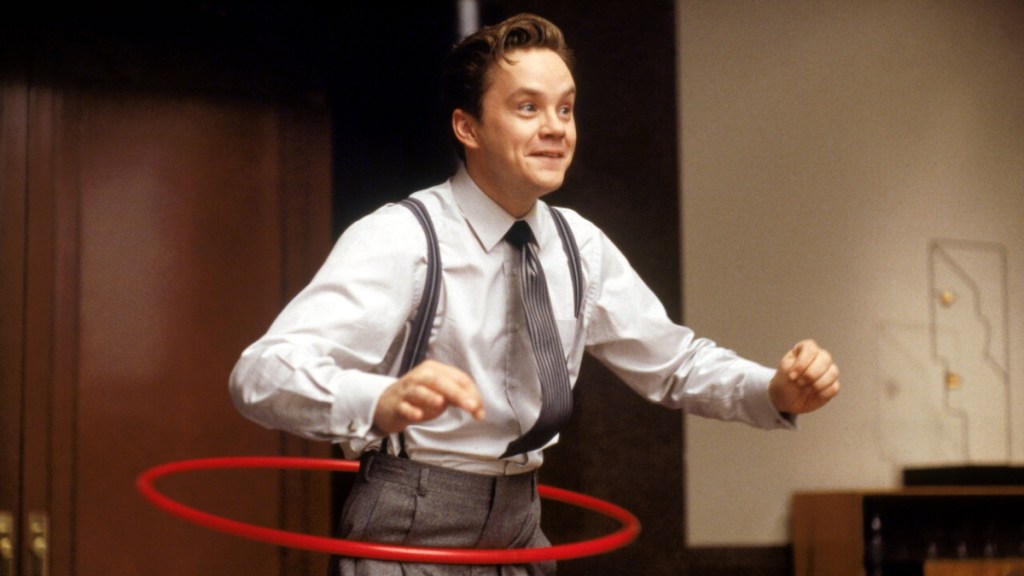
Speaking of relating to characters in a Coen Brothers movie… throughout The Hudsucker Proxy, which the brothers wrote with their friend and sometimes collaborator Sam Raimi, corn-fed Indiana boy Norville Barnes shows someone at Hudsucker Industries his brilliant idea. The lanky doofus Barnes (Tim Robbins) fishes a slip of paper from his pocket, unfolds it, and proudly displays it to whomever will listen, showing them what appears to be just a circle. “You know,” explains Barnes, “For kids!”
The circle turns out to be a hula-hoop, and does indeed become a sensation for Hudsucker. The same can be said of The Hudsucker Proxy, a broad Preston Sturges homage that baffled viewers for years, but has since become a fan favorite. The story of an idiot who becomes a top-level executive because of scheming businessmen (led by Paul Newman), The Hudsucker Proxy‘s screwball sensibilities are a required taste. But, like those who finally figure out what Norville’s circle means, you’ll be richly rewarded once you accept the wacky comedy on its own terms.
7. Miller’s Crossing (1990)
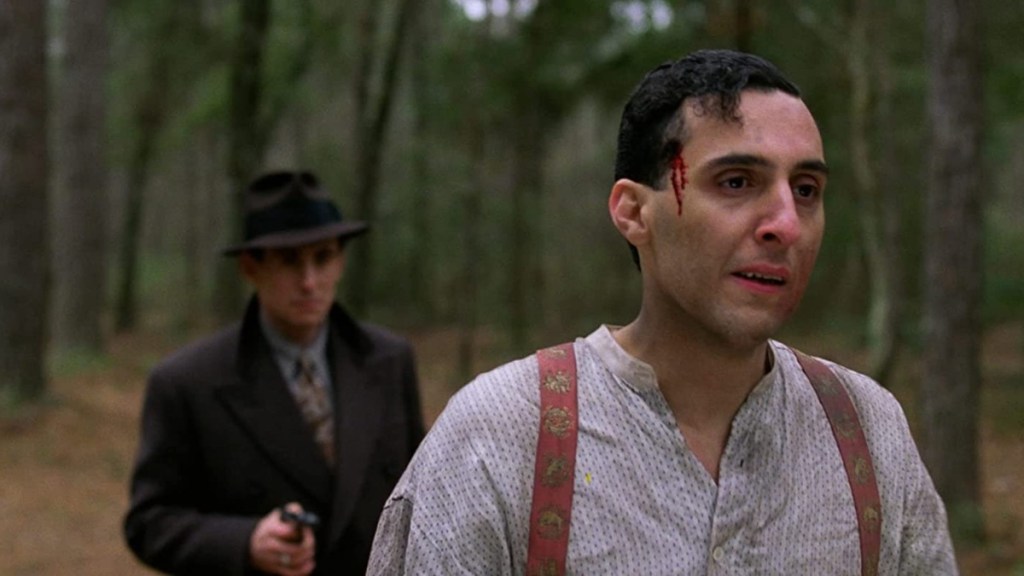
Most great filmmakers do one thing great and everything else really well: they tell good stories, but their visuals are flat, or they have compelling dialogue, but the movies lack thematic weight. Early in their career, the Coens established themselves as masters at dialogue, visuals, and theme, all of which are on display in their third feature, the gangster picture Miller’s Crossing.
The story of genius Tom Reagan (Gabriel Byrne) negotiating his way through volatile gangsters in 1929 New York, Miller’s Crossing offers a compelling look at the destructive nature of power and the cost of a moment of humanity. It opens with an incredible monologue from Jon Polito, who lectures on the nature of ethics in language at once true to noir and utterly idiosyncratic. And midway through the movie comes a jaw-dropping action sequence, as Irish boss Leo O’Bannon (Albert Finney) escapes a mob hit on his home. In most filmographies, Miller’s Crossing would be the clear number one, a work of such bravado that it would be impossible to replicate. For the Coens, it’s number seven.
6. O Brother Where Art Thou? (2000)
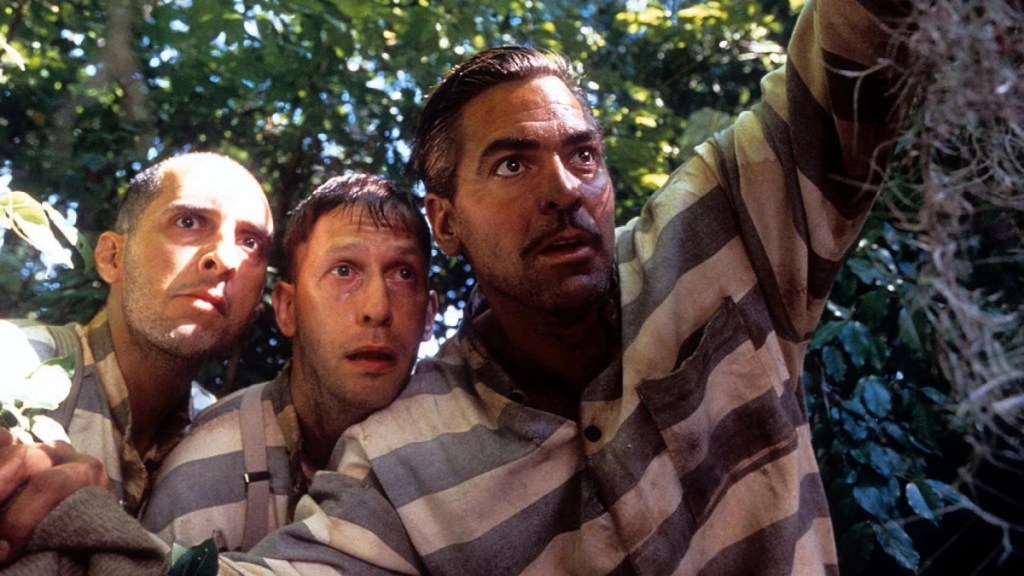
Despite all the masterpieces on this list, the Coen Brothers greatest contribution to cinema may simply be figuring out that George Clooney, perhaps the most handsome and charming star in all of Hollywood, is really, really good at playing a buffoon. O Brother Where Art Thou? takes its name from the 1941 Sturges film Sullivan’s Travels, features a bluegrass soundtrack that became a genuine sensation, and it is an adaptation of The Odyssey. But it is fundamentally a slapstick comedy about three bozos on a quest.
Clooney stars as Ulysses Everett McGill, a fast talker and slow-thinker who convinces cellmates Pete (John Turturro) and Delmar (Tim Blake Nelson) to break out of prison and come with him to find the money he stole from a bank and buried in a field. The trio encounters all sorts of oddities as they make their way across the Depression-era South, all digitally colored to dusty yellow, long before learning that Ulysses simply wants to prevent his wife Penny (Holly Hunter) from remarrying. That reveal gives O Brother some genuine pathos, but not at the expense of the movie’s true pleasures: watching Clooney, Turturro, and Nelson execute incredible comic bits.
5. The Big Lebowski (1998)
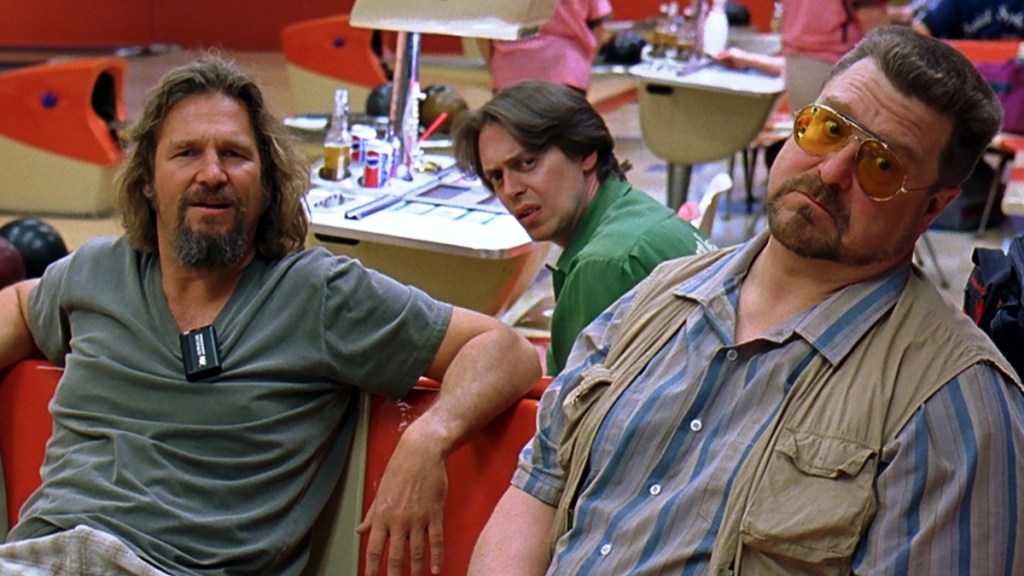
Can we now, in Year of Our Lord 2026, finally admit that The Big Lebowski is a masterpiece, full stop? You wouldn’t think that a movie so oft-quoted, so fully ingrained in the American consciousness, would need such a defense. But The Big Lebowski has had such an unlikely journey that, even today, it feels risky to include it in the Coens’ top five.
A riff on The Big Sleep and other film noirs that puts aimless stone the Dude (Jeff Bridges) in the Humphrey Bogart role, The Big Lebowski infuriated theater-goers in 1998, who expected the precision of their previous film, Fargo. However, the movie soon found an audience on college campuses, where the Dude’s love of weed, bowling, and coitus seemed relatable. Rather than stay among the likes of Cheech & Chong’s Nice Dreams and Half-Baked, The Big Lebowski received another reassessment, and is now recognized for what it truly is: a brilliant piece of anti-detective fiction, anchored by incredible performances by Bridges, John Goodman, Julianne Moore, and others. But honestly, it doesn’t matter what people think of The Big Lebowski. Through it all, the Dude abides.

4. Inside Llewyn Davis (2013)
With O Brother, Where Art Thou?, the Coen Brothers had already adapted The Odyssey. But they return to the format in a very different way for Inside Llewyn Davis, which takes place within the Greenwich Village folk scene of the 1960s. On a literal level, the object searched for here is an orange cat, who escaped from the apartment where down-on-his luck folk singer Llewyn Davis (Oscar Isaac) had been allowed to stay for a night. But really, Davis looks for some sort of peace, a peace that he so often denies himself.
Still reeling after the death by suicide of his singing partner, the incredibly talented, but incredibly flinty Davis tries to make his way through the world. His sweet singing voice and solid fundamentals draw people to him, including fellow folkie Jean (Carey Mulligan), who is pregnant with his child, and her affable husband Jim. Yet, Llewyn refuses to take any sort of comfort from them, in part because he fears it will corrupt his art. As a result, Inside Llewyn Davis stands as the Coens’s most difficult film, a portrait of someone who can’t seem to get out of his own way, but we love him anyway.
3. No Country For Old Men (2007)
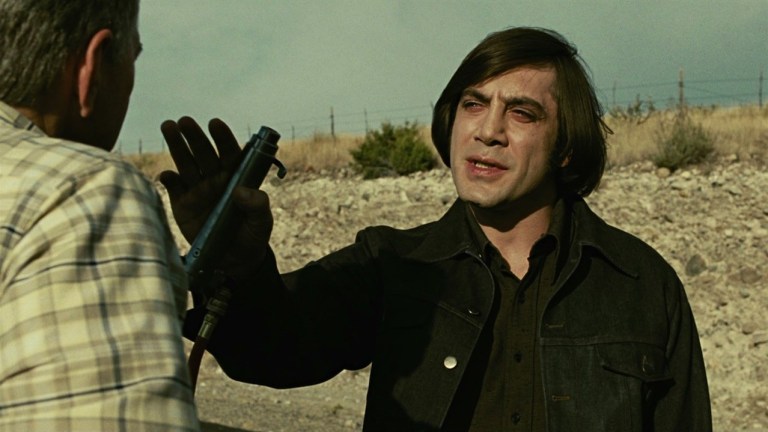
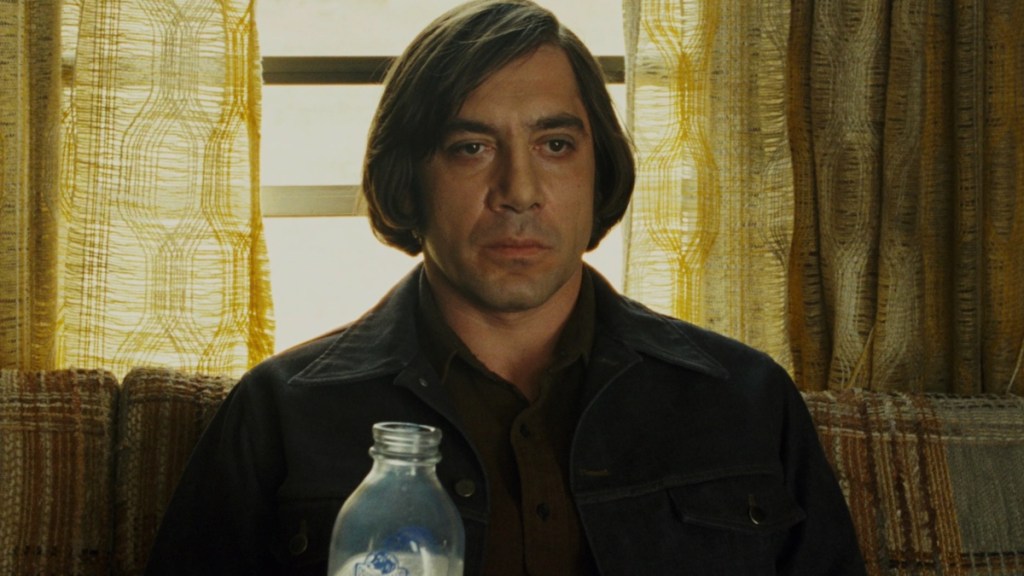
At first glance, No Country For Old Men represents a hard split in the brothers’ filmography. The duo loves making broad comedies, goofs and farces such as The Big Lebowski and The Hudsucker Proxy. They also love bleak serious works, including the Cormac McCarthy adaption No Country For Old Men. The story of a desperate man (Brolin), who swipes money from a drug deal and goes on the run across 1980s Texas, pursued by both an honest lawman (Tommy Lee Jones) and the seemingly supernatural killer, Anton Chigurh (Javier Bardem), No Country seems like a serious work that reduces the comedies to mere larks.
Yet, No Country shares much in common with the rest of the Coens’s filmography, and not just because it is, itself, very funny (come on, just look at Chigurh’s haircut!). Rather, because No Country has the same pessimistic, nihilistic outlook of the comedies. The gut punch of a final scene, in which Jones’ Sheriff Bell describes a troubling dream and then calls upon God to explain it, only for the screen to cut to black, captures the Coens’s driving belief. Everything is meaningless, whether you’re laughing or crying.

2. True Grit (2010)
There are many remarkable things about True Grit, the Coens’ 2010 adaptation of the Charles Portis novel, previously made famous by John Wayne. One is Hailee Steinfeld‘s performance as Mattie Ross, perhaps the greatest acting ever done by a child on screen, and she in her film debut. Another is the rich Carter Burwell score, which turns the hymn “Leaning on the Everlasting Arms” into something, at turns, mournful, rousing, and frightning. Yet another are Bridges and Matt Damon as those hired by Ross to hunt down Tom Chaney (Brolin), the man who killed her father.
But the most remarkable thing about True Grit is how perfectly suited the Coens are for Portis’s writing. An early scene in which Mattie out-haggles a businessman to procure a horse and a saddle plays like something out of The Big Lebowski or Miller’s Crossing, with its stylized dialogue and quick wit. But it comes directly from the novel, word for word. However, Portis’s novel does add one thing often missing from the brother’s films, a redemption narrative for Cogburn that at least makes him acceptable, if not heroic.
1. Fargo (1996)
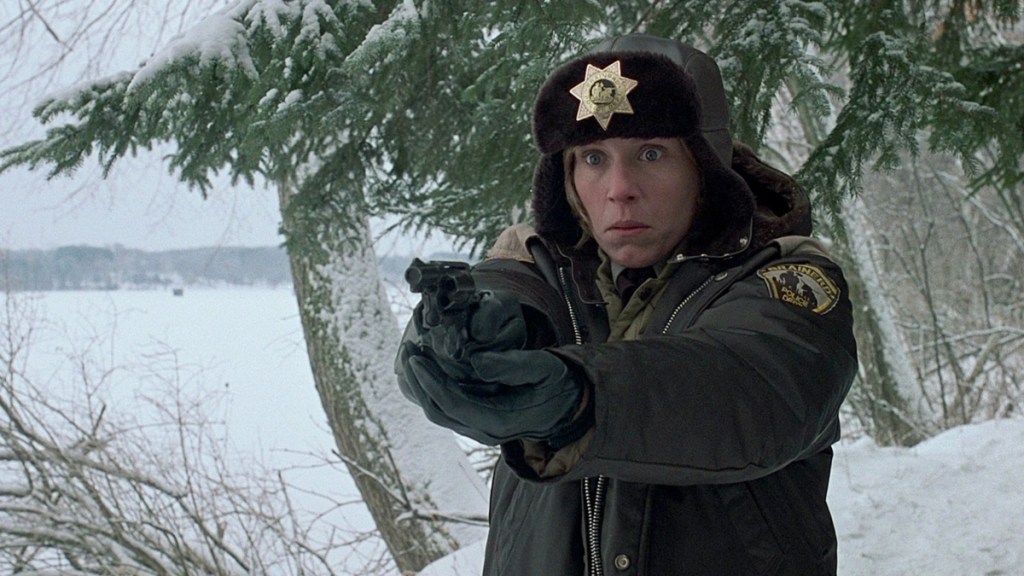
Outside of Rooster Cogburn, only one other Coen Brothers character deserves the title “hero,” and she’s a very pregnant police chief in Brainerd, Minnesota in Fargo. As Marge Gunderson, Frances McDormand plays a rarity in the Coen’s universe, a person driven by simple human decency, decency that matters. As Marge investigates a set of seemingly random murders, she gets pulled further into a plot concocted by sad-sack salesman Jerry Lundegaard (William H. Macy), who hires a pair of criminals (Steve Buscemi and Peter Stormare) to kidnap his wife (Kristin Rudrüd) and extort money from his father-in-law (Harve Presnell).
From the exaggerated accents to the absurd image of a foot sticking out of a wood chipper, Fargo is often very funny. And, as critics at the time pointed out, the laughs often come at the expense of the characters, inviting us to condescend to the pathetic Jerry and guffaw at criminals’ rants about the Pancake House. But when Marge delivers a heartfelt speech about the beauty of the day, and then crawls into bed alongside her husband Norm (John Carroll Lynch), we have no choice but to agree with her assessment that she’s got a good life. And it’s hard to imagine that the Coens don’t agree as well.