Teenage Sex and Death at Camp Miasma Celebrates the Problematic Pleasures of Trash Cinema
Slashers can change the world in Teenage Sex and Death at Camp Miasma.

This article contains full spoilers for Teenage Sex and Death at Camp Miasma.
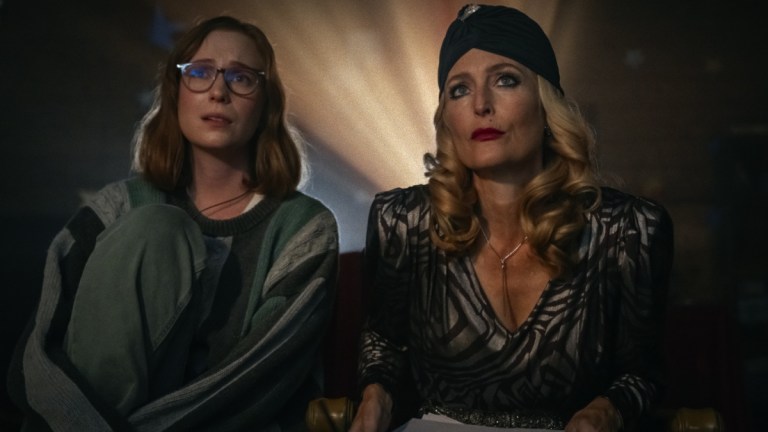
Trailers for Teenage Sex and Death at Camp Miasma made clear that the film would celebrate ’80s slashers. What’s more surprising is the fact that Jane Schoenbrun‘s latest is also about junk food. Not only do up-and-coming director Kris Williams (Hannah Einbinder) and reclusive actor Billy Presley (Gillian Anderson) eat a lot of candy throughout the movie, but a stand-out scene involves the latter seductively placing pieces of KFC on a silver platter to serve to the former. While preparing the meal, Billy half-apologizes for serving take-out, speculating that Kris would be vegan or otherwise opposed to such crass food. But when Kris admits that she loves fried chicken, Billy purrs, “Right answer.”
The KFC scene, with its sensuous shots of the women smearing dipping sauce on breaded chicken, echoes Teenage Sex and Death at Camp Miasma‘s central point about ’80s slashers like Friday the 13th (1980) and Sleepaway Camp (1983). Yes, they are problematic. Yes, they deal with harmful tropes. Yes, they often objectify women. But they sure are fun. Moreover, viewers of slasher movies don’t just passively take in their stories. Rather, the transgressions in the movies invite the viewers to define themselves in ways that trash movies could never imagine.
Beyond Good Camper and Evil Killer
Unlike their previous films We’re All Going to the World’s Fair (2021) and I Saw the TV Glow (2024), Schoenbrun gives Teenage Sex and Death at Camp Miasma a fairly straightforward narrative. After a promising breakout film that deconstructs slasher tropes, the sort of elevated horror film synonymous with A24, Kris has been hired to revive the Camp Miasma series, which was a massive hit in the ’80s but eventually went fallow after a host of increasingly lackluster sequels. Kris seeks out Billy, the series’ original final girl, and coaxes her out of the self-imposed retirement she’s been in for decades. But as the two connect and revisit the first movie, they find that there’s something deeper in the Camp Miasma franchise than anyone expected.
In a particularly telling scene, Kris and Billy watch the first movie together, which more or less follows the plot of 1980’s Friday the 13th: a group of partying counselors visit a summer camp that closed down years ago, when a camper drown and a killer called Little Death (Jack Haven) later attacked. Before the first night of partying can truly commence, one of the counselors (Zack Cherry) gathers his colleagues around a campfire to tell the story of the legend of Little Death. According to the counselor, Little Death was once a camper whose parents dressed them as a different gender every other day, which confused his fellow campers so badly that they drowned him in the lake.
“They had to do it,” insists the counselor, which his fellows all agree with and the fictional movie Camp Miasma seems to accept. But when Kris leans over to Billy and whispers, “This part is transphobic,” the actress hisses back, “Hush.”
Notice that Billy doesn’t tell Kris that she’s wrong. The counselors’ description of the non-binary camper, the actions of the other campers, are all transphobic. And that’s a completely acceptable read of not just the fictional movie Camp Miasma, but also the films that inspired it. In particular, Camp Miasma also echoes Sleepaway Camp, in which gender confusion drives the killer, and the reveal that the killer Angela (Felicia Rose) has a penis is treated as something more horrifying than the fact that she’s cradling a boy’s severed head.
Obviously, it’s wrong for any movie to suggest that anyone should be killed or feared because of their gender identity. But when Billy shushes Kris, she isn’t thinking about morality. She’s drawing attention to something deeper.
Our Killers, Our Selves
As Teenage Sex and Death at Camp Miasma unfolds, we learn that Kris is not just interested in recruiting Billy to reprise her role. Rather, she wants to know more about a key scene from the original movie, in which Billy (played by Amanda Fix in the 1980s scenes) sexually climaxes while being stabbed by Little Death. In particular, Kris focuses on a shot from the film, an extreme close-up of Little Death reflected in Billy’s widening eye.
Through the surrealism that follows, Kris learns from Billy how to sexually release by identifying with both Little Death the killer and with Billy the victim, something that Billy herself did when playing the role years ago. That lesson comes through reality-bending scenes in which fiction and reality merge, to the point that Little Death may in fact be a mad god who watches humanity suffer for entertainment, and emerges through a hole in the lake to stave off boredom by killing innocents.
The movie builds not just to a climax in which Little Death invades the real world to kill for his own enjoyment, but also with Kris becoming a stereotypical final girl herself, running away from the killer in her underwear in a slow-motion shot that emphasizes her heaving breasts.
To be sure, there’s an inversion at work here, in which the intelligent and multifaceted filmmaker transforms into a one-dimensional sex object as defined by the male gaze. But the movie doesn’t degrade or victimize Kris in the transformation. Rather, it retains her agency, positioning her becoming a stereotypical final girl as an identity that she’s taking on as a way of making sense of the world. Moreover, she also identifies with Little Death in those moments, learning from Billy how to see herself as both the victim and the killer. Or, in the case of her final girl transformation, as both the object of the camera’s desire and the desiring subject.
In that moment, it doesn’t matter if Camp Miasma is moral or immoral, if it’s transphobic or inclusive, or anything else. In that moment, Kris has gone beyond enjoying Camp Miasma to embodying and transcending it, using the film and its tropes as a way to form her own identity and navigate the world. She becomes Kris, the sexualized victim in her underwear, but also Kris who is one with the killer Little Death, who is, in fact, the god of this world.
The Joy of Trash
The Teenage Sex and Death at Camp Miasma establishes the history of the Camp Miasma franchise via winks to real-world slasher movies. The covers to the VHS tapes and many of the subtitles come directly from Friday the 13th movies, while jokes about Little Death cutting a rap album recalls the 1987 A Nightmare on Elm Street novelty record Freddy’s Greatest Hits. But a lot of the DNA of Camp Miasma recalls other, less reputable films, knockoffs like The Mutilator, Blood Rage, and, of course, Sleepaway Camp.
Most of those slashers were made on the cheap and sought quick profits by delivering base thrills. Sexism, homophobia, and racism were not uncommon. And a surprising amount of them followed the lead of Psycho and made gender-bending a sufficient reason for someone to start killing people.
And yet, as Schoenbrun’s film so powerfully illustrates, this bad behavior doesn’t brainwash moviegoers. Instead, indulging in something transgressive can open space for redefinition and even agency, whether it be the joys of watching an innocent camper get killed or luxuriating in the Colonel’s special blend of eleven herbs and spices.