Taika Waititi Should Take a Page from M. Night Shyamalan
M. Night Shyamalan has been where Taika Waititi is at. And he can provide a way forward for the once-praised filmmaker.

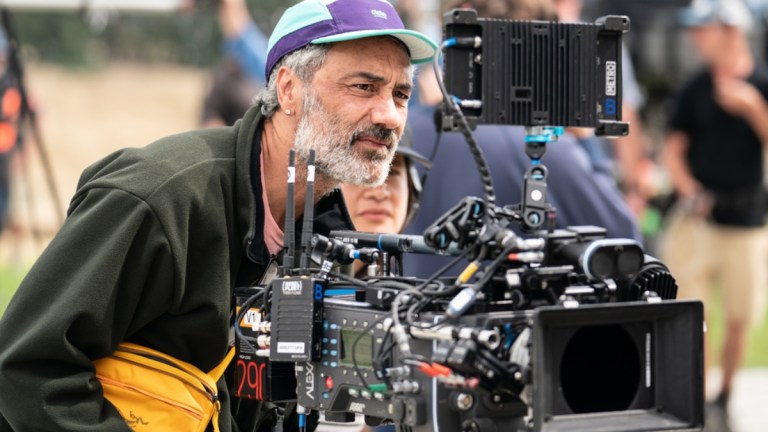
Taika Waititi had a bad weekend. It’s not just that his latest film, Klara and the Sun, released to disastrous reviews so bad that Sony canceled a wider global release; it’s also that he went to social media, reposting an article about Klara and the Sun‘s 78% audience score on Rotten Tomatoes, along with a self-aggrandizing statement. “I haven’t read a review of anything aimed at me or my peers in almost 15 years,” he wrote, going on to describe critics as “sad lost souls who couldn’t achieve their dreams of becoming artists,” and are now “Irrelevant. Out of touch. Obsolete. In the bin.” Conversely, Waititi claimed he does “listen to the people,” a claim undercut by the fact that he disabled comments on his post.
Waititi is hardly the first filmmaker to position himself as a populist after less-than-favorable reviews. But he may find it more constructive to try a different approach, one followed by a filmmaker who went from beloved auteur to critic fodder to now a reliably safe bet: M. Night Shyamalan.
Although his debut pictures Eagle vs Shark (2007) and especially Boy (2010) received more fanfare than Shyamalan’s first two movies, Praying with Anger (1992) and Wide Awake (1998), both directors enjoyed breakthroughs on their third feature, The Sixth Sense (1999) and What We Do in the Shadows (2014), respectively. From there, Shyamalan was declared “the Next Spielberg,” delivering well-received thrillers such as Unbreakable (2000) and Signs (2002). But by the time that The Village hit in 2004, critics grew tired of the conventions in Shyamalan’s work, particularly his stilted dialogue, the airlessness of his movies, and an over-reliance on twists.
Waititi followed What We Do in the Shadows with Hunt for the Wilderpeople in 2016, a mostly slice-of-life drama with absurdist edges, and then became a household name with 2017’s Thor: Ragnarok, still recognized as one of the best MCU entries. Although the strange Holocaust dramady Jojo Rabbit (2019) split audiences and critics, it received multiple Oscar nominations, including a win for Best Adapted Screenplay. From there, however, it was all downhill for Waititi, as Thor: Love and Thunder (2022) was met with a lukewarm reaction, and the 2023 soccer comedy Next Goal Wins barely made a ripple in the larger consciousness. And we all know what’s happened with Klara and the Sun.
It’s hard to pinpoint what, exactly, went wrong for Waititi. A controversial Oscar player will always be met with blowback, so it’s no surprise that some critics and audiences were angered by Jojo Rabbit‘s success. Further, Thor: Love and Thunder hit just as superhero fatigue set in, as audiences have grown tired of even a more unconventional entry in the genre. Finally, Waititi himself became something of a celebrity, perhaps overestimating the public’s interest in him as a figure. For many, rumors about his love life and lackluster performances (see: the noxious riffing he does as a cool boss in the Ryan Reynolds comedy Free Guy) made Waititi an irritant, despite the success of the TV series What We Do in the Shadows and Our Flag Means Death.
In short, Waititi became too big, too hyped, and too separated from what he does best. The exact same thing happened to Shyamalan, who went from small, somewhat sappy genre pictures with a nasty edge, to bloated, high-concept messes like The Last Airbender (2010) and After Earth (2013).
By the time What We Do in the Shadows hit theaters, M. Night Shyamalan was a byword among movie fans, an utter joke. Yet, he’s managed to recover, to the point that all of his movies do fairly well, and fans are waiting with excitement for his next picture, Remain, a collaboration with romance author Nicholas Sparks, of all people.
How did things turn around for Shyamalan? It wasn’t lashing out at critics, even though he did do some of that. In his most self-indulgent film, Lady in the Water (2006), in which he cast himself as the world’s most important storyteller, Shymalan also cast Bob Balaban as a bitter, snotty critic, one who gets justly mauled by the movie’s monster.
Rather, it was by going small again. To hear him tell it, he had to learn to be scared again. Starting with the nasty little found-footage movie The Visit (2015), Shyamalan has mortgaged his house to fund his movies, betting entirely on himself instead of a studio. But for us viewers, Shymalan has simply gone back to doing what he does best. There’s no more talk of him being Spielberg, no more sticking his name on too many undeveloped projects. He makes small-scale horror movies that are kind of sweet, kind of nasty, and totally idiosyncratic.
Not everyone can accept the open-hearted absurdity of Old (2021) or the utter disregard of realism in Trap (2024). But there are enough people on Shyamalan’s wavelength for those movies to keep making money, almost completely redeeming the reputation he seemed to have lost.
Waititi can do the same. What We Do in the Shadows has been his most enduring property, even more so than the blockbuster hit Thor: Ragnarok, but Hunt for the Wilderpeople is likely the model that Waititi needs to follow: A simple story about his native New Zealand, something he knows well and most others do not. The movie has a strong emotional core, anchored by great performances from the late Sam Neill and young actor Julian Dennison, with still room for Waititi himself to come in and be weird.
Shyamalan managed to shrug off the colossal expectations placed upon him and get back to the business of making movies that only he could make. There’s no reason to believe that Waititi couldn’t do the same. Critics were the biggest champions of his first movies, urging “the people” to whom he now appeals to go check out Boy, What We Do in the Shadows, and Hunt for Wilderpeople. And if he makes another unique picture like those, we critics will be back to urge people to check them out.
But to do that, Waititi needs to stop worrying about social media, stop telling us he doesn’t care about critics, and stop being a public figure. He just needs to do what Shyamalan does and make his movie. If it’s good, critics will be his biggest supporters again