Revisiting ‘90s Era Satanic Panic in Carry the Darkness
Director Douglas Forrester and stars Joel Meyers, Helen Laser, and Jaden Gant teach us how to Carry the Darkness.

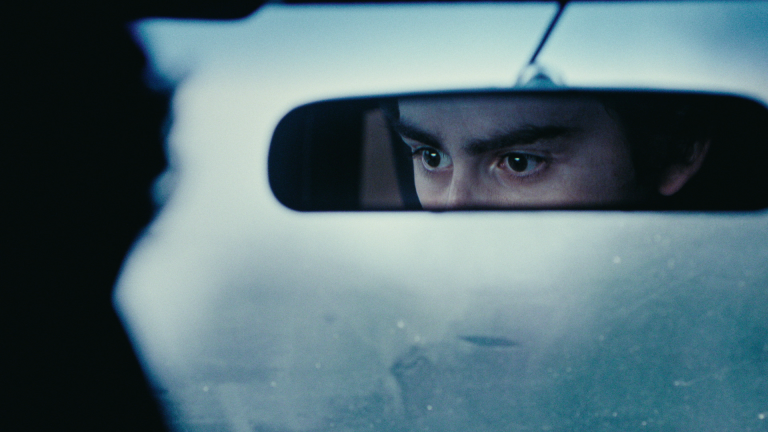
Carry the Darkness recalls a time and place that should be intimately familiar for its writer-director. After all, Douglas Forrester shot much of the film literally in the small Maryland community he grew up in, which while hundreds of miles from West Memphis, Arkansas was nonetheless gripped by the same fears in the 1990s: teenagers in black, teenagers listening to heavy metal, just teenagers.
It’s also a great backdrop for a genre indie that inspects incidents like the “West Memphis Three” incident in 1994, wherein kids like Damien Echols were dubiously convicted of murder based largely on charges of alleged Devil worship. (Echols was later set free in 2011.)
Forrester’s Carry the Darkness similarly follows Travis Baldwin (Joel Meyers), a metalhead gaming teenager in 1993 who is lured by a mysterious, and apparently quite literal, paranormal element during his own town’s Satanic Panic. And in a conversation ahead of the movie’s Sept. 8 release on VOD, Forrester and the actors behind the horror indie project discuss their various inspirations behind the film, from real life panic to lighter ‘90s touchstones, such as The Fugitive and a video game that is definitely NOT Mortal Kombat. For realsies.
I was very happy to see references to Paradise Lost in some of the press materials. So I’m curious Doug, where was your interest in that at the get-go? Did you tell the cast to see certain things before starting this movie?
Douglas Forrester: I don’t think I mandated anything to be to be watched necessarily, but I definitely talked to them about the sort of baseline influences. Paradise Lost came to me especially through my brother. He was also kind of a metal-head back in the day. He introduced me to a lot of that stuff. And then the other influences, like Twin Peaks and The X-Files and The Fugitive as well, everything from the early ‘90s and especially 1993, they just all fall on that year for some reason. Those are sort of the baseline influences. But I don’t know if I mandated something like “You must watch this.”
Helen Laser: You were nice about it, but you sent me two episodes of X-Files and said, ‘I really want you to see these.’ You gave me your Hulu so I could watch them!
Joel Meyers: Yeah, it was strongly suggested to watch Paradise Lost, which I did, all of all six hours of it.
I want to talk about locations. You use a dam on the poster that is quite striking. Is that a specific location from your childhood?
Douglas Forrester: It is specific, funny enough, we didn’t have a script for those scenes that we shot there. I mean, most of those scenes are just like [the actors] existing in space. And I was like ‘damn with the schedule, we need to go there!’ That space was something that I was familiar with from my childhood. So a lot of the exteriors and stuff were areas around my parents house where I grew up. When I was writing the script, a lot of it was built around the geography that I was familiar with.
Joel Meyers: I remember several long car rides after the shoot where Doug and I would be in the car and we would go back and forth. We had some long rides out to various parts of Maryland and Long Island and other wooded areas and something came of it.
As a Long Island guy, I’ve got to ask: where in Long Island?
Douglas Forrester: Some of the woods was the Stony Brook campus, which we got to use because I’m an alumni of their MFA in film program. The other abandoned Gateway space, if you will, was at a place called Whirlwind Preserve in Glen Cove.
Let’s talk about the gateway that leads into the ‘darkness,’ both for creating it and then witnessing it. What was your feeling for going into what seems to be a horrific place to be so bright and open when you’re shooting it?
Joel Meyers: I think it was another part of the film that was discovered as we went. In part from the story and in part from the places we had access to, as often dictates indie filmmaking. The church chapel space is one that we found later in the process, and I just felt like the disorientation of that was really important to throwing off not only the characters, but also just the experience of the story going through it. I think so much of the story’s about these characters not necessarily seeking out this darkness or this presence, but it’s kids stumbling into something they don’t understand. It gets weirder and weirder and that became kind of a driving force behind that last third of the film especially.
Douglas Forrester: Absolutely. I mean, I remember calling our DP and having many, many consultations throughout. And then of course you build it, then you reconstruct it. I don’t really know if it was supposed to be such a sort of shapeshifting type of space initially, but because we couldn’t be in that area after dark, I had to figure out how we could day-for-night, some of it, or make it like very close to evening. This space was supposed to target each of them specifically and feel like it’s beckoning each of them individually, and targeting them—acting as a metaphor for what was going on in the world at the time.
I know it’s not abnormal for a lot of actors, but what is it like going back to pretending you’re in high school, while also acting in an area that you didn’t grow up in yourselves?
Jaden Gant: I actually just got out of high school, it was like my first acting job. So I had to learn the lines in drama class. It was, honestly, just having fun and trusting one another. That was the biggest thing, really.
Joel Meyers: And trusting Doug too, as the one who was allegedly there for more of the ‘90s than any of us. I think to do a period piece like this is such an endeavor on a low budget. The ‘90s lived strong in Doug’s parents house, so that definitely helped put us in the mindset. That’s where we started our first leg of the shoot was in Maryland, so we all kind of got to dip our toes into the world.
What is it like recreating a version of Mortal Kombat for your own movie?
Douglas Forrester: That was a whole experience in itself! We had to make something that was evocative of it, and so from the get go it was like a sort of knockoff of the game. I had one of my friends from college, Jacob Beers, do the music for it. And it was two Jacobs actually, a Jacob that did the music for it and a Jacob that was the lead game designer.
It’s a playable game. It is literally what you see on the screen and VFX supervisor screen recorded him playing the game with five controllers connected to a laptop and then put that through all the CRT filtering to make it look legit. But it is an app that I have on my computer that is playable so hopefully that will be our viral sensation.
This film deals with the duality of human beings: who we are expected to be and the darker parts we hide. Are there parts of yourselves you could feel while exploring that dichotomy, either as a writer or an actor?
Douglas Forrester: A driving thing from the get-go was always “don’t judge a book by its cover”, and I think that’s in the wrongfully-accused genre as well. All the way back to The Count of Monte Cristo to The Fugitive. I think that you have to embrace the negative aspects of yourself in order to become a better person, and that was the sort of coming of age aspect of it.
Stars Helen Laser: I thought that the choice to have it be teenagers was really important because I think that when you are at that age, you’re sort of mainlining emotions and you’re also mainlining the world and finding out what it’s supposed to be and who you’re going to be. It’s a point in your life where you’re making decisions like, ‘What’s the kind of person I want to be?
[Before that moment], you’ve had people deciding everything for you. And now you’re finally having a little bit of control. Are you going to use that control for good or are you going to lose control or use it for bad? And so I love the idea of it being, you know, people who are just about to be adults and they’re having to make decisions for the first time and figure out who they are.
Joel Meyers: Yeah, I think that is also very much the Damien Echols part of this story. You watch the documentary, and it’s been a number of years since I’ve seen it, but there are moments in it where you’re watching him testifying, and you’re like digging yourself in your own hole here. You read his book and what shines through is how much of just a kid they all were and how much they were being accused of being into witchcraft.
That time in life, it’s so hard to know how to channel your interest and your emotions, especially when the world is throwing judgment at you. I remember that being a big part throughout the process as the guiding light. It can’t be a black and white thing here. There has to be a gray area, and in the movie, there are things that Travis does that are unforgivable to a certain extent. That was also an important part. He’s not completely innocent in all of this, but he’s also not completely guilty. There are forces beyond his control that he doesn’t understand.
Douglas Forrester: Trying to capture this sensationalism of those things. It’s you picking your issue throughout the decades of the culture wars. And that day it was the music, listening to Metallica and wearing all black.
Jaden Gant: Especially playing Jordan, who was told what to do his entire life and his goals. I like the idea of him kind of making that choice, making a choice that you know is wrong, figuring it out, and experiencing it for yourself. You learn a lot about yourself doing things that way.
Joel, you obviously spent some time playing Albus Severus Potter on stage in Harry Potter and the Cursed Child, and now there is that new HBO series coming out. Clearly you couldn’t play the same character, but is there any weird desire to go back to being a part of that world?
Joel Meyers: I mean, look, if they call, a job is a job, I’m sure it’s a great paycheck. I’m still a huge Harry Potter fan after being in that show for two years. And if that isn’t a testament to the franchise, I don’t know what is. I would love to go back to the Potter universe.