Pillion: Alexander Skarsgård Keeps BDSM Love Story Uncut and Intact for Americans
Exclusive: Pillion director Harry Lighton, and stars Alexander Skarsgård and Harry Melling, take us into the making of a unique LGBTQ love story—and why not a frame was changed for American sensibilities.

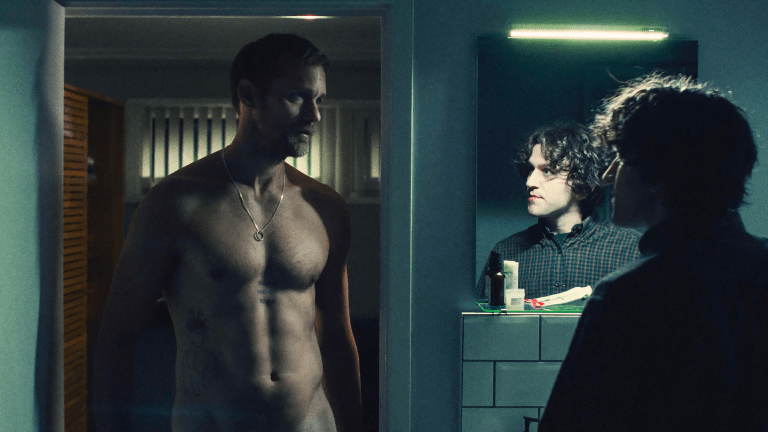
On a typical film shoot, Alexander Skarsgård can appreciate the expected mode of prep work. You meet with your co-stars and scene partners regularly, you discuss the motivations and the underlying subtext of an exchange, and you rehearse as much as possible. Time permitting.
The thing about Pillion, Harry Lighton’s simultaneously elegiac and kinky love story between a dominant and his inexperienced submissive in a queer BDSM biker gang, is that things stray far from the typical path. And that trajectory created a unique opportunity for stars like Skarsgård, who plays the dom, and Harry Melling of Harry Potter and The Queen’s Gambit fame, who portrays the half-a-foot shorter sub.
“We didn’t dissect the scenes throughout the shoot or sit and talk about where we wanted it to go,” Skarsgård says. “But it was also not a case of us avoiding each other either. We hung out. It wasn’t, ‘I gotta be in my corner and you and yours,’ and then we clashed in front of the camera.”
Be that as it may, it remained a conscious choice on Skarsgård’s part to not meet Melling until two days before shooting. There were opportunities, as Skarsgård acknowledges: “I was in London for stuff or we could have had a Zoom.” But while he talked with Lighton beforehand, who rehearsed extensively with Melling since the latter plays the film’s heart and soul, the Swedish actor kept some distance. “There was something quite fun about having this discovery and letting this relationship play out in front of the camera.” And it’s a relationship that’s left a mark on every viewer who has seen it to date.
When we catch up with the director and his two leading men, it’s at the tail-end of a press tour that’s taken them from Cannes to London, and finally now back to New York City ahead of the film’s U.S. premiere. It is, in fact, the second time we have met, the first being briefly after the picture premiered in Gotham a few months ago during a raucous New York Film Festival screening. At the time, Skarsgård quipped, “It’s gonna be a good afterparty, guys,” following a round of catcalls.
But there’s been curiosity, too, about how the film would release into American cinemas this Friday following its UK premiere late last year. Rumors continue to circulate that it would be cut significantly to earn an R-rating stateside due to the generally more puritanical notions toward sex scenes in the MPA. And to be sure, Pillion has some memorable ones involving Ray (Skarsgård) and Colin (Melling).
“There weren’t any cuts as far as I’m aware,” Lighton confirms to us. “I know that the version which has been released in cinemas in the U.S. is the same one which was released in the UK, and that’s exactly the version I want people to see.” He goes on to add that A24 was always onboard of bringing a love story as unorthodox but honest as Pillion to the screen, noting, “I think anyone who read the script knew what it was about. It was a very explicit script. There’s like five paragraphs describing an erection in the script. So people knew what they were kind of getting into bed with.”
But what seems to most strike audiences who’ve watched Pillion isn’t so much the frankness of the sex scenes, but the quiet universality of a love story about a young, impressionable person, discovering something in himself that might be unorthodox but fills a need beyond just desire.
The film walks a careful line in this way since the first scene involves Colin as a young, lonely lad on Christmas Eve, singing in an antiquated barbershop quartet for his doting parents and a blind date going nowhere. So enters the leather-clad Ray, the Mysterio biker who picks Colin up and invites him to a fairly physical first date the next night. One reading might be Colin is indoctrinated into a subculture. Another interpretation, which is also Melling’s, is that he has found his tribe.
“I like to think of it as that thing when you don’t consciously know you want something, but when something happens in your life, you suddenly realize, ‘Oh wait a minute! This actually makes a lot of sense to what I’ve been looking for or what I’ve been wanting,’” Melling muses. “It’s not like he’s thinking secretly, ‘You know what I need to be in? I need to be in a sub-dom relationship. That’s going to make sense to me.’ But the fact that this opportunity gets presented to him, and the fact that clearly he’s so attracted to this man, and then this dynamic is presented to him, I think things start to click. Things start to make sense about how he wants to express himself and how he wants to experience love.”
Exploring that epiphany is one of the main attractions to the material for Lighton, a first-time feature director who came to the material as an adapter. While the Hampshire-born Lighton pulls from Adam Mars-Jones’ Box Hill novel, he also made bold changes to the story, including by setting the screenplay in a modern context as opposed to its literary 1970s roots.
“Primarily, I thought the change made Ray’s mystery more interesting to me,” Lighton explains. “If the novel’s set in the ‘70s, when I think about why Ray withholds his background from Colin, there is quite an easy explanation for me: it was probably because he’s in the closet, which was much more common in Britain in the ‘70s than it is now. So I like the fact that if you put it in a contemporary setting, it opened up all these new questions. It could be an erotic game on Ray’s part; it’s not necessarily because of some kind of homophobic landscape he’s in.”
Furthermore, a 21st century backdrop allows Lighton to interrogate what is considered “normal” and what might still be construed as taboo, even with ostensibly open-minded parents of a queer child. As opposed to the novel, where Colin’s parents attempt to ignore their son’s homosexuality, Colin’s mother (a touching Lesley Sharp) and father (Douglas Hodge) are supportive—up to a point.
“[I wanted to] explore where the limits of acceptance are and what is an acceptable version of homosexuality in some people’s eyes versus an unacceptable one,” Lighton explains. “We see the parents go from acceptance at the beginning to some version of rejection, which in a way is the reverse of the normal trajectory you go on in a queer film where parents initially aren’t supportive and then grow to support over the course of the film.”
A big reason for the parents’ reservations though is, of course, Ray, a figure who by design remains aloof and almost unknowable. Skarsgård admits he has his own personal explanation for the choices Ray makes in the movie, yet even those shifted as they filmed the thing.
Says Skarsgård, “I noticed that throughout the shoot [my motivations] kept changing. I didn’t really know how Harry was going to play Colin, and I felt that Harry’s reactions in those scenes informed my version of Ray. So I felt it was a journey of discovery. I kept kind of revising my thoughts on Ray, not that I had a fully fleshed out backstory, but I had some thoughts, and then I was like, ‘Oh, maybe that’s not the case?’”
The evolution of the characterization was part of the pleasure of the shoot. “It was not scary,” the Swede continues. “It was kind of exciting to be like, ‘Oh, I learned something new about the character today. That was surprising!’”
The discovery has proven exciting for audiences, too, even those from a family of filmmakers. When we meet with the Pillion trio, it’s only about a week since Skarsgård’s father, Stellan, received his first Oscar nomination for Sentimental Value, a beautiful movie that Alexander has been fielding questions about all awards season. So it seemed prudent to ask: what was Stellan’s review of Pillion?
Dropping his voice down an octave, and adding a well studied layer of scratchy gravel atop his cadence, Alex leans back in his chair to imitate a father’s posture, and exclaims, “‘This is the movie of the year!’”
For more than a few audience members, he’s not wrong.
Pillion is playing everywhere now.