The Best Westerns and Neo-Westerns of the 21st Century
Even long after the genre's peak, there's nothing quite like a great Western.

It doesn’t matter if they’re thinking of singing cowboys like Gene Autry and Roy Rogers, if they’re thinking of ol’ John Wayne swaggering across the field, or even if they’re thinking of Clint Eastwood bringing the apocalyptic fury of a pale rider—when most people think of Westerns, they think of a movie genre long since past.
True, the Western no longer dominates the screen like it did in the 1950s, when High Noon and The Searchers were massive hits. But filmmakers still come back to stories about cowboys, cowgirls, and all manner of drifters along the lonesome plain. Sometimes, these storytellers go back to the Wild West to retell classic stories with modern techniques. Other times, movie-makers bring the genre into the 21st century with Neo-Westerns, which look at today’s versions of white hats and black hats. Both approaches have kept the Western alive, as demonstrated by these 10 great films.
Brokeback Mountain (2005)
As a heartbreaking romance between two lovers who can never be together, Brokeback Mountain sometimes gets overlooked as a Western. Sure, everyone knows that Jake Gyllenhaal‘s Jack Twist and Heath Ledger‘s Ennis Del Mar meet while working as sheep herders, but we too often talk about the duo as if their occupations as cowboys are incidental to the plot.
Make no mistake, Brokeback Mountain absolutely is a Western, with a screenplay written by no less than Larry McMurtry and Diana Ossana of Lonesome Dove fame. Directed by Ang Lee and adapted from the short story by Annie Proulx, Brokeback Mountain is filled with ranchers, rodeos, and rustlers—everything you’d want from a Western, save for a six-shooter duel. More importantly, Brokeback Mountain has men who don’t fit anywhere in civilized society, and long for the peace of the solitary wilderness.
No Country For Old Men (2007)
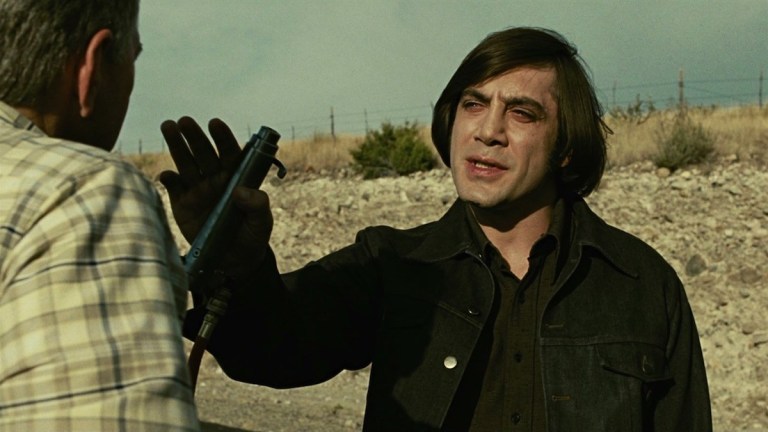
If Brokeback Mountain presents the landscape as a place of refuge from the demands of society, then No Country For Old Men reminds us that not everything uncivil is safe. Joel and Ethan Coen‘s adaptation of the Cormac McCarthy novel visualizes the author’s belief that something evil lurks in humanity, which no amount of progress or hope can contain.
Moreover, the Coens also bring out the dark humor in McCarthy’s work, as demonstrated by the manifestation of that evil, Anton Chigurh (Javier Bardem), with his nonsense coin-toss games and Beatles mop-top. As Chigurh hunts down sad sack Llewelyn Moss (Josh Brolin) for taking a bag full of cash, viewers are left as mystified as old Sheriff Bell (Tommy Lee Jones). We can only watch in horror at the fragility of human existence, and try not to laugh.
True Grit (2010)
In most cases, we try to limit ourselves to one movie per director, to get in as much variety as possible for a 10 film list. But no list of the best modern Westerns would be complete without two works from the Coen Brothers, because they made the best two works in the genre. True Grit, of course, re-adapts the Charles Portis novel that inspired a John Wayne classic. By stripping from the story the Duke’s larger-than-life persona, the Coens allow True Grit to stand for itself, revealing the wonderful story within.
In perhaps the greatest kid performance of all time, Hailee Steinfeld stars as Mattie Ross, a 14-year-old girl who hires burned-out Marshall Rooster Cogburn (Jeff Bridges, at his most billy goat) to hunt down the man who killed her father, Tom Chaney (Brolin). Along the way, they get from the dandy Texas Ranger LaBoeuf (Matt Damon), resulting in wonderful banter that feels like classic Coens, even though it comes straight from the Portis novel.
Meek’s Cutoff (2010)
Often, revisionist Westerns forced us to reconsider the American myth by revealing our heroes to be bloodthirsty brutes. Meek’s Cutoff takes the opposite approach, revealing the men at the center to be ineffective dunces. Directed by Kelly Reichardt and written by Jonathan Raymond, whose 2019 movie First Cow would also fit on this list, Meek’s Cutoff stars Michelle Williams as Emily Tetherow, the most outspoken of a group of settlers who hire trapper Stephen Meek (Bruce Greenwood) to guide them across the Oregon territory.
Like most of Reichardt’s movies, Meek’s Cutoff is about mood and character, not plot. That approach works particularly well here, underscoring the sense of aimlessness the pioneers experience while their inept guide moves them in no direction at all. Meek’s Cutoff may not be as harsh as The Wild Bunch or Unforgiven, but it’s no less damning about the mythological men who explored the West.
Bone Tomahawk (2015)
If you’ve only heard of Bone Tomahawk from its frequent appearances on internet lists of incredibly disturbing movies, then you may have a wildly inaccurate concept of the film itself. Yes, Bone Tomahawk does have a horrific act of violence, when a man gets split apart like a whishbone by the film’s antagonists. But that moment shocks, in part, from the way it comes out of nowhere, interrupting what has been largely a serene, if dour, film.
Written and directed by S. Craig Zahler, Bone Tomahawk is very much a classic-style Western, for better or worse. Kurt Russell stars as Sheriff Franklin Hunt, who leads an unlikely party (played by character actors such as Patrick Wilson, Matthew Fox, and Richard Jenkins) to hunt troglodyte monsters (not Indigenous people, the movie unconvincingly insists, via a one-scene appearance by Zahn McClarnon). Everything leading up to the big gore scene consists of long philosophical debates between the various characters, debates that get immediately ignored—by the characters and the audience—as soon as the violence begins.
The Hateful Eight (2015)
If Bone Tomahawk flirts with mixing horror and the Western, 2015’s other Kurt Russell-led Western leans right into it. With The Hateful Eight, Quentin Tarantino remakes John Carpenter’s The Thing in the Old West, forcing a bunch of strangers who don’t trust one another to take shelter together when a winter storm sets in. These antagonists include bounty hunters played by Russell and Samuel L. Jackson, their madwoman quarry (Jennifer Jason Leigh), a pair of Confederates played by Walton Goggins and Bruce Dern, a Mexican (Demián Bichir) an Englishman (Tim Roth), and a cowboy (Michael Madsen). Also, Channing Tatum suddenly shows up.
It sure sounds like a lot of fun to watch all these big personalities bounce off one another and spout Tarantino dialogue. But The Hateful Eight is easily Tarantino’s most unpleasant film, one made all the nastier for the way it handles concepts like American racism and the Confederacy’s lost cause. Viewers cannot help but try to cobble a coherent worldview out of The Hateful Eight, but none is forthcoming, leaving a frustrating, but often fascinating film.
The Rider (2017)
Most readers of Den of Geek know Chinese director Chloé Zhao for either her MCU misfire Eternals or her two Oscar players, Nomadland and Hamnet. But her best film remains 2017’s The Rider, a much quieter and more soulful film than any of her calling cards. As its name suggests, The Rider tells the story of a rodeo star, Brady Blackburn, who tries to make sense of his life after a head injury leaves him prone to seizures.
Like nearly every other character in the film, Brady is played by a non-professional Lakota actor from the Pine Ridge Reservation. In this case, it’s Brady Jandreau as a lightly fictionalized version of himself. Zhao effectively turns Jandreau’s unvarnished screen presence into a type of authenticity and honesty, bringing us into the plight of someone who only had one path for his life, a path now taken away.
The Nightingale (2018)
Many movies on this list have their nastier moments. That comes with the genre, which often deals with an unforgiving wilderness and people who solve their problems via gunfights. But nothing can match the pure meanness on display in The Nightingale, Australian director Jennifer Kent’s follow-up to The Babadook. The film follows a young Irish woman called Clare Carroll (Aisling Franciosi), who must survive the Australian outback with the help of an Aboriginal man named Billy Mangana (Baykali Ganambarr) after she’s assaulted and her husband and infant daughter are killed.
From the above synopsis, one can probably infer the nature of the attacks done against Clare. But Kent does not allow the viewer to hide from the horror, and instead puts the camera in Clare’s point-of-view while she’s assaulted, and shows us the murder of her family. Yet still, The Nightingale shows the level of suffering further done against the Aboriginal people, as the English—personified by Sam Claflin’s cruel Lieutenant Hawkins—exert their will over colonized Australia.
The Power of the Dog (2021)
At first glance, no one seems more unsuited to playing a manly cowboy than Benedict Cumberbatch, who plays the swaggering Phil Burbank in New Zealand director Jane Campion’s The Power of the Dog. Yet, as the film unfolds, it’s clear that Cumberbatch is the only one who can play Phil, a sensitive man who deals with discomfort with his social station and his sexuality by adopting the manner of a rough and tumble cowboy.
Based on the lyrical novel by Thomas Savage, The Power of the Dog follows Phil’s attempts to maintain his rugged lifestyle, even after his kind brother George (Jesse Plemons) brings a new wife (Kirsten Dunst) into their home. As a power struggle unfolds, we learn the truth about Phil’s past as an academic, and his love for his mentor, the late cattle rustler Bronco Henry, making The Power of the Dog into a surprisingly gentle deconstruction of cowboy masculinity.
Killers of the Flower Moon (2023)
Cowboys vs Indians have always been a mainstay of Western movies, often without much self-reflection. Martin Scorsese‘s epic Killers of the Flower Moon doesn’t exactly interrogate that fictional history, but it does seek to address the real history of Euro-American conquest of Indigenous lands, via a shocking and surprisingly recent moment in our nation’s history.
Based on the nonfiction book by David Grann, and written by Eric Roth and Scorsese, Killers of the Flower Moon takes place in early 20th century Oklahoma, where World War I vet Ernest Burkhart (Leonardo DiCaprio) lives with his Osage wife Mollie (Lily Gladstone). Despite his avowed love for Mollie, Burkhart gets involved in his uncle’s (Robert De Niro) plot to steal the Osage people’s rights to the oil beneath their land. A master of depicting organized crime, Scorsese does not flinch at the insidiousness of people like Burkhart, who would poison his own wife in pursuit of money.