Batman v Superman: Dawn of Justice – A Decade Since Fandom Broke
Ten years later, we look back at the impact Batman v Superman: Dawn of Justice had on DC fandom and the larger culture. Hint: things grew a lot more negative.

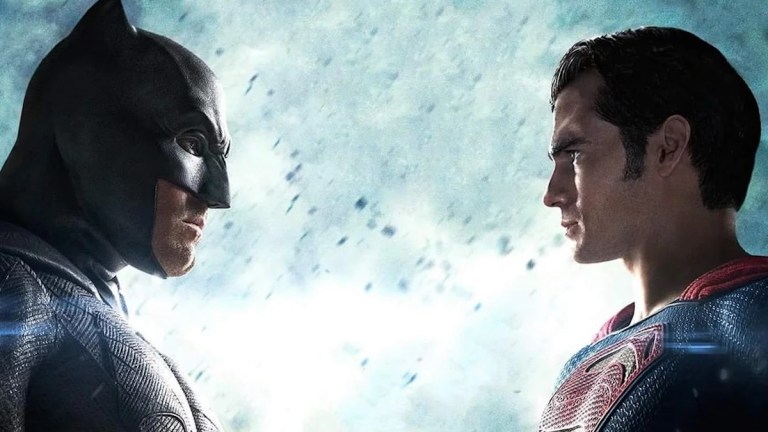
There was a time, not so long ago, when the mere thought of “fandom” filled folks with joy. Or at least amusement. In our modern world, where everything’s oversaturated by fine, algorithm-tuned hater content on YouTube, manosphere misanthropy on X and Reddit, and review-bombing at Rotten Tomatoes and Letterboxd, it is sometimes hard to remember those early “Wild West” days of the internet. But back then, and even during a good chunk of the 2010s, fan culture was seen as a unifying force by the converted, and a harmless pastime by the agnostic. It was never fully a source for division and despair.
There are many flashpoints that led to this transition from the geek’s golden age to a modern era of acrimony and internecine conflict in which the definition of “true fans” is constantly drawn into question. The first large-scale attempt to drive fan complaints and grievances toward coordinated bigotry (often with heaps of misogynistic harassment baked in) was “Gamergate” in late 2014. And for casual, non-terminally online civilians, it probably became a more recognizable in the aftermath of Star Wars: The Last Jedi, a movie which grossed $1.3 billion, earned glowing reviews, and still left online Star Wars fans so frenzied that small portions harassed its female stars until they left social media… and Disney cravenly caved to their demands in the sequel by minimizing the non-white characters and largely undoing everything transgressive about The Last Jedi.
And yet, in lieu of last month’s 10th anniversary milestone for Batman v Superman: Dawn of Justice coming and going, I think it’s worth acknowledging how this decade of decline started becoming undeniable following this very specific kind of pop culture car wreck. Before the spring of 2016, online nerdiness was generally seen as a form of escapism. Afterward, superhero movies, and soon enough pop culture writ large, became just another battleground in the ceaseless culture wars that plague us to this day.
Unto itself, Batman v Superman, nor the people who made the film, including director Zack Snyder and screenwriter Chris Terrio, can be blamed for this fan reaction (at least in 2016). To their credit, they sought to make a more ambitious epic than what had quickly become the superhero movie boilerplate of the 2010s thanks to the glut of Marvel Studios films. If Marvel movies were uniformly light, colorful (if in costume and not cinematography), and defined by a sense of winking self-effacement that frequently undercut any dramatic heft in favor of nudge-nudge easter eggs, then Snyder sought to make BvS grandiose, operatic, and endlessly dour.
Despite Superman and Batman often being contrasted by their varying sense of light and dark, hope and gloom, in the comics, Snyder’s vision of the DC Universe was uniformly gray, oppressive, and frankly nihilistic. Heroism is treated as a fool’s errand, with no less than the Man of Tomorrow glumly conceding at one point to Lois Lane that “no one stays good in this world.” Batman v Superman wanted to be aggressively “adult,” but that aggression came across more as adolescent angst to many critics at the time (including myself). It certainly suggested a more thoughtful world of realpolitik consequences for superheroes, with Superman at one point being subpoenaed to appear on Capitol Hill before a hostile committee hearing—albeit the way Snyder glibly then blows up that institution in the film’s second ham-fisted attempt to evoke 9/11 comes off less profound than it does desperate.
Indeed, that gap between aspiration and actual achievement is one of the reasons BvS remains so divisive to this day as simply a film. Critics largely loathed it, with the film still sitting at a bleak 28 percent on Rotten Tomatoes, and general audiences were not far behind. In spite of opening at a gargantuan $166 million, the film dropped an astounding 69.1 percent in its second weekend, suggesting an unsatisfied audience—and for that matter studio, which in the pre-COVID 2010s expected every major superhero event to be able to cross $1 billion like The Dark Knight Rises did four years earlier. Instead BvS tapped out at $874 million and was perceived as a disappointment by WB. (An irony now since the newest Superman movie is considered a success after crossing $600 million in 2025.)
To be sure, WB had good reason to fret. As strongly hinted by its unwieldy title, Batman v Superman: Dawn of Justice was intended to be a clumsy shortcut to the studio’s very own Avengers movie, with two such Marvel crossovers in the previous four years already grossing $2.9 billion between them. But the general mainstream audience reaction to BvS was so sour that, sure enough, the following year’s Justice League was received with a shudder of indifference in the marketplace. The film opened to $93.8 million—a disastrous 44 percent down from Batman v Superman—and ultimately grossed only $661.3 million worldwide. This was a year after Marvel’s own nominal “Captain America vs. Iron Man” movie picked up a cool $1.1 billion, and barely six months removed from the next official Avengers movie grossing $2.1 billion in 2018.
Speaking purely in dollars and cents, the “DC Extended Universe,” or whatever else you want to call it, had been a commercial disappointment up to that point.
However, fandom (thankfully) is not defined purely by dollars, cents, or corporate bottom lines. It springs from what people like, and a healthy subset of DC fans liked Batman v Superman, and Snyder’s Man of Steel too. Some even came of age when these movies were in theaters and found nostalgic value in all of the above, and hell, David Ayer’s helter-skelter Suicide Squad too!
So they had reason to be disappointed in the fact that WB effectively “canceled” the DCEU as it was originally conceived by Snyder and screenwriters like Terrio and David Ayer. They perhaps more rightly deserved to be frustrated, too, by 2017’s Justice League being a Frankenstein’s Monster of a production, with Snyder being pressured to leave in post-production during a time of personal tragedy in his life; all so WB could bring in Joss Whedon to rewrite and ghost-direct large portions of the movie into something a little more zippy and tonally discordant with the rest of the picture.
Creatively speaking, fans, and most assuredly Snyder, had good reason to be disappointed with Justice League. The eventual “Snyder Cut” of the production released on HBO Max during the pandemic in 2021 is an assuredly better film (although at an indulgent 242 minutes, hardly the masterpiece his most ardent defenders make it out to be). Still, we’d argue his vision never did connect with a larger audience, and the 2017 cut of Justice League’s bitter opening weekend bears that out. Audiences rejected the movie even before seeing the committee-room compromise that WB had made in a panic.
Beyond the quality of either of these two movies—or three if you count the two cuts of Justice League as effectively separate films—what remains as the greatest legacy of BvS is how it shaped DC fandom, the superhero movie genre, and just fan culture at-large in the decade that followed. The divisive reception to Dawn of Justice wasn’t just a death knell for the DCEU as it then existed, but of any broader sense of online enthusiasm that previously marked the announcement of a new IP-leaning film.
2013’s Man of Steel, also directed by Snyder, was fairly divisive in its own right, but its flaws did not dim the excitement for either BvS or Suicide Squad three years later. Nor was the prequel trilogy of Star Wars films in the 2000s—hardly critical triumphs in their own time—treated as an albatross around the 2010s’ shiny new Star Wars trilogy from Disney. At least not at first.
Admittedly the quality of these 2010s studio tentpole extravaganzas played a big role in the shifting tastes of audiences—personally I cannot think of many worse geek-targeted spectacles than The Rise of Skywalker or Justice League—but it is fair to argue fan culture itself changed for the worse in the aftermath. Not only would Justice League be judged for the sins of BvS and the studio that abandoned its director in its aftermath, but so would every DC film released henceforth.
To this day, a small but vocal contingent of online fans persist in posting daily on X, Reddit, or their neighborhood HoA boards about how much they hate the new James Gunn Superman films because they don’t star Henry Cavill as an Ayn Randian Übermensch. And no Star Wars film, TV show, or lunchbox can be announced or released without preemptive backlash on TikTok.
In this course of things, fandom has changed from being a refuge for nerds to another exhausting outlet for purveyors of conflict. Indeed, as first teased by the Gamergate episode of 2014/15, bad faith opportunists and political hacks can make entire careers out of gaming YouTube algorithms with content designed to enrage and radicalize, often by perceiving any fan-friendly film or TV show starring a woman or person of color as an attack on (white) culture and therefore “tragic.” And to be sure, this early-20th century, Aryan-coded view of Western culture fits snugly with the Batman/Superman film where the Dark Knight muses, “My parents taught me a different lesson dying in the gutter for no reason at all. They told me the world only makes sense if you force it to.”
Maybe, in the end, it’s a good thing if the fandom wars of the last decade teach the next generation not to invest so much of their personality and interest in products owned by corporate entities who have turned out to be quite susceptible to reactionary political pressures. Increasingly, superheroes, Star Wars, and their ilk are perceived as a Millennials-and-up fantasies, with their multigenerational appeal ebbing for the first time in decades as younger gens opt out of dealing with all that fire. Why would you when there’s anime, K-Pop, Minecraft, and Roblox to play with?
Nonetheless, it’s a shame to see what once was a sanctuary for giddy geekiness dragged down into Martha Wayne’s monochrome gutter.