Avengers: Endgame and the Gamora Problem
Avengers: Endgame still leaves plenty of questions about the final fate of Gamora in the MCU after Infinity War.

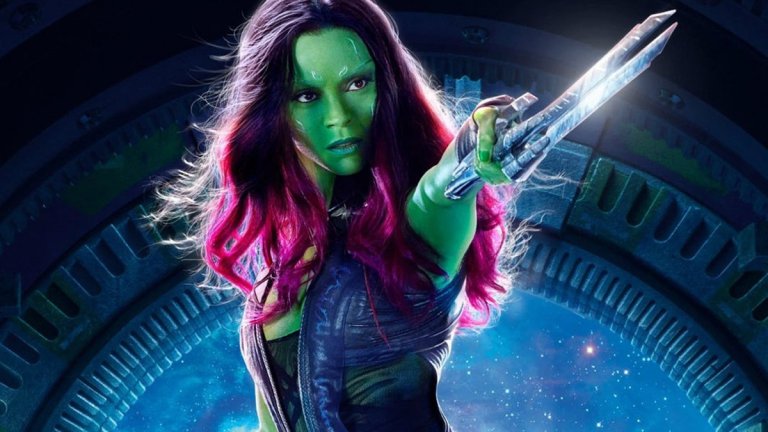
Warning: This article contains MAJOR Avengers: Endgame spoilers. We have a completely spoiler free review right here.
Time travel has a tendency to confuse everything, and Avengers: Endgame has no shortage of time travel and confusion. Gamora is the subject of much of it, and adding her death in Avengers: Infinity War, not to mention the curveball of the Soul Stone into the mix doesn’t help matters. We’ll try and sort out the new/old Gamora’s place in the MCU here.
Watch Marvel and more with a FREE Disney+ TRIAL!
When Nebula travels back to Vormir and Morag in 2014, Thanos and Gamora are able to access her information thanks to a convenient time travel quirk that links her cybernetics with her “previous” self’s cybernetics. Of course, they set out to attempt to foil the plan of the remaining Avengers, which results in 2014 Thanos and Gamora arriving in “our” present. 2014-era Gamora, without the benefit of time and her experiences with the Guardians of the Galaxy, is firmly pro-Thanos and sees present-day Nebula as a traitor and a coward. The longer they talk, though, the more intrigued Gamora seems by this version of her sister.
One of the more satisfying parts of Gamora’s story in Avengers: Endgame came when she asked the present-day Nebula about her relationship with her sister. In her typical style, Nebula was honest about both how far the fraught relationship had come, as well as the multiple times she had tried to kill Gamora between 2014 and her present reality. Eventually, Gamora comes around to “our” Nebula’s way of thinking, indicating that, much like we saw in the events of the first Guardians of the Galaxy movie, she didn’t need much of a push to see the light about her father.
In a marked departure from the relationship we’ve come to know and love, when Gamora watched present-day Nebula kill her 2014 counterpart in front of her, she didn’t seem especially concerned. Contrast that with the pain in our Gamora’s voice in Infinity War when she pleaded with Thanos not to torture Nebula. She begs him to leave Nebula alone, her voice cracking. When she eventually gives up the location of the Soul Stone to save Nebula’s life, Gamora goes to Nebula’s side and puts a hand to her sister’s cheek to comfort her. I can’t imagine these two characters doing this when they first met, and it’s jarring to go back there again so quickly thanks to this “past” version of Gamora. It would have been great to see Endgame acknowledge this dichotomy more directly, whether by highlighting Gamora’s interiority or by having Nebula react or comment on her blase demeanor in some way.
2014 Gamora’s indifference to her sister’s death seems like a sign of just how damaging it was to be raised by Thanos. While we’ve heard Nebula and Gamora refer to each other as sisters, it’s usually with a sneer, and Gamora’s disregard for another life is disturbingly definitive proof that they never acted like it, in any normal sense of sisterhood. No one was expecting a warm and fuzzy upbringing from a genocidal cosmic warlord, but during Infinity War’s flashbacks it seemed like Thanos had true love and affection for Gamora and whatever his faults, killing her in exchange for the Soul Stone did cost him something.
By Avengers: Endgame‘s own time travel rules, present-day Nebula’s choice to kill her 2014 antecedent did not erase herself from the narrative. This makes killing her former self less of a sacrifice but no less weird or confusing. Referring back to Tony and the Hulk’s attempt at parsing the rules of time travel, this seems to fall under the idea that going back in time doesn’t alter the present, but rather creates a new branch in the timeline.
When Tony Stark snapped with the Infinity Gauntlet and removed Thanos’ army from existence (at the cost of his own life), Gamora wasn’t turned to dust. So where did she go at the end of the battle? Since she doesn’t particularly know any of these characters and isn’t close to her sister, it’s no big surprise that she noped right out of the situation. But what we do know is that Peter Quill is now looking for her (even though she didn’t recognize him and kicked him in an uncomfortable place). Back on his ship, before Thor walked in, Quill was running a search for Gamora and coming up empty. The Guardians are a family, and I imagine that feeling will only grow after the events of Infinity War and Endgame. If the rest of the crew knows there’s a Gamora out there, even if she’s not the Gamora who knows and loves them, I imagine they would want to track her down, just like Quill.
Is it possible that the “original” Gamora is somehow be trapped inside the soul stone, and could be restored to Gamora’s 2014 physical self? When Thanos snapped in Infinity War, he spoke to the childhood version of Gamora. It might have been some kind of hallucination, but it seemed like it was through the cosmic power of the Soul Stone. Might her essence still be in there somehow, waiting for the right method to release it, and a physical manifestation it can inhabit? We’ll have to wait until Guardians of the Galaxy Vol. 3 to find out.

If, like many fans, you viewed all pre-snapture Infinity War deaths as permanent, then getting the 2014 Gamora is a second chance at having a character we love. Seen another way, she has literally regressed back to a time when she had even less character development than right now. However thinly drawn Guardians-era Gamora was, we at least had some understanding of her motivations, whereas we know little about why this Gamora was loyal to Thanos and what caused her to abandon that loyalty. Was it the hope of a deeper relationship with this version of her sister, spurred on by present-day Nebula’s uncharacteristic (to her) honesty? Or perhaps the prospect of a life out from under Thanos’s thumb?
I’m hoping that when we see her next, we get more from Gamora than just a deadly, highly capable woman who is not to be trifled with. As one of few women in the MCU I want to love Gamora. But after watching her in so many movies we know so little about her other than the generic “badass” label, one that is applied to practically every woman in an action movie. Now that she’s back to her 2014 vintage, we know even less about her. I’m trying to be optimistic that this is somehow a good thing, an opportunity for a re-do on developing her character. I’d like to know what she disliked about her old life and what she’s hoping for in her new one. What she was looking for when she held out a hand to a woman she didn’t know but who called herself her sister, and why she left that same woman without saying a word. Does she ever think about the people she used to hurt, the father she betrayed? What does it feel like to be a woman out of time, but only just? For now, we can only speculate and hope for the best.
