The Legend of Zelda Ocarina of Time Reminds Remakes Are Interpretations, Not Copies
The Legend of Zelda: Ocarina of Time is different in 2026 than it was in 1998, and that's a good thing.

“Hey, listen!” Just reading those words is enough to make anyone who has played The Legend of Zelda: Ocarina of Time sit up and pay attention. Link’s fairy guide Navi says those words approximately ten billion times while traversing across Hyrule’s past and present to prevent Ganondorf from using the Triforce to conquer the world. Annoying at first… and second… and third, Navi’s little interjections are as much a part of the game as the various puzzles and boss battles.
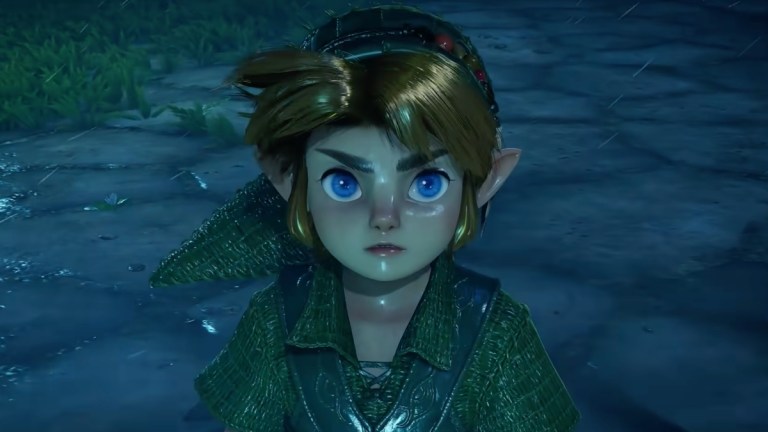
So fans would be forgiven for being slightly taken aback by the trailer for Nintendo‘s remake of The Legend of Zelda: Ocarina of Time. The trailer is full of familiar sights and sounds, from Link’s various grunts as a kid and an adult to him targeting the enemies he strikes with a sword to the sound of the Ocarina itself. Moreover, the remake has a darker, more realistic feel, replacing the bright cartoon visuals of the originals—which is exactly what a remake should do.
Remakes are, of course, nothing new to video games. As soon as Pong left arcades and made its way into living rooms, people learned that games had to go through some sort of change in order to work on a different system. Often, the changes are a result of hardware abilities and limitations. Pac-Man at home, whether the depressing Atari version or the impressive Intellivision port, didn’t look and sound the same as it did in the arcades. As much as we loved to play Teenage Mutant Ninja Turtles II: The Arcade Game on NES, we knew it fell short of the four-player brawler we got at Chuck-E-Cheese.
However, Nintendo also showed us that remakes can take advantage of stronger hardware to give us a game that retains the same basic mechanics, but presents them with better graphics and sound. The Super Mario All-Stars compilation on the SNES played as both an update and a celebration of the games from the previous generation, allowing the screen to match the way the games made us feel.
But with the Ocarina of Time remake, Nintendo is showing us something different. It’s showing a game that has a lot of qualities of the version we first played on the Nintendo 64 decades ago, but is ultimately a new game. The first half of the trailer plays the greatest hits, giving us shots of Link doing the usual combat and puzzle actions that we’ve done during hundreds of replays. However, the shadows are a bit darker and the textures a bit more pronounced, creating a change that goes beyond transitioning from polygons to fully-rendered people and involves matters of tone.
The second half of the trailer only intensifies those feelings, as it adds voice acting and newly designed cut scenes, replacing the mostly static images and subtitles of the original game. Suddenly, Zelda and Darunia the Goron have voices, and they don’t sound like we expected when first played the game. Suddenly, Ocarina of Time isn’t the same game we played before.
But that’s not a bad thing, especially if we think of video games as art instead of just entertainment technology. If they’re just entertainment technology, then we can and should complain when the new technology doesn’t entertain like the previous technology did. But if they’re art, then we need to allow room for the work to change in order to be perceived differently. We need to let video game remakes be interpretations.
Other forms of art have long had to wrestle with questions of interpretation in adaptations and remakes. Consider one of the best examples of adaptation and remake, the 1938 novella Who Goes There? by John W. Campbell and the three movies based on it, 1951’s The Thing from Another World, 1982’s John Carpenter‘s The Thing, and 2011’s The Thing.
Campbell’s original story focuses on a group of researchers in the Antarctic who repel the attack of a telepathic and shapeshifting alien. The 1951 movie takes the premise and turns it into the sort of sci-fi adventure popular during the nuclear era, complete with a group of jocular soldiers and scientists battling a vegetable creature with a definitive shape. Carpenter’s version amps up the gore and the cynicism that reflects his view of the 1980s, building to a far more ambiguous ending than either of the two other versions. Likewise, the 2011 movie is a product of its time, a Hollywood IP cash in that repeats familiar beats and emphasizes audience recognition.
While audiences may prefer one version of The Thing over the others, no one thinks that the worse versions cancel out the best. Heck, few think that even the worst versions shouldn’t exist. Instead, we understand them each as interpretations of the same story, valid in some degree in their own way.
In fact, we don’t even need to leave the world of video games to understand the importance of interpretation. Recall the 2002 Resident Evil remake, which still confounds people expecting simply an updated version of the original game. Resident Evil 2002 cuts out whole scenes and moments, giving the characters new voices and dialogue, creating a game that doesn’t just play differently from its predecessor—it’s effectively a whole new experience. While gamers hardly embraced the remake upon first release, it’s now accepted as the definitive way to play Resident Evil, especially for newcomers. The original version now only appeals to purists who want to recreate the experience of the game in 1996.
Which is also fine. The 1996 version of Resident Evil didn’t disappear when the remake came out, and those who want the pure experience can still find copies to play, anymore than each version of The Thing erased previous versions. If anything, Resident Evil 2002 enhanced the 1996 game by highlighting two different approaches to the same material.
Ultimately, gamers need to view The Legend of Zelda: Ocarina of Time through the same lens. They need to accept this new version not as a copy, but as a distinct game that interprets the original without repeating it. And if gamers prefer one version over another, that’s all the better, because those good points of the original stand out even more. They can still get yelled at by Navi in every version of the game, whether she’s telling us to look at bright polygons or shadowy modern textures.
The Legend of Zelda: Ocarina of Time remake releases on the Nintendo Switch on November 5, 2026.