The Boys’ Kimiko Reveal is the Ultimate Improvement Over the Comics
Kimiko embodies the humanity of The Boys. The TV show, not the comic.

This article contains spoilers for The Boys season 5 episode 1.
“The Female (of the Species).” Those words, presented in a caption block of white text on a black background introduce the world to the one member of the Boys who isn’t a boy. The caption appears in 2006’s The Boys #2, written by Garth Ennis and illustrated by Darick Robertson, setting off a scene in which the character knocks on a door, stands silent as the men inside the house mock her, and then lunges inside. A few panels later, a bloody vivisected face slaps against a window.
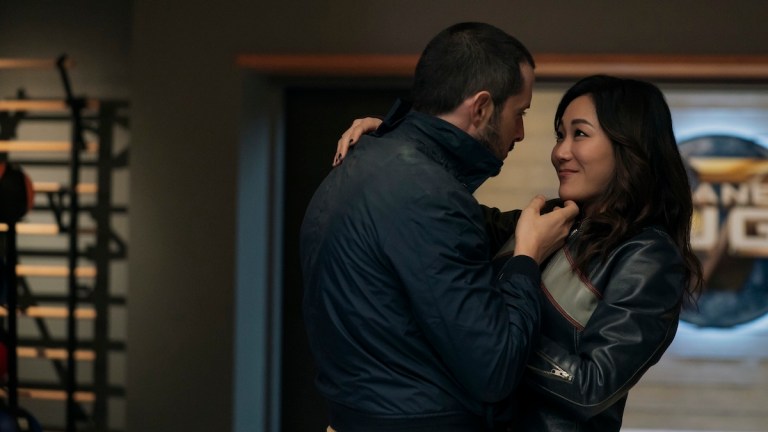
Our latest look at the same character plays very differently. In the season premiere of final season of Prime Video‘s live-action adaptation of The Boys, “Fifteen Inches of Sheer Dynamite.” Midway through the episode, we find Kimiko Miyashiro (Karen Fukuhara) kindly sharing a family treat with a young boy. She communicates with sign language and a smile. She reverts to her comic book analogue when Butcher appears in her home, all snarls and sneers. But when she reunites with Starlight, Kimiko cannot stop laughing and talking.
Kimiko’s newfound gift for gab is just the latest improvement that Eric Kripke and the live-action show has made over the comics, and it may be the most important.
While the television show The Boys is an R-rated superhero saga that peppers its satire of American power politics with gore and gross-out gags, the comic book The Boys is an exercise in unpleasantness. Ennis, never a fan of superheroes who aren’t Superman, indulges every schoolboy gag about the cape and cowl set, and Robertson brings them to life with grotesque detail.
For that reason, it’s hard to hold the series to any moral expectation. It exists to disgust and offend, and it certainly achieves those base goals. However, even by that low standard, the Female is a particularly odious figure. One of the two major female characters and the only main Asian character, the Female embodies every negative stereotype to the extreme, reducing her to an unthinking, unfeeling hunk of flesh that murders everyone who isn’t Frenchie. The series never grants her agency, outside of maiming those who offend her—and even that tends to happen on someone else’s orders.
By the time of her death in 2012’s The Boys #69, her only character progression involves her being nice to Butcher’s dog, Terror. Not even her origin story did anything to humanize her, as we learn that she was a baby in a lab who fell into a pile of discarded Compound V. In short, the comic feels that the Female has always been trash.
At first, it seemed like the television series would follow suit. Despite Fukuhara’s energetic presence, she still played the Female: brutal, inhuman, unknowable.
But over the past several seasons, the character became the exact opposite of her comic book counterpart. She gained a backstory and a family, including a brother named Kenji who stayed with her after their parents were killed. Her powers are no longer a cosmic accident, but the result of American experimentation, an extension of the imperialism that finds its fullest form in Homelander.
Her inability to speak isn’t just a sign of her lack of humanity. Rather, it’s a response to the loss of Kenji, deep-seated trauma that in fact speaks to increased vulnerability and compassion, not the absence of those feelings. Moreover, she has a name. Even though Butcher never recognizes her as such, her friends come to know her as Kimiko, and her arc across the previous seasons have shown how she finds her identity and humanity once again.
Which makes her ability to speak so important, as Kripke himself acknowledges “It felt like she’s been evolving in terms of letting go of the trauma that caused her mutism in the first place,” he told Hollywood Reporter.” And she’s been working so hard to deal with it, that it felt right to then take her to the next step, which is she does get her physical voice back.”
Kripke’s phrasing here matters. According to him, Kimiko has gotten her voice back, restored something that she once had. The Female of the comics never had a voice, and thus nothing was lost and there’s nothing to restore. That approach fits the entirety of the comic’s ethos. The characters in the comics are, at best, stock figures from the history of Marvel and DC, and therefore any “satire” that Ennis and Robertson attempt can go no further than shots at the industry.
Kripke and his co-creators have turned The Boys into a satire about American politics and the people harmed by it. For that to work, the series must have human beings in it, even if the humans are absurd and even if they sometimes die in horrible ways (see: Love Sausage being strangled by his own member in the season 5 premiere).
By getting a name and agency and a voice, Kimiko represents the humanity of The Boys, which makes the humor that much deeper and the satire that much sharper.
New episodes of The Boys stream every Wednesday on Prime Video.