A Knight of the Seven Kingdoms: House Beesbury Is REALLY Committed to the Bit
House Beesbury lives up to its name in more ways than one.

This article contains spoilers for A Knight of the Seven Kingdoms episode 6.
One of the more charming aspects of A Knight of the Seven Kingdoms is the way it depicts the Westeros that exists beyond the big Houses that most Game of Thrones fans are already familiar with. Sure, there are Targaryens and Baratheons and even a Tully or Hightower or two involved, but many of the show’s major players hail from smaller, lesser-known families we’ve never really heard of before, like House Ashford, House Hardying, and House Fossoway. (Team Raymun for life!) But none of them are as hilariously bizarre as House Beesbury, who are really invested in the theme that gives their family its name.
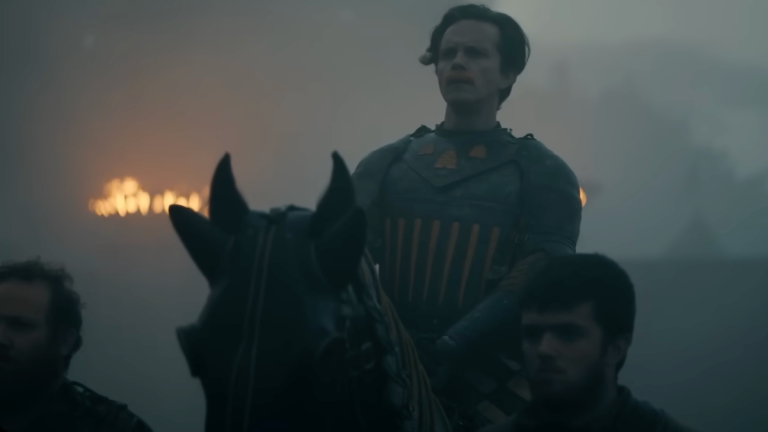
Ser Humfrey Beesbury is introduced in A Knight of the Seven Kingdom’s fourth episode, as one of the knights who agrees to fight for Dunk during his trial of seven. He’s generally nondescript in terms of the show itself, the brother by marriage of Ser Humfrey Hardying, whose leg was broken when Aerion Targaryen killed his horse while the pair were jousting. Beesbury doesn’t really get any attention (and barely any lines) in life, but what happens after his death is wildly memorable. Killed during the trial’s first charge, he gets a raucous wake in his honor during the season finale, where his coffin is displayed prominently for all the mourners to honor. It is also positively covered with bees.
The visual is cool enough in and of itself, so much so that Ser Raymun actually asks if there is some sort of “bee magic” at work. It isn’t; the effect is apparently achieved by someone slipping a queen bee into Humfrey’s coffin and causing the rest of the insects to treat it essentially as a replacement beehive. But it’s just one more example of how fully committed this family is to the creature that gives them their name and livelihood.
House Beesbury, a minor noble house from the Reach, and bees are pretty much their entire personality. Technically sworn to the Hightowers, their family seat is named Honeyholt, located next to the Honeywine river. (We can all probably guess what this area’s main export is.) Their colors are black and yellow, their sigil features three yellow beehives set vertically on a black and yellow field, and while their House motto doesn’t technically appear in George R.R. Martin’s books, several semi-canon ancillary sources insist that it is “Beware Our Sting.” Even Beesbury’s armor has beehives on it, and he’s dyed his moustache to match. Truly a baller move.
But while this all seems fairly ridiculous on the surface, House Beesbury was probably quite right to take pride in their family’s beehives. If only because it undoubtedly made them fairly rich. Much of George R.R. Martin’s vision of Westeros cribbed details from the real-life history of medieval England. And beekeeping was one of the most profitable ventures of that time period, as honey was a primary food sweetener and beeswax was one of the only (and certainly most pleasant) options available for making candles. Yes, yes, Sansa Stark’s canonical love of frosted lemon cakes hints that cane sugar somehow exists in this universe, but let’s not kid ourselves. The Beesburys were most likely doing just fine. And more families could probably stand to get on their level.