Star Trek: Starfleet Academy Writer Resolves a Deep Space Nine Mystery
Starfleet Academy's Tawny Newsome, Cirroc Lofton, and Kerrice Brooks dig into an episode that honors Star Trek's past and looks to its future.

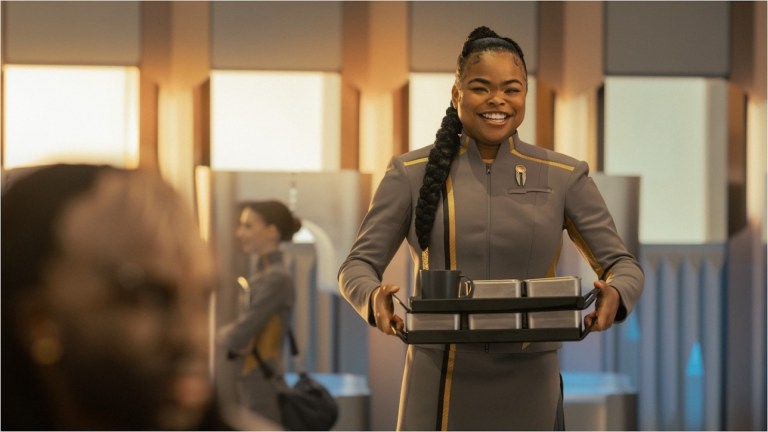
The following contains spoilers for Star Trek: Starfleet Academy episode 5.
Technically speaking, Star Trek: Starfleet Academy’s “Series Acclimation Mil” is a Sam-focused episode, an origin story of sorts for the first Kasquian student ever to attend the institution. But its traditional coming-of-age tale, in which she must figure out the sort of person (hologram?) she wants to become, is a story that looks to the past as much as the future. Old school fans will doubtless love this episode’s connections to underrated franchise gem Star Trek: Deep Space Nine, but the hour is at its best when it’s using its legacy to help define its future.
Ordered by her makers to help them better understand the lives and motivations of organics, Sam (a.k.a. Series Acclimation Mil) finds herself undertaking a research project into the life of former Starfleet captain Benjamin Sisko (Avery Brooks). His career was full of many notable achievements, but ultimately concluded in mystery, as he seemingly sacrificed himself during the series finale “What You Leave Behind.” But his spiritual form appears to live on — he wakes up in the Celestial Temple and is told his work as an emissary for the non-corporeal pantheon of beings known as The Prophets was just beginning. Determined to earn a spot in a class called “Confronting the Unexplainable,” Sam decides to solve the mystery of his disappearance, and in the process, begins to define herself. Along the way, Starfleet Academy takes a very unique opportunity to pay homage to what’s come before.
“We were just massively intentional,” co-writer (and former Star Trek: Lower Decks star) Tawny Newsome tells Den of Geek. “It’s Sam’s story, and she’s a new character from a new species of aliens that we are just introducing in canon. And we also have to honor this massive legacy character that has been largely overlooked in modern Trek and is the only reason we have characters like Michael Burnham, [Beckett] Mariner, or even Sam. That’s a huge thing. Then we are bringing back in the flesh Jake Sisko, another massive legacy character who’s been overlooked and underutilized and under-loved in my opinion. There’s so much to honor and to uphold.”
At the same time, “Series Acclimation Mil’s” is also an episode about moving Sam’s story forward.
“It was so important because Sam herself is an Emissary,” Newsome says. “She is a bridge between worlds, as Jake Sisko puts it, written by my incredible co-writer, Kirsten Beyer. She is the bridge between the Kasquians and the organics. And she didn’t necessarily choose that, but we’re seeing her rise to the challenge, and that to me so clearly mirrored what Mr. Brooks did as Sisko. He didn’t necessarily choose to be the Emissary to the Prophets, but he sure did an incredible job for them and for the Bajoran people and for his crew. It was a no-brainer that as soon as we started calling Sam an Emissary in the writer’s room, I was raising my hand like, “Ooh, oh, oh, oh, I know who we need to talk about.”
The hour’s Sisko-focused subplot doesn’t exist simply for nostalgia’s sake. It’s through her research into the captain’s life that Sam begins to understand her own agency and purpose — something that’s both true and valuable whether or not she ever truly figures out what happened to him.
“I say it in my last monologue to Sisko: I have to learn how to do things my own way,” Kerrice Brooks, who plays Sam, says. “You did things your own way. You found your own way to be an Emissary, so I guess I have to find my own way to do it too. And I think that’s what I took away from [her] trying to reach out to him.”
For Brooks, Sam’s search for Sisko is as internal a process as it is an external one. And, for her, the question of what happened to him isn’t as important as what knowing him, even in this roundabout way, has done for her own story.
“I think he responds in his own way, even though I don’t know how conscious she is of it, but in that search for him and in talking to him on her own, it’s kind of like you’re talking to the spirit. You download whatever you can receive,” Brooks says. “For Sam, it’s a matter of her opening up to receive. And the only way to open herself up is to find herself. And to find herself, she’s got to explore.”
Though the episode technically leaves the question of Sisko’s ultimate fate unanswered, the folks behind the scenes feel as though “Series Acclimation Mil” is a confirmation that the beloved character lived on past the ending we saw onscreen (and may still, in some way).
“I think Jake does tell us,” Newsome says. “As we all know, Mr. [Avery] Brooks requested at the end of Deep Space Nine to add that line saying he would come back because, as an actor, he said, ‘Don’t make me a Black man who leaves his family.’ And so we honored that by having Jake insist that, ‘Yeah, maybe I can’t prove it scientifically. Maybe it’s not in the Starfleet records. But he was there, he didn’t miss those moments.’ I think, in a way…technically we don’t answer it. But in our hearts, it’s answered for me.”
This view is bolstered by the return of Cirroc Lofton, who originally played Sisko’s son Jake on Deep Space Nine. Since Starfleet Academy is set hundreds of years after that series, his character’s presence is presented as something of a historical artifact — a presence in a museum archive, a hologram hidden within a book — that nevertheless helps Sam better understand the man his father was.
“This was an opportunity for me to revisit this character as an adult, having lived now 47 years and gone through all of these things,” Lofton says when asked about returning to the Star Trek franchise after so long away. “One thing I admire about Avery Brooks is that he was so conscious of the material and the work he did throughout our time on Deep Space Nine. He was always involved in making sure that things were accurate, that it was believable, that this is what his character would do. For example, we did an episode where Sisko went back to Vegas in the 1950s, and he was adamant that he wouldn’t be in the casino because Black people weren’t allowed in the casinos at that time. And so he always made sure to instruct, inform, and deliberate on what was going to be put on screen.”
To hear Newsome tell it, Lofton himself played a key role in how this episode came together in the first place.
“Cirroc has been a part of this episode’s creation from before it was even an outline,” she said. “It was literally just a pitch, and then I immediately took Cirroc to lunch. It might’ve broken an NDA or two, but I was like, ‘I have to make sure that I’m doing this right. I have to make sure we’re getting your blessing. We’re getting Mr. Brooks’ blessing before we even proceed.’ It was very organic. It was just a lot of us going to lunch or having a drink at a con and talking about the best way to do this, both for Jake and for Benjamin.”
As an episode, “Series Acclimation Mil,” wrestles with many of the same questions Star Trek has addressed over its 60-year run, finding new ways to express much of the same hope and optimism it always has. But for the creators who brought this story to life, it was also a labor of love, meant to honor those who have come before.
“For me, this was an opportunity to approach this creative process in the way where I actually have an input on what’s being done,” Lofton said. “It’s a deliberate way of performing. I learned that from watching Avery perform, and I finally got a chance to do the same in honoring him.”
And, for Lofton, too, the answer to the question of what happened to Sisko is clear.
“In my head canon, he was there,” he says. “And whether he appeared in visions or in dreams, he was always in communication with Jake. I felt like that was also translated in the episode as well, that he was this ever-present being that was just watching over [his son], and that’s what he feels like in my life, because he’s always been there for me, so it resonated.”
The episode ends on a philosophical note. While Brooks doesn’t appear in “Series Acclimation Mil,” despite the many references to the character he once played, his voice does. As Sam thanks whatever aspect of Sisko that may be listening to her, she hears back a snippet of something that sounds like a mission statement for much of this episode — and the larger franchise itself.
“Divine laws are simpler than human laws, which is why it takes a lifetime to be able to understand them,” a voice that is clearly Brooks’s reads. “Only love can understand them. Only love can interpret these words as they were meant to be interpreted.”
Googling this quote isn’t going to tell you much — that way leads frustration and madness, I can confirm — but it is Brooks, from an album many fans may not be aware he made. And its inclusion was very deliberate.
“The snippet is from Avery Brooks’s album that he recorded,” Lofton explains. “The album is called ‘Here,’ which is a play on words on Paul Robeson’s biography, which was called ‘Here I Stand.’ And so Avery did a jazz album, and in there is some spoken word and those words you may find in poetry, ancient poetry of someone by the name of Rumi.”
“The album isn’t widely available,” Newsome adds. “Cirroc literally had to meet me at a dumpling restaurant and handed me a physical CD that I put on my laptop and then sent to production. The whole process of bringing this episode to light was very analog, very personal, and very heartfelt. It could not have happened without literal handoffs between loved ones to make this possible.”
New episodes of Star Trek: Starfleet Academy premiere Thursdays on Paramount+, culminating with the finale on March 12.