Arco: The Most Wondrous Animated Movie of the Year Is Finally in Theaters
Arco stands apart from any other animated movie in the theater right now.

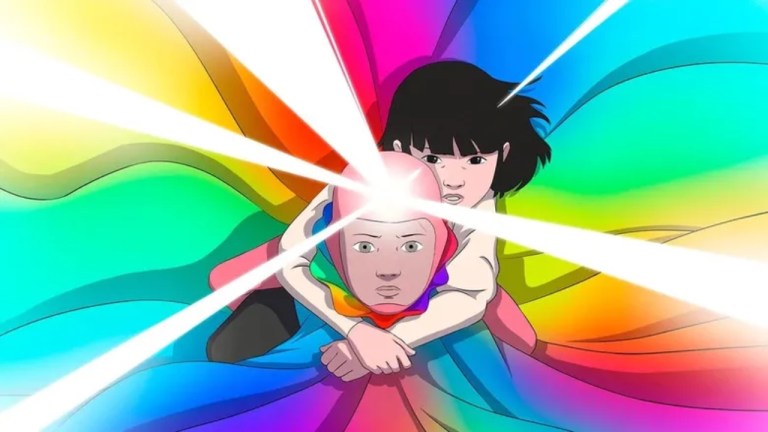
If you’re not paying close attention, you might mistake Arco , the NEON-backed animated movie that keeps being nominated for awards, including at the Oscars, for any other animated movie at the multiplex. The film features a pair of misfit kids who go on an adventure that teaches them a lesson, a couple of adults voiced by famous Marvel actors, and it even has a trio of bumbling villains voiced by famous comedians.
But outside those superficial similarities, the film has nothing in common with the usual fare that Disney and DreamWorks pump out each year. Arco is a rich, beautiful family movie, one that challenges young viewers and excites the imagination in a way that films for kids rarely do anymore… so it’s kind of a relief audiences outside of the major cities and critics groups are finally seeing it.
Flying Beyond the Ordinary
A French production being distributed in North America by NEON, Arco follows two children who meet one another across time and space. Living in the fantastical world of 2932, young Arco (Juliano Krue Valdi in the English dub) wants nothing more than to fly through time like the rest of his family, but government regulations force him to wait until he’s older.
And with good reason, as demonstrated by what happens when Arco defies the rules and goes out for a test flight in his incredible rainbow suit. He tumbles through time and space to arrive in 2075, where he befriends Iris (Romy Fay). As they hide out and look for the diamond that allows him to time travel again, Iris and Arco find themselves pursued by three odd men (voiced by Will Ferrell, Andy Samberg, and Flea), who seem to have a scientific interest in the boy.
Director Ugo Bienvenu, who developed the script from his original drawings with Félix de Givry, animates Arco in a style that most recalls Studio Ghibli anime. The fluid flying sequences and focus on wide-eyed children brings to mind classics such as My Neighbor Totoro. There’s a sketchiness to the line work and a use of shimmering landscapes that would be familiar to anyone interested in Asian animation.
But in place of the European steampunk that works its way into Hayao Miyazaki‘s stories, Arco has the retro-future aesthetics of the 1960s, ’70s, and ’80s. The flight costumes donned by Arco and his family recall the hoods and frocks worn by the humans in Beneath the Planet of the Apes or participants in the Carousel in Logan’s Run. The pointed glasses donned by the men pursuing Arco and Iris look like the futuristic eye wear devised by the creators of Star Trek: The Next Generation and Back to the Future Part II.
Animating Our Current Time
Yet when at its best, Arco feels of the moment, as opposed to either the future or the past. Iris’ neighborhood seems idyllic. She passes plenty of trees on her way to school, and it’s safe enough that she’s allowed to go out without parental supervision. When she starts feeling queasy in the middle of a lesson, the teacher does grumble for a bit, but allows her to go. Bath time for Iris and her brother is playful, as their guardian does impressions of cowboys and pirates to entertain them.
However, instead of being bathed by a parent or taught by an older person, Iris spends her time surrounded by robots. We learn later that most adults work in the city, and only come home to be with their children on the weekend. In the meantime, they either speak to the kids via virtual reality holograms, beaming blue, flickering versions of themselves into the living room, or through their blank-faced robots.
Iris’ primary robot, Mikki, looks like a smaller version of K-2SO from the Star Wars movie Rogue One and his voice often sounds like the low, machine-like rumble of most movie bots. However, when the parents (Natalie Portman, who also produces, and Mark Ruffalo) need to interact with the kids, they speak through Mikki. The result is at once uncanny and familiar to anyone who has shared intimate moments via Zoom screens and FaceTime.
Arco reflects our current reality, at once close and safe and mediated by technology. The movie makes it clear that Iris’ parents, just like the others in this reality, do care for their kids. They are involved in the lives of Iris and her brother the best they can, and they try to use what’s available to give their kids a good life. And yet, that good life requires them to submit their children to robots and to lock them behind giant glass towers, which cover each of the neighborhood houses when a threat arises in the third act.
A Different Type of Family Film
To its credit, Arco doesn’t attempt to teach the parents a lesson, ending on a false note about how grown-ups can simply drop everything and become perfect caretakers, without having to worry about jobs or their own feelings. The time-travel story does allow for Iris and Arco to have their own lessons, as the latter’s decision to fly leads to massive changes in the lives of both children. Arco‘s final act has real stakes in a way one rarely finds in modern family entertainment, bringing to mind upsetting moments from The NeverEnding Story or Time Bandits.
But that doesn’t mean that Bienvenu is interested only in traumatizing a whole new generation of kids. Even though the final part of Arco takes a surprisingly upsetting turn, there’s genuine humanity to it, one that inspires empathy among young viewers. Furthermore, it leads to a hopeful ending about struggling to make things better for later generations. That’s a theme important to any moviegoer, young or old, and one that you’ll only find in a film as rich and wonderful as Arco.
Arco is now playing in theaters across the U.S.