Ms. Marvel: Why Kamala Khan’s Powers Were Changed for TV
We spoke with the folks behind the newest Disney+ MCU series to find out why they changed Ms. Marvel's powers.

This article contains some Ms. Marvel episode 1 spoilers.
It’s no secret that changing Kamala Khan’s powers has been a big deal to Ms. Marvel fans. In the lead-up to the Disney+ show’s premiere, just about every trailer release or behind-the-scenes photo drop has been accompanied by speculation about the Jersey City hero’s power set and what changes to them mean for her story, thematically. We spoke with the executive producers/directors of the first episode Adil El Arbi and Bilall Fallah; Kamala Khan herself, Iman Vellani; and heard from the creative minds behind the show at a virtual press conference to get the scoop on Ms. Marvel’s powers.
MCU fans might not realize that Sana Amanat, one of the people who created the character of Kamala Khan to begin with, is an executive producer on the show and has been involved since the beginning. As head writer Bisha K. Ali puts it, “Having Sana around really felt like, okay, there are border lines of how we can do this and stay true to the character that’s in the comic books and that’s on that on the pages and still add something new, add a freshness.”
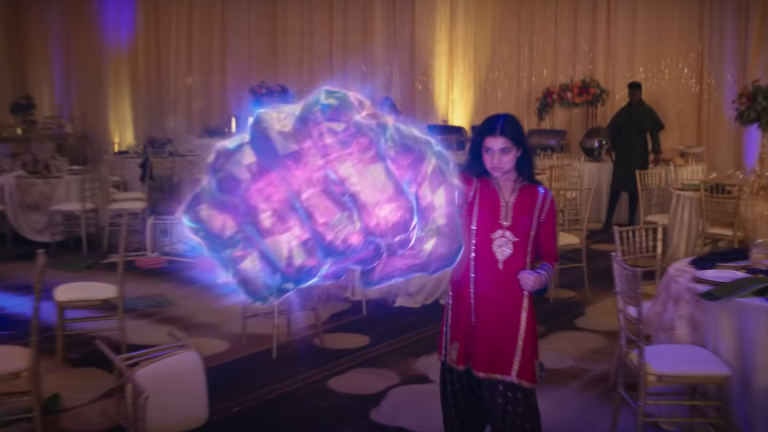
We’ve only just gotten a peek at Kamala’s abilities, seeing her put on a bangle her grandmother sent from Pakistan that triggered an ability to shoot energy made into a physical form out of her hands and feet that have been powerful enough to take on rogue AvengerCon decorations and even hold her weight, if only momentarily. There are some clear similarities between the way Kamala’s powers manifest and the other Marvels, Captain Marvel and Monica Rambeau. Their eyes have a glow when powered up and all three have been surrounded by that cosmic-looking energy.
All of this is in contrast to how things went down for Kamala Khan in the comics, where she was a polymorph inhuman: a fully shape-shifting person with Inhuman DNA, activated by Terrigen Mist. She could transform the size and shape of individual body parts as well as grow or shrink her entire body – hence the Ant-Man shout-outs – but it also sapped her of energy. During her introductory arc, Kamala physically became a carbon copy of her hero Captain Marvel, and had to go through her own journey of realizing that if she was going to help anyone, she first needed to learn to be comfortable in her own skin.
Kamala is set to be a big part of MCU Phase 4. Ali says that the team working on the show wanted to stay true to the spirit of the comics, while being mindful of how Kamala will fit in with the MCU as a whole.
“That was really a group decision talking through how she’s gonna exist in the MCU,” Ali says. “How she’s going to fit into this web of storytelling that Marvel Studios has done in live action for the last decade, and putting all those pieces together while staying true to this beautiful incredible character that Sana and her team crafted over in their publishing side.”
Adil El Arbi, an executive producer and one half of the directing duo billed as Adil & Bilall who took the reigns for the first and sixth episodes, talks about the desire to adapt Kamala Khan’s comic book powers without doing a literal translation. “It was important for them, for Marvel and also for us, to still have a connection with the essence of the comic book. So that’s why there are a lot of parallels between those two, even though visually they might be different.”
Fans should be happy to see two things in the premiere: Kamala’s limbs can grow very long, and she can embiggen her fists! For some comics fans, these were the sticking points, as they are two of her more interesting and iconic powers. However for many other readers, the themes of identity and self-acceptance are the crux of the issue, and it looks like the Ms. Marvel team is trying to incorporate those into the series in other ways, for example Kamala’s fight with her mother about dressing like Captain Marvel and Kamala lamenting that you can’t wear shalwar kameez to AvengerCon.
For El Arbi & Fallah, the bangle is a connection to “family and the family history” while their version of the stretchy powers is something of a reference to puberty and the growing pains of coming of age. El Arbi explains, “That’s why her hand is still ‘embeginning’ and you still have this awkward moment where her body’s changing, [as it’s like] a breakout on her nose.”
Vellani says she isn’t sure where Kamala ranks in comparison to the other Avengers, but the character is certainly powerful. One might think that acting out the pre-VFX version of super powers could be something of a letdown, but not for Vellani. “Basically, the way they do it is they shine a purple light at my hand if I have a scene with power, so it just feels strong and bigger.”
Even seeing the concept art at the beginning of the journey was moving for her.
“I still have all those photos on my phone,” she says. “I’m not allowed to have them, but I do. I just keep looking back at it, and it makes me very happy because it’s a girl with powers.”
One of the beauties of genre storytelling is that it can make metaphors very literal in order to speak directly to the audience in a meaningful way. While there is a loss by diverging from the comics origin storyline, within the MCU there are also gains. Here, Kamala’s bangle was handed down to her by her grandmother, reinforcing the show’s familial themes, while also making a statement that heroes can and do come from anywhere, including Pakistan.
As Sharmeen Obaid-Chinoy, the director for episodes four and five puts it, “I always believe that everyone has a superhero in them; they just have to activate it. And telling this story is going to change so much for so many people, because I know I have two young girls that when they see Kamala Khan, they too will know that they can also be a superhero.”
We hear some variation on the “anyone can be a superhero” line often enough, but Ms. Marvel is making that truth literal by proving Kamala’s lament that “It’s never the brown girl from Jersey City who saves the world” incorrect and incorporating literal activation of her powers into her story, thanks to a familial object strongly tied to her Muslim, South Asian identity.
The director El Arbi puts it another way. “She has super powers, but her real powers are the love and the care from the friends and the family.”