Dressing for Sunshine Noir in Blade Runner 2099
Costume Designer Helen Huang brings color and a fashion revolution to Blade Runner 2099.

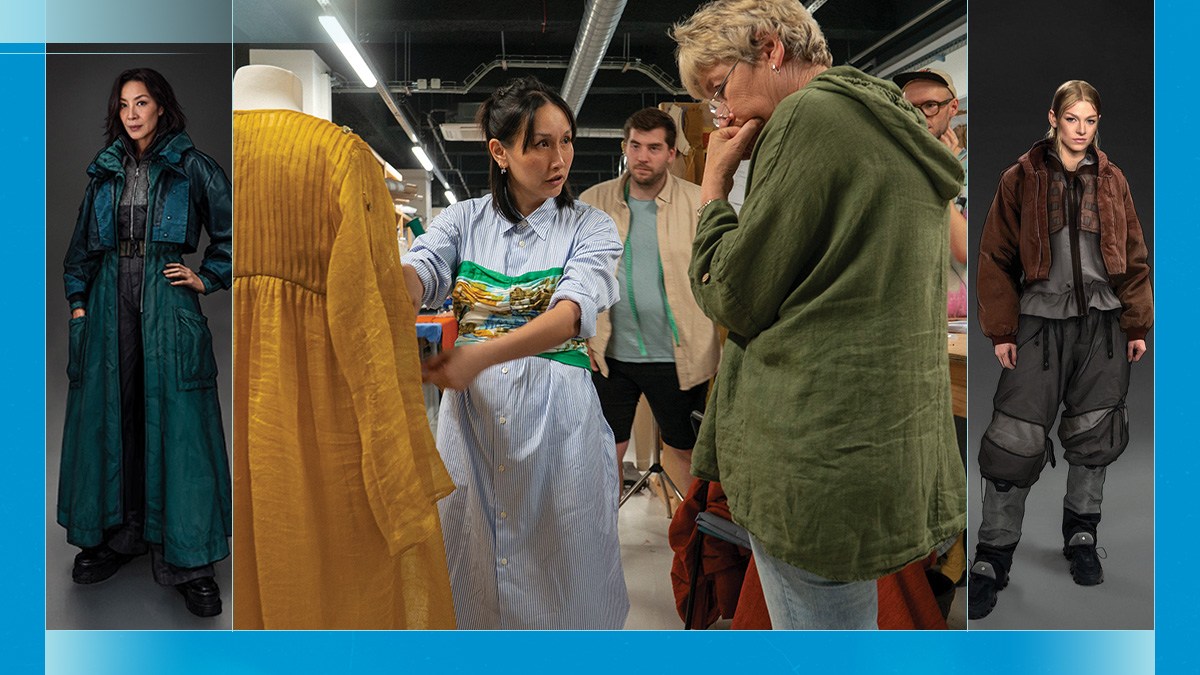
This article appears in the new issue of DEN OF GEEK magazine. Find out how you can subscribe to get the full physical copy right here!
They say you should dress for any occasion, but in the realm of science fiction, and even more so in Blade Runner, that really can mean any occasion—or time period. Often all at once. This is the challenge, and the opportunity, facing Helen Huang, the costume designer on Blade Runner 2099, who’s tasked with building off the original 1982’s iconic looks, including Harrison Ford’s Blade Runner uniform and Sean Young’s massive fur coat, and making them her own. It’s a responsibility to stay true to the source material, but also an imperative to adapt unique looks for this project’s role reversal. Replicants now rule the world and humans are the lower class. Clothing, self-expression, and consumer culture will be different in this brave new world.
So the first step in entering it? Extensive research and narrowing down what specific elements to experiment with. “I do take a look at a lot of images,” Huang tells us, “whether it’s clothes or art installations, everything that informs the overall picture.”
She describes her pitch deck for Blade Runner 2099 as nonlinear. “I talked a lot about how there are certain things that feel more human than synthetically made fabrics. Blade Runner is about finding your humanity, your soul, and with clothing, that’s being reflected; it’s really about textile exploration, and overall textile exploration for the world.”
Exploration befits this take on Blade Runner’s dystopian future. As showrunner Silka Luisa notes, unlike the rainsoaked original movie, she wanted the weather and costuming to reflect a world that’s very hot and very dry.
“I’m from Miami, and there’s something about having very volatile weather,” Luisa says. “It creates this sense of unease, because you don’t know if it’s going to rain or start downpouring, but you’re always hot and sticky, so it makes you a little crazy.” Huang built on this concept and embraced what folks on the production call “sunshine noir.”
“Silka wrote about sunshine noir, [which made me think] about color,” the designer says. Color is inherently very human, and people are extremely reactive to it, so I chose to explore that, too. Those are the things that I really wanted to use as the foundation of costume design for this project.”
Color was Huang’s main tool when it came to creating something new while keeping the project’s inherent ‘80s roots at the center.
Says Huang, “We used a lot of 1980s sportswear, we even had a Talking Heads reference. It was anything and everything from the ‘80s we referenced in the show, but in our own way. We tried to make the colors interesting.”
Inspiration was also piqued in unexpected ways while the series was shooting in Prague.
“We were really lucky, because there was a costume house in the studio and they had a lot of vintage clothing. Things as far back as World War I all the way to the ‘70s. We pulled a lot of things to look at for inspiration. I like to look at older things where the colors seem odd, or the texture seems odd, but they made perfect sense at that time.”
The Blade Runner uniform is a key costume in this universe, and in this story, it is no longer a symbol of power over replicants; instead it is now the humans living in fear of its silhouette. For Hunter Schafer’s protagonist, Cora, the uniform conceals her true identity, a representation of her need to play pretend.
“Putting on the Blade Runner uniform and feeling like it takes up more space, there was a power in it,” Schafer tells us. To Huang, that outward power is part of the deceptive appeal.
“We did want to give her a shield-like silhouette for her character,” she says. So even though she’s afraid on the inside, visually she looks very powerful and very in command of her surroundings.”
For Michelle Yeoh’s authoritative replicant, the uniform features a large, floor-length trench coat, inspired by Harrison Ford’s Deckard and his famous rainwear in the original film.
“Deckard had the trench coat; Ryan Gosling’s character in the second film also had a trench coat, so we decided to continue that for Michelle,” Huang says. “Silka really wanted those things to stay for the duration of the show because she felt like they were important to the storytelling.”
Huang also gave Yeoh her flowers when it came to the challenges of performing stunts in the attire. “When you have a long coat, it’s always hard. But Michelle is an expert, as you can imagine, in all things stunts, so she was like, ‘Give me the long coat. I’ll work it as I’m fighting.’”
It comes through in sequences where Yeoh compares the garment to a cape. “Batman, step aside!” the star muses with a wry smile.
Huang mentioned other recreations she was proud of. “We remade Roy Batty’s jacket, the famous Rachael fur coat [worn by Young], and all of her suits for a different actress. Another antagonist had J.F. Sebastian’s jacket. We remade his doublet jacket that they used in the 1980s as a flight jacket. There was a lot of referencing, but turning things into something else.”
It is about making the old seem new again and finding our future in the past. Like fashion itself, it’s an expression of being inhuman, no matter how synthetic the world outside becomes.