Blade Runner 2099: Michelle Yeoh and Hunter Schafer On Bringing Classic Sci-Fi Into the Future
Blade Runner 2099 creator and showrunner Silka Luisa and stars Michelle Yeoh, Hunter Schafer, take you inside the latest story in the sprawling sci-fi universe.

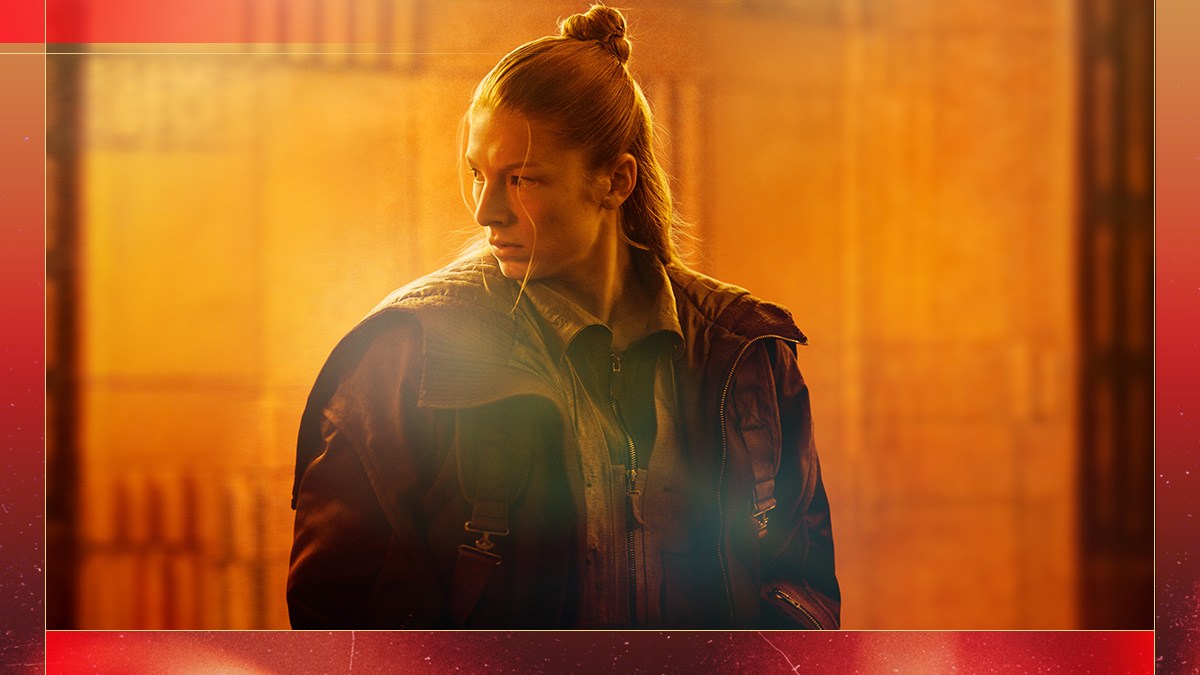
This article appears in the new issue of DEN OF GEEK magazine. Find out how you can subscribe to get the full physical copy right here!
Light blasting through twirling fans. Grime on wet streets. Electronic music tones. Trench coats. Flying spinner vehicles. Off-world colonies. “Tell me only the good things that come into your mind about your mother?”
We are definitely back in the world of Blade Runner.
The new eight-part Prime Video limited series Blade Runner 2099 tackles the double challenge of honoring Ridley Scott’s 1982 masterpiece, Blade Runner (and its many alternate cuts), while simultaneously evolving its dystopian world in ways that push the story into brave new territory. From the jump, viewers will feel instantly transported back to the moody futuristic cityscapes that defined sci-fi aesthetics for decades.
“In terms of honoring the legacy of Blade Runner, there are worldbuilding principles fundamental to how you create the look,” says Silka Luisa, the series creator and showrunner. “In order to imagine the future, you look to the past. That was an idea that we talked about within all the departments, using real-world references from all over the world outside of our era; so looking to the ‘80s, to the ‘40s, to the ‘30s, to the ‘70s, and collaging them together so that you create something that feels ‘other’ but with components that are familiar.”
Adding to that familiarity is a tone and pace set by director Jonathan van Tulleken (Shōgun), who directs episodes one and two, and cinematographer Rob Hardy (Mission: Impossible – Fallout), which announces itself in the first episode with a scene pre-dating the original film. Towers of flame flank the fortress-like Tyrell Corporation as two execs discuss the possible downsides of the Nexus-4 replicants (forerunners of the bioengineered humanoid slaves played by Rutger Hauer and company in the first film) should they rebel. The original Blade Runner features Harrison Ford’s Rick Deckard as a seemingly human cop hunting down runaway Nexus-6s who’ve gone off the reservation.
Fast-forward to 2099, and both Deckard and his replicant replacement K (Ryan Gosling) from Denis Villeneuve’s 2017 sequel Blade Runner 2049 are long past their sell-by date. In the interim, a war has been waged between humans and the artificial beings they created, with the latter coming out on top. The downsides of a replicant rebellion have become a reality.
“The big update with our series is that there’s been a complete role reversal compared to the last two movies,” explains Hunter Schafer, the Euphoria star now stepping into Blade Runner 2099 to embody Cora, a human going undercover as a replicant. “It’s creating a completely new dynamic, and I think it’s really fun and exciting to watch what replicants being in power looks like and feels like.”
Surviving humans are now made to serve, and those who do not fall in line are hunted down by replicants going under the familiar name of Blade Runners.
“They took the name that caused them the most fear, which is a really human thing to do,” says Matthew Needham, who plays a particularly vindictive replicant Blade Runner named Yahya. “It’s a triumphant thing to be the oppressed and to take the identity of your oppressor and use it for your own. I don’t think my character has much sympathy with humans. He’s got a deep-seated resentment and hatred for them. He’s on a mission to eradicate them all.”
If a show follows in the footsteps of Ford and Gosling, you need someone with comparable status as the standard bearer, and those shoes are filled by iconic Oscar-winner Michelle Yeoh (Everything Everywhere All at Once).
As Luisa notes, “You need an icon in that role because the world is so foreign. You need someone you would follow to the ends of the earth, and that is Michelle Yeoh. The role demanded incredible physicality. You had to be terrified of her. She had to feel unpredictable and stronger than humans. At the same time, her arc over the season takes her to very fragile places. Her story is a mirror of [Rutger Hauer’s replicant] Roy Batty, where in these last days, as you’re slipping away from life, your humanity becomes unlocked.”
The action movie legend plays Olwen, a replicant Blade Runner reaching the end of her lifecycle in nine days (the show’s ticking clock) while trying to uncover the mystery of another Blade Runner compatriot named Marek (Johnny Harris), who has gone mysteriously dark. To track him down, Olwen takes on a new partner in Schafer’s Cora, a resistant human disguised as a replicant in order to infiltrate the Blade Runner ranks.
“[Replicants] are now in charge,” Yeoh tells us. “It’s their time, right? And humans are obviously not giving up on humanity and are wanting to claw their way back. I think Olwen’s biggest challenge is that she’s a replicant running out of time, and Cora’s a human trying to be a replicant. Because Cora’s been running away so long, she’s lost her humanity in a way that even Olwen cannot detect anything in her anymore. The danger of being found out… can you imagine?”
If that “mole encroaching on the enemy from within” plot sounds familiar, that’s because Infernal Affairs/The Departed was one of several neo-noir touchstones Luisa and her team drew on for inspiration, alongside Donnie Brasco and Chinatown. Although the showrunner remains mum on the perennial “Deckard: replicant or human?” debate, the thin line between the two species remains a major source of both paranoia and tension throughout the eight episodes, right down to the distinguishing behavioral traits of the replicants.
“It’s a psychological thing of just moving cleaner, moving quicker,” expresses Needham. “I tried to shut down the part of my brain that cared about other people’s feelings. It’s amazing how direct you can be when you’re not worried about offending someone or how you’re going to be perceived. Physically, that adds a bluntness and extremeness without excess movement.”
“I think the idea that you can’t tell a replicant from a human is baked into the franchise,” Luisa adds. “It’s important because as an audience member, you can never really get on completely solid ground, because you never know who anyone is, and that puts you in the mindset of the characters in the show.”
This is appropriate because Blade Runner originator Philip K. Dick’s stock-in-trade was very much about asking the question, “What does it mean to be human?” The showrunner is also a longtime fan of PKD, the late sci-fi literary legend who penned the 1968 novella Do Androids Dream of Electric Sheep?, which Blade Runner is adapted from. Dick fans can also keep an eye out for easter eggs paying tribute to his work, from the photo of electric sheep in the police chief’s office to a toy robot called My Lord from the author’s short story “The Little Movement.” With help from the author’s daughter/Blade Runner 2099 executive producer Isa Dick Hackett, the show will incorporate several new elements from the source material, including a cyber cult called Mercerism.
“We excavated a lot from the novel, even more so than the films,” Luisa reveals. “Mercerism was always very interesting to me. The idea that there could be this religion that is technologically based and is somehow teaching collective empathy, even though you’re never in a room with other people. We had a really good time building that into the series.”
Actor Lewis Gribben, who plays Cora’s brother Elias adds, “There is kind of a cult element in the show through a resistance movement that we start planting the seeds for in episode three or four. We meet a mysterious character who starts turning the wheels in Elias’ head toward having his own path. You see this leadership thing start to emerge throughout the show. He loves his sister, but he knows they can’t keep running from the Blade Runners forever… he starts feeling that there’s something else out there for him. Elias and Cora start to go different ways, shall we say?”
Bebeto (Dimitri Abold), a human veteran of the war, is now a civil servant who works for the city performing the administrative function of giving out city IDs. He sends Cora undercover to infiltrate the LAPD to retrieve an item that was confiscated.
“He’s utilizing his skills,” Abold says of his character. “He sees his medical expertise as another strategy to bring about the change that he’s looking for.”
Ridley Scott once described his style of visually layered filmmaking as akin to an 88-layer cake. Blade Runner 2099 adheres to this ethos with almost fanatical dedication.
“Bebeto’s home is filled with little trinkets, gadgets, and gizmos that historically span a bunch of different ages,” says Abold, whose engraver surgery device in episode one was refashioned out of an old typewriter with added components. “They encapsulate his character, and it’s that level of detail and meticulousness that was really built into every single fabric of this production.”
Adds Needham, “For the police station, any drawer you opened was going to have something that belonged in that world. The entire set was full.”
One of Luisa’s favorite sets was not invented by the production team at all, but rather discovered while lensing in the Czech Republic: various rising/falling platforms with mounted cameras placed around futuristic Los Angeles: “Those platforms were taken from the Social Security office in Prague. That’s their filing system. They go up to the desk, and the slot comes out, and there are all these paper cards; then they fill them out and put them back in. It’s so stunning, so bureaucratic, but it’s incredibly functional. That’s how you can use real-world references and put them in this totally new context… it creates some of that Blade Runner magic.”
Another way the series recaptures that old Blade Runner magic is through the grueling stunt work the entire cast did. After all, it wouldn’t be Blade Runner without lots of cuts, bruises, and people being pushed through walls. This time around, the dynamic sees lots of camaraderie between the two leads, but that didn’t mean the fight scenes between their characters were anything short of brutal.
“I’ve done action for 30-something odd years,” Yeoh laughs. “We come with a lot of experience; you learn the hard way. I adore this young lady and didn’t want her to get hurt, because when I started watching her do stunt rehearsals, I would go, ‘Stop!’ Too late… Hunter had already hurt herself, and I’m like, ‘You actually didn’t have to do that, Hunter.’”
“How lucky was I to have her, the expert of all experts?” Schafer gushes. “She was there to give me pointers immediately, right away!”
“It was wonderful to watch someone so fearless,” adds Yeoh. “When I look at her, I remember myself when I first started. That was the right way to approach it, because that’s the only way to learn, unfortunately, but you have to do it within reasonable measures. When she took a bad knock on the head, I was like, ‘Baby helmet, put it on now.’ I made her walk around in this goofy little shark helmet.”
While the main dangling thread from Blade Runner 2049 of Deckard’s daughter Ana Stelline (Carla Juri) will not be addressed in the show, per Luisa, the showrunner says that she hopes there will be more Blade Runner movies in our future to go down those rabbit holes, preferring to make Blade Runner 2099 work as a standalone experience.
“Purely as a fan, I had a lot of those same questions,” she says. “I wanted to know where that story went. For our show, it was really important that we introduce new characters and touch on lore. There definitely are historical moments in our investigation; we wanted to create completely independent characters so it didn’t feel like you needed to have seen 2049 in order to understand the show.”
Adds Yeoh, “I think the first thing is to respect the franchise, then try your best to understand the story that’s going to be told. ‘How do you make it original yet in the same world as the iconic movies or TV series that came before us?’ My biggest thanks would be to Silka, who imagined this new Blade Runner series and gave us a good, solid premise to build on.”
Blade Runner 2099 debuts on Prime Video on November 25, 2026.