Blade Runner 2099: Exploring the Human Condition, Replicant or Otherwise
Stars Matthew Needham, Dimitri Abold, and Lewis Gribben open up about finding the human side of a synthetic future, whether they’re playing a person or a synthetic.
 | |
Blade Runner has always been about juxtapositions: what are the differences, or lack thereof, between what we call human and the glorified, fleshy machines known as replicants? To put a finer point on it, what does it mean to be human? A real boy? It’s a question that goes back to Philip K. Dick’s original science fiction story, and which has mutated in every film, anime short, and extension that has grown from there.
In Blade Runner 2099, it takes on a new, almost haunting context via the role reversal that sees replicants on top and humans as the underclass. Ostensibly, this should be a chance for replicants to do things differently, and yet by virtue of the fact characters like Michael Needham’s Yahya has himself taken up the mantle of Blade Runner—someone who hunts humans now with a title that his people once feared—suggests he is not unlike previous oppressed minorities who revel in the power, even coopting the name of their abusers.
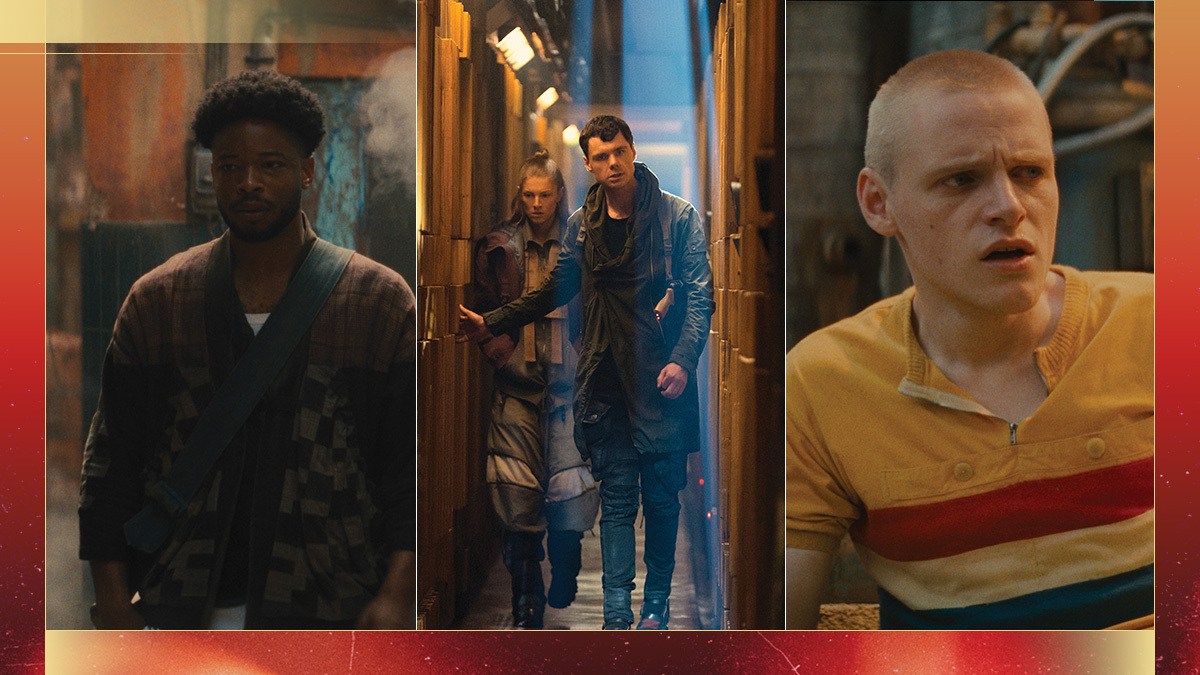
It’s a mental minefield that the entire cast of Blade Runner 2099 is navigating when we sit down with Needham, Dimitri Abold, and Lewis Gribben, two folks on the human side of the equation. Abold plays Bebeto, a human doctor and (possible) freedom fighter whilst Gribben is Elias, a true incendiary and brother to Hunter Schafer’s main character that thinks they should not wait so long for change. Below is our conversation edited for length.
Y’all play both sides of the spectrum in this series. Do you think any of your characters can sympathize with the other side, be it human or replicant?
Matthew Needham: I don’t think my character has much sympathy or any sort of positive feelings that have to do with humans. [Laughs] I think he’s got a real deep-seated resentment and hatred for them really, so no I dont think so I think he’s on a mission to eradicate them all.
Dimitri Abold: I’d have to join in with Matthew on that. I think there is too much resentment that has sort of developed through the advent of the war that humans lost against the replicant for Babeto to even consider having a good relationship with the replicants.
Lewis Gribben: Yeah basically the same. Elias has a really really bad time with the replicants. In fact, at one point, we square off. So yeah, and he does not like how they treat him or his sister. I guess there is a lot of resentment in this room with all three of us!
What first drew you into the world of Blade Runner? Was it the original 1982 movie, Philip K. Dick’s story, or something else?
DA: I was too young to watch the movie in theaters, but of course when I had the chance to watch the movie digitally, I did, as well as the Ryan Gosling movie that came out a couple of years ago from Denis Villeneuve. But I think the thing that really got me into it, if I’m gonna be honest, is that I love anime, so I actually got into Blade Runner deeply through Blade Runner: Black Lotus. It just sort of melded cyberpunk, anime, and music, and I love the director as well, so that was my entrance.
LG: Mine was also Blade Runner 2049. I saw it in cinemas when it first came out. I was blown away by the visuals of it, the distinctness of it, just the color. I found it one of Ryan Gosling’s most interesting performances; it was so muted and so held back for most of the film, which was really different from what I’d usually seen him in. So that film and the visuals of it, and then that fight that he and Harrison Ford have in the [holographic nightclub] was just so cool.
MN: I was the same. I mean I was just a big fan of the original film and it’s just such an effect on so much just outside of the film itself. It’s sort of a singular vision and it really created its own genre and I think had influence on fashion, sound, music, just the way things look, just the vibe of that film is like unmatched.
Playing a replicant seems like it could be physically taxing. How did you prepare to master the movement and fighting techniques in the series?
MN: I just kind of tried to shut down the part of my brain that cared about other people’s feelings. And it’s amazing how direct you can be when you’re not worried about offending someone or you’re not worried about how you’re going to be perceived. Physically that adds to a sort of bluntness and a cleanness, and there’s no excess movement that’s unnecessary. But I didn’t also get too hung up on moving like something that wasn’t really human. That’s what makes it interesting. They’re indistinguishable, so I think if we started moving a bit like meep meep beep beep, that’s the wrong road to go down. It’s more of a psychological thing of just moving cleaner, quicker.
You mentioned your character is still somewhat human, and to that point, the Blade Runner title was the name of his oppressors. Now he wears that title proudly, even though it’s a little bit like reclaiming the name ‘gestapo.’ How does your character reconcile what a Blade Runner was what he is now?
MN: That’s a really interesting question. I don’t know. They took the name that caused them the most fear, which is a really human thing to do—like a triumphant thing to be oppressed and to take the identity of your oppressor and use it for your own.
For Yahya, the way I saw of him is he’s an oppressed person who is now put in charge of his oppressors. And I’d love to say that if the same happened to me, I would be magnanimous and would be kind, but I don’t know if I would be. I think that’s a very relatable thing of what would you do to the people who oppressed you.
Dimitri, home seems to be a big aspect for your character Barbeto. He’s a human who says he was born in Los Angeles and he’s not leaving. How did that inform your performance?
DA: I live in a context now that is so far removed from what it used to be, from what I’d grown up in, what I was comfortable with; the place where I felt like I was safe with my family, and to see that space deteriorate over time is, firstly, heartbreaking, and secondly, you want to return to old form. Using that as the central thread for Babeto’s entire arc was my little cheating way of really getting in.
… Also, I was born in Jamaica, right? And Babeto’s character and family are very much tied to Jamaican history, Jamaican culture. And one of the things that I noticed that made me feel right at home is that the first day I came into the set, they had a pot boiling. Food was cooking, real food, and there was one pot that I was supposed to dish something out from. The pot smelled like, and also looked so much like Jamaican cornmeal porridge. I don’t know if it was planned like this, but I was like, ‘Yo, why do I feel like I’m at home right now when my mom is cooking up a nice pot of cornmeal porridge?’ … [so there is] no gap between Dimitri and Barbeto. They feel very synonymous with each other.
Your character is a doctor. Do you think when he helps Cora pass as a replicant that he views it as an act of resistance, or is he just trying to make ends meet?
DA: I’d say that if he does see it as an act of revenge or an act of protest, I don’t think that he is necessarily actively thinking of it. I think he’s utilizing the skill set he’s developed through his entire life in order to bring about the change that he wants to bring about.
Elias is so mysterious in the first two episodes, even though he is the driving force behind Korra’s journey. What is it like embodying that and not giving too much away?
LG: Elias goes through a major change even in the first two episodes: from being physically disabled to having to walk again, and always having to rely on what Cora wants to do. He just starts to feel a bit like a burden; he doesn’t feel like he has his own motivation. But it’s one of those things where [we have] a guy who changes so much throughout the show, and where he ends up is drastically different from where he started. The thing is, he loves his sister, and there’s a real core relationship there, but obviously he knows that they can’t keep running from the blade runners forever.
How do you think he’d react if he knew his sister was interacting with replicants and even living amongst them? She might even be helping them.
LG: It would be a big no for him, I think. [Laughs] I think it would be the main source of tension, and he would absolutely want to fight his sister verbally about it. He would just fundamentally disagree. It would be such a point of tension and, interestingly, the kind that develops as the show goes on.