Patrick Stewart Finally Became a Star Trek Captain in TNG’s First Great Episode
"The Measure of a Man" made Patrick Stewart into Captain Jean-Luc Picard.

The Captain has left the bridge. Patrick Stewart has died at the age of 86. With his passing comes the opportunity to remember the remarkable body of work that he left behind, including roles on the stage and screen, ranging from genre works like Dune and X-Men to stirring reinterpretations of Ebenezer Scrooge and King Claudius. But for most of us here at Den of Geek, Stewart is synonymous with Jean-Luc Picard, Captain of the USS Enterprise on Star Trek: The Next Generation.
Even after the character veered more toward action in the movies, Picard will forever be defined by his patrician presence, the impassioned and eloquent speeches he delivered about maintaining one’s duty or showing empathy for the unknown. He was an inspiring, compassionate figure, one fully distinct from his predecessor Jim Kirk and casting a shadow over Sisko, Janeway, and all who followed. And that persona did not come together until relatively late in the show, in the season two episode “The Measure of a Man.”
Unlike its predecessor, The Original Series, but very much like every series that followed, TNG did not start out strong. The first season is largely an embarrassment of reused scripts written for the abandoned TOS sequel series Star Trek: Phase II and failed ideas, such as the more feral Ferengi. Furthermore, many viewers, Trekkies and casuals alike, weren’t quick to accept a crew without Bones or Spock, and especially not a bald Englishman in the place of the dashing and toupee-wearing Jim Kirk.
The cast were not unaware of these problems. They all expressed frustration with the series and saw it as a dead end, most obviously Denise Crosby, whose character Tasha Yar dies late in the season. For his part, Stewart stayed in a hotel and kept his clothes packed during the shooting of the season, convinced that he would be fired at any second when the series was canceled. To that end, Stewart also distanced himself from the rest of the cast, who quickly developed a jovial sense of camaraderie. Stewart described himself as “a severe bastard” in his recent memoir Making It So, admitting with embarrassment that he chided his castmates for having fun.
All of this means that Star Trek: The Next Generation wasn’t Star Trek: The Next Generation in its first season. And even though the second season isn’t much better, it is better, as the cast begins to find its place. Geordi and Worf get promoted and assigned to engineering and security, respectively. Riker grows his beard. And Patrick Stewart establishes himself as the Captain Picard we know and love today.
That establishment comes with episode 9 of season 2, “The Measure of a Man,” written by Melinda M. Snodgrass and directed by Robert Scheerer. In “The Measure of a Man,” a Starfleet scientist named Bruce Maddox (Brian Brophy) arrives to study Data. An expert in the works of Data’s creator Dr. Noonien Soong, Maddox plans to disassemble Data to understand how he works, with the hopes of manufacturing more copies. When Data refuses, Maddox asserts that he is Starfleet material and not a person.
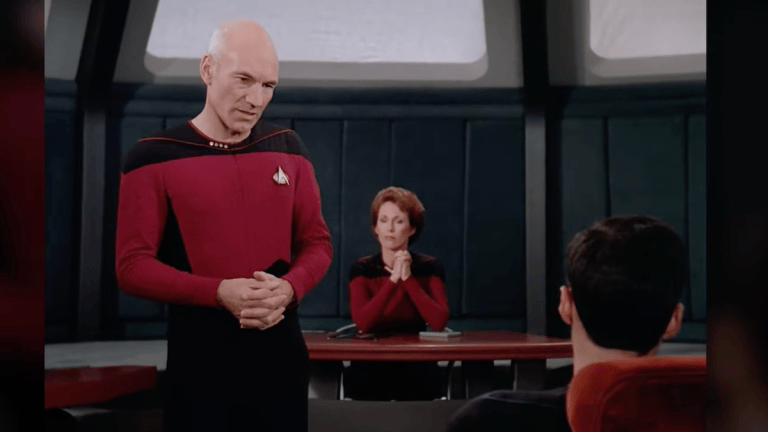
To save his crewman, Picard demands a military trial, one overseen by Captain Phillipa Louvois (Amanda McBroom), with whom he has a complicated past. While Picard takes the role of Data’s defense attorney, Louvois appoints Riker as Data’s prosecutor, and threatens him with sanctions if he does not argue to the best of his ability against his friend.
What follows is a fascinating bit of courtroom television, expanding the philosophical debates that Kirk, Spock, and McCoy would have in TOS and turning into a full-length trial. Maddox expresses his admiration for Data as a wonder of technology, Riker proves his point by pressing a button to shut off Data’s processors, and Guinan (Whoopi Goldberg) compares the dehumanization of a sentient being like Data to slavery.
Inviting Maddox to the stand as a hostile witness, Picard questions the three criteria used to establish personhood: intelligence, self-awareness, and consciousness. After proving that Data has intelligence and self-awareness, Picard runs into an issue, admitting that he doesn’t know how to measure consciousness. Rather than hide from this admission, Picard leans into it, pressing the fact that none of them there actually know how to measure consciousness. Moreover, because Maddox plans to create a thousand versions of Data, he’s effectively creating a new race. For that reason, Starfleet must be very careful when deciding on the consciousness and value of a new race.
“Your Honor, the courtroom is a crucible. In it we burn away irrelevancies until we are left with a pure product, the truth for all time,” he pleads, leaning slightly forward and softening his voice before moving into the final boom. “Your Honor, Starfleet was founded to seek out new life,” he points out, before turning toward Data and declaring, “Well, there it sits. Waiting. You wanted a chance to make law. Well, here it is. Make a good one.”
Stewart is captivating as Picard delivers the lines, shifting from a deep, resonating voice to quiet reservation. He makes his body huge while projecting his strongest arguments and pausing to give his audiences, both fictional and real, time to consider the Captain’s points.
In that scene, Stewart proves that he understands the stakes of his role. Picard’s argument doesn’t just carry on the Star Trek tradition of thoughtful, high-concept genre television. It gets to the heart of what sci-fi does so well, its contribution to the humanities, in its ability to ponder fundamental questions about the nature of humanity. Even in terrible episodes like “Code of Honor,” we all knew that Patrick Stewart was a great actor. But in “The Measure of the Man,” when he delivers that final defense, Stewart proved that he could meet and exceed the measure of a Captain.