Star Trek: Celebrating the Scene-Chewing Genius of William Shatner
William Shatner deserves respect as the ideal Star Trek actor, precisely because he's so over-the-top.

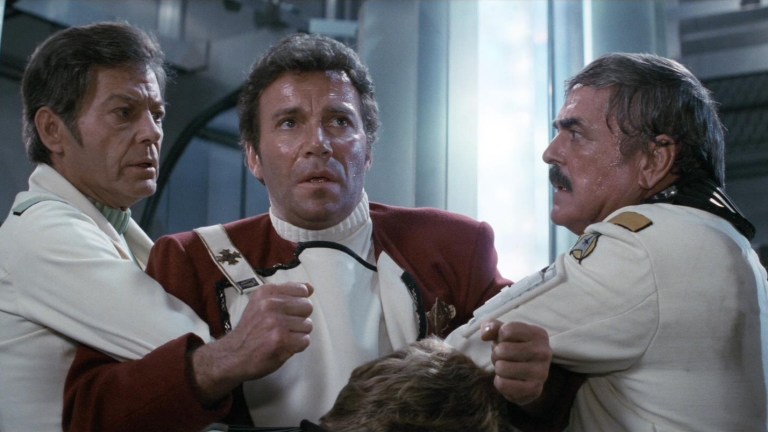
At the end of Star Trek II: The Wrath of Khan, Admiral James T. Kirk stands before the crew of the USS Enterprise to offer some words of solace on a heartbreaking occasion. Their friend, colleague, and commanding officer Spock has died, sacrificing himself to save them all. Kirk in particular has lost the person who understood him best, and fans of the franchise have lost their favorite character.
“Of all the souls I have encountered in my travels,” begins the Captain. “His was the most… human.” Kirk’s words are fitting, even the fact that he identifies the half-Vulcan as fully human, a designation the living Spock would have rejected. But its not the words that really stand out. It’s the way that William Shatner delivers those words, the preposterous pregnant pause he holds right before spitting the word “human,” the way he twists his face in anguish.
For years, moments such as these made Shatner’s acting an object of ridicule. But it’s high time that we recognize them as what they are: excellent melodramatic acting.
A Laughed-At Legend
It’s hard to say where Shatner’s reputation went sour. Certainly, people noticed and mimicked his off-beat cadences early on. See, for example, the way John Belushi milked the pauses when playing Kirk on a sketch in a 1976 episode of Saturday Night Live. Even Shatner himself seemed to play it up on various chat show appearances. But all of these seemed like extensions of the show itself, Star Trek’s tendency to prattle on about weird alien names or borrow from Shakespeare for titles such as “Dagger of the Mind.”
Yet, for those who grew up in the era of The Next Generation, Shatner seemed like the old buffoon we had to put up with before we got to the good stuff. Shatner would go on Conan and sing/talk “Common People,” or he’d show up in a spoof of Seven on the MTV Movie Awards. But surely he didn’t deserve to be taken as seriously as Jean-Luc Picard, played by properly serious dramatic actor Patrick Stewart?
Perhaps it was all of those goofy roles that diminished Shatner’s reputation. Perhaps it was his turn as the title cop in the ‘80s series TJ Hooker that did him in. Where Star Trek let Shatner monologue about humanity’s better nature and the joys of discovery, TJ Hooker asks Shatner to deliver diatribes about permissiveness corrupting society, and how the police should be given free reign to crack down on degenerates. On TJ Hooker, Shatner’s speeches felt like the boasts of a blowhard right wing talk show host, hardly engendering the same sympathies as the intrepid captain.
And so, Shatner became a joke, even among Trekkies. That is, until Kirk finally shared the screen with our beloved Captain Picard. And then, the magic of Shatner’s style could no longer be denied.
Generational Talent
Star Trek: Generations is a terrible movie. It somehow botches the lay-up of getting Malcolm McDowell to play a fanatical villain, it turns the explicitly kid-avoidant Picard into someone who longs for a Victorian family, and it lets Kirk die on a rusty bridge. It doesn’t even do justice to the central hook, teaming Kirk and Picard on an adventure.
But Generations does do exactly one thing correct: it gets out of the way and lets Shatner do his stuff.
For those who have forgotten, Star Trek: Generations involves an anomaly called the Nexus, which traps whoever enters it, but fills them with bliss. The Nexus destroys the Enterprise-B, under the command of hapless Captain Harriman (Alan Ruck), and seemingly kills Kirk in the past. But when Picard encounters the Nexus in his present, he finds Kirk apparently living out his dream, on a ranch with horses and an off-screen wife.
The story asks Picard to convince a seemingly contented Kirk to return to action and stop the villain Soran. Picard does so by using what we’ve come to know as his greatest skill, his gift of argument and oration. Yet, in the actual conflict between the two, Picard comes off stiff and uncomfortable, while Kirk seems sprightly and excited, full of life.
Take one of their first exchanges, when Picard enters Kirk’s homestead and tries to explain that he’s the captain of the future Enterprise. Stewart stumbles over his words, talking slowly in the fear that his revelations will startle his predecessor. At the same time, Shatner bounces around the room, with Kirk paying little mind to his visitor and instead taking stock of the items around him. Kirk stops when he finds a clock and realizes it was once a gift to Doctor McCoy. Shatner, of course, pauses as he delivers the line, holding his face stone still to register the shock. When Kirk snaps out of it, Shatner speaks the next lines in a rush, as if he can’t get them out quickly enough.
Were an impressionist on SNL to speak the lines in the same way, they would sound silly and ill-chosen. But in the moment that Shatner says them, they feel perfect. He knows that the occasion calls for pomp and circumstance, and he meets that moment. The meeting of two legends should be a big deal, it deserves awe and playfulness and even sanctimony—not whatever Stewart is doing.
Shatner delivers, over-delivers, the emotion the scene requires, and he does it well, because he’s been answering the call as Kirk for decades.
Boldly Going Where No Actor Has Gone Before
Part of Star Trek’s longevity owes to the fact that it covers so many tones and genres. Yes, it is absolutely an inspiring, utopian show about how humanity gets better over time and improves to explore space. It’s an adventure show that features humans punching aliens in the face, and it’s a philosophical show that sees those same humans sitting down with aliens to talk through their differences. It’s a serious show with pretentious titles, and it’s a silly show that has its doctor chase around a white rabbit to find a pair of girls in bikinis.
In short, Star Trek involves big feelings and big thoughts, and, as such, it calls for big performances. No one has answered that call as deftly and consistently as William Shatner. Laugh if you want, do goofy impressions if you want. But of all the actors in the absurd, far-out world of Star Trek, William Shatner is undoubtedly the most human.