The Greatest Gross Horror Movies Ever Made
For some horror fans, only the gnarliest stuff will do. Here are our choices for the best that the gross-out genre has to offer.

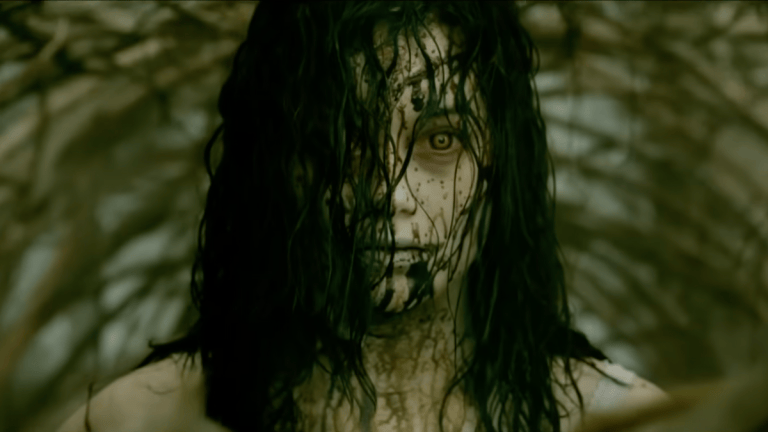
Everyone loves horror movies in October. Every year when spooky season comes around, even your timid grandma likes to put on something that makes her skin crawl at least a little. But for the weirdos who watch horror movies 12 months out of the year, October is a chance to kick it up a notch. This is the time to indulge one’s self in real stomach-churning, gross-out glory. Fortunately, there are lots to choose from, and we’ve sorted out the 10 best of the tasteless worst.
Well, sort of tasteless. Because we may be a bunch of sick freaks here, but we do have standards, so let’s set out a few ground rules. First, we’re here to have fun, not stare into the void and wonder if humanity was a mistake. So we’re going to avoid empty provocations that exist only to push buttons (e.g., The Human Centipede, A Serbian Film, and The Coffee Table). Second, we want a gross movie, but we want a good movie too. So while icky effects are the most important criterion for inclusion here, it’s not the only one. Which means that if the movie is best enjoyed as a supercut of kill scenes (looking at you, Hatchet and Terrifier), then there’s no point in its inclusion here.
With those boundaries in place, let’s get into it and start pushing them with some ooey, icky classics.
Blood Feast (1963)
And immediately, we’re pushing against our own rules by including 1963’s Blood Feast, a film that no one would seriously call “good.” But what kind of gore movie list would be complete without the Godfather of Gore, director Herschell Gordon Lewis? Lewis and screenwriter Allison Louise Downe put together the barest of narratives to justify scenes of bodies being dismembered in a way never before seen on the screen.
That story involves a detective hunting down caterer Fuad Ramses (Mal Arnold), who is killing women to make them into a blood feast that will revive the goddess Ishtar. As much as one must forgive the narrative conceits, the gore needs no apology, as the lurid imagery still shocks today, more than 60 years after Blood Feast hit theaters.
Night of the Living Dead (1968)
George A. Romero didn’t have vivid colors to work with on his first feature. Instead, the cameras he borrowed from his day jobs, shooting industrial films and episodes of Mister Rogers’ Neighborhood, captured only grainy black and white. But that was enough to make the original story about the dead rising from their graves and devouring the living into something utterly nauseating.
For most of Night of the Living Dead, the undead (the word “zombie” is never uttered in the film, in part because Romero considered his monsters “ghouls”) simply shamble around, menacingly. But as the film goes on, the gore ramps up, as when a little girl murders and devours her parents, or the ghouls feast on pieces of an unlucky couple who cooks themselves alive.
Zombi 2 (1979)
Anyone who visited a video store in the heyday of the VHS boom knows Zombi 2, by slipcover if not by name. “We are going to eat you!” declares the text on the top, accompanied by the image of a rotting face, maggots pouring from its eye-socket. The shocking picture pays off in the movie itself, and not just because we actually see that man in the film.
Zombi 2 comes from director Lucio Fulci and screenwriter Elisa Briganti, who pick up where Romero left off by documenting an undead attack on a small Caribbean island. The monster attack results in plenty of upsetting imagery, including an infamous sequence involving a splintered door and an eyeball.
From Beyond (1986)
With the exception of perhaps Frank Henenlotter, no one in the 1980s made smart, gross movies better than Stuart Gordon. A veteran of experimental theater, Gordon teamed with producer/writer Brian Yuzna and special effects legend John Carl Buechler to create movies that challenged the audience’s intellect as much as they did their stomachs.
Such is the case with Gordon’s 1986 H.P. Lovecraft adaptation From Beyond, about a team of researchers (played by Jeffrey Combs and Barbara Crampton) working under the mad Dr. Pretorius to learn about an alternate dimension. The discovery leads to a series of upsetting transformations, resulting in some gloriously goopy neon images.
Dead Alive/Braindead (1992)
To this day, when the director has devoted most of his time to restoring old film footage, it’s still shocking that respected and respectful Lord of the Rings adaptations came from Peter Jackson. Before chronicling adventures in Middle-earth or the dissolution of the Beatles, Jackson made nasty little movies in his native New Zealand, none more infamous than the film known Dead Alive in the U.S., Braindead.
Co-writing with Stephen Sinclair and Fran Walsh, Jackson uses Braindead to tell the story of Lionel Cosgrove (Timothy Balme), a young man who can’t separate himself from his domineering mother (Elizabeth Moody). Lionel’s crisis gets exacerbated by the onset of zombies, created by a disease spread by a Sumatran rat-monkey. The transformation turns victims into cruel, blood-thirsty monsters, who rip apart humans with glee, driving Lionel to take equally grisly measures.
Saw III (2006)
Now 20 years later, the torture porn fad of the 2000s seems reasonable, given the U.S.’s embrace of “enhanced interrogation” techniques, if not quaint. But at the time, detractors saw franchises such as Saw and Hostel as the end of civilization, dismissing them as little more than scenes of cruelty strung together.
Of course, anyone who has actually seen a Saw movie can tell you that the franchise actually has a preponderance of plot, laughably so. But critics aren’t wrong about the series’ infamous set-pieces. And while Saw III may not be the best overall of the films, it does have the grossest trap sequences. There is, of course, the famed trap that slowly twists an unlucky motorist into unnatural shapes. But Saw III also includes the pig guts trap, perhaps the most evil thing ever concocted by John Kramer or Hoffman or Dr. Lawrence Gordon or whoever was running things at the time.
Tokyo Gore Police (2008)
Of course, a Japanese splatter film had to make this list and, with apologies to Ichi the Killer, we had to go with Tokyo Gore Police. It has “gore” in the title! Were someone to read the synopsis of Tokyo Gore Police and, you know, not pay attention to the movie’s name, they might be forgiven for thinking it describes a standard sci-fi or even X-Men style plot. Eihi Shiina plays Ruka, a member of a special police force commissioned to fight Engineers, biomechanical warriors created by a mad scientist called the Key Man (Itsuji Itao)
However, these Engineers aren’t just superpowered beings. Their weaponry emerges from any wounds they sustain, turning them into horrific and dangerous grotesques. With her guns and katana, Ruka slices through the Engineers in gnarly fight scenes that cover the screen with sprays of blood. Director Yoshihiro Nishimura, working from a script co-written by Kengo Kaji and Sayako Nakoshi, keeps things just cartoonish enough to prevent viewers from passing out at all the mayhem.
Martyrs (2008)
To complete the trifecta of 2000s-era gross-out cinema, we have to go to Europe to include an entry from the New French Extremity. Many of these movies, such as Inside or High Tension, went for psychological torture as well as physical torture, which knock several out from contention on our list. Pascal Laugier’s Martyrs certainly has plenty of means-spiritedness. But its compelling story and icky visuals make it impossible to ignore.
Martyrs stars Mylène Jampanoï and Morjana Alaoui as Lucie Jurin and Anna Assaoui, who were tortured for a year as children. As an adult, Lucie returns to the site of her captivity to seek revenge, eventually bringing Anna along, but comes to learn about the religious fanaticism that led to their captivity.
The Evil Dead (2013)
Sam Raimi isn’t a slouch when it comes to gore. Even his latest movie, the PG-13 thriller Send Help, had way more viscera than one would expect from a studio picture starring Rachel McAdams. But when Fede Álvarez and his co-writer Rodo Sayagues wanted to strip away the comedy from the Evil Dead franchise and bring it back to its gnarly roots, he made the original Evil Dead feel like Army of Darkness.
2013’s The Evil Dead has the same basic plot as the 1981 original, with a bunch of teens (led by Jane Levy’s Mia, in this case) convening in a cabin in the woods, only to face possession after reading from a scary book. In the new version, however, the possessions drive victims to mutilate themselves with shards of glass and electric knives, building to the movie’s climactic deluge of blood.
The Sadness (2021)
Even if The Sadness didn’t release on the coat tails of a global pandemic, it would leave audiences feeling nauseated. A Taiwanese body horror film, written and directed by Canadian Rob Jabbaz, The Sadness deals with a virus that makes people indulge in their worst impulses (why, yes, Jabbaz is making the adaption of Garth Ennis‘ Crossed), leading to plenty of unsettling set-pieces.
Unlike other works with similar premises (hey, Crossed isn’t out yet), The Sadness avoids being a collection of misery scenes by focusing on Jim and Kat (Berant Zhu and Regina Lei), a couple who gets separated because the former doesn’t take the outbreak seriously. Despite the sense of doom hanging over them, Jim and Kat give The Sadness just enough humanity to ground the gross-out moments.