Mike Flanagan on Carrie White’s Place in the Stephen King Multiverse
Exclusive: Mike Flanagan talks Carrie, the TK gene, and why Stephen King doesn't get enough credit for his storytelling multiverse.

This article contains spoilers for Prime Video TV series Carrie.
Carrie White was never alone.
While the titular teenager of Stephen King‘s debut novel may have felt isolated under the burdens of high school bullies, an abusive mother, and burgeoning telekinetic powers, in reality she was but one of many experiencing those same trials and tribulations… yes, even the “telekinetic powers” bit. That’s made apparent in the pages of King’s epistolary text and it’s something that showrunner Mike Flanagan wanted to make even clearer in Carrie, Prime Video’s eight-episode modern update to Carrie White’s story.
“[King] is pretty explicit about the fact that Carrie is not unique in this ability,” Flanagan tells Den of Geek. “She’s very rare, but she’s part of a sorority of other gifted women that have this ‘TK gene,’ as King calls it. An opportunity we had that a lot of the other adaptations didn’t have was we had the real estate to really explore that. There’s a much larger world that Carrie belongs to that she doesn’t know about. And I think one of the tragedies of King’s story is she never finds out. We had a chance to change that.”
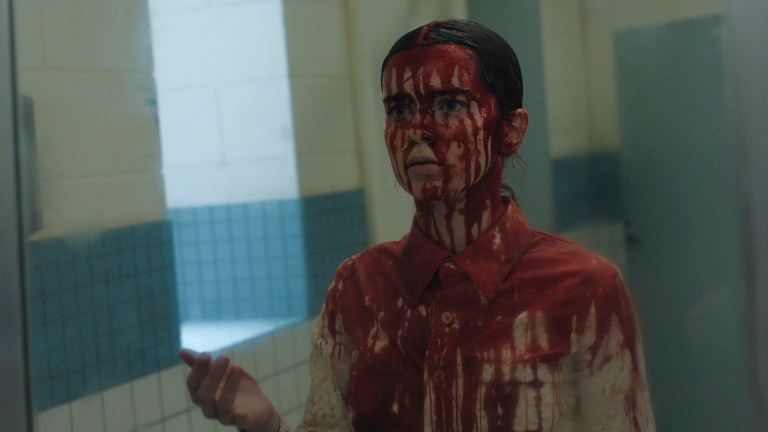
Carrie does indeed change Carrie White’s (Summer H. Howell) perception of her own world, and in grand fashion too. The series features multiple other “TK” individuals who lurk in the background of the narrative before (quite literally) bursting onto the scene of a familiar climactic prom night at Thomas Ewen Consolidated High School. Emaline West (Thalia Dudek) astral projects to the gym to encourage Carrie’s fiery revenge, eventually going so far as to get her permission to “take the wheel” of her consciousness and ratchet up the mayhem. Meanwhile members of a telekinetic cult Cara (Ruth Codd), Caitlin (Delainey Hayles), and Sable (Cassandra Naud) also arrive on scene to maximize the shadowy ambiguity of what actually happened that night. Masterminding these events is Adelaide (Kate Siegel), the leader of said cult who interviews survivors in the wake of the prom night massacre and eventually kills Carrie’s mother Margaret (Samantha Sloyan).
Even before all that violence, however, Carrie finds a creative, less explosive way to communicate the true scope of the show’s supernatural universe. Episodes two through seven of the series feature cold opens that depict supposed real life instances of women displaying telekinetic powers. These range from a woman lifting up a car in 1982 Georgia to a woman levitating in 2010 Hebei, China, to a mysterious teleporting young sleepwalker in 2015 Iowa.
According to Flanagan, these scenes were not only fun to research and shoot but they also placed Carrie in an important larger context.
“We named some real historical figures who can very easily be viewed as potentially part of Carrie’s world. That was a blast to research but it also kind of helps it on the biggest themes of the show, which is a young woman finding out the legacy of the community to which she belongs. The one thing about our Carrie is that she’s been sequestered away from any community her whole life in an effort to protect her. So getting to expand that world, it’s a very Stephen King thing to do.”
While the real life instances of suspected paranormal activity tie Carrie into our world, there’s another, arguably more important world that Carrie White needs a connection into: Stephen King’s. The horror maestro and undisputed heavyweight champion of pop culture has been playing with storytelling multiverses long before the Marvel Cinematic Universe made them a household concept, something that frequent King adaptor Flanagan believes often goes under-appreciated.
“He started [a multiverse] when he was 19 and he doesn’t get enough credit for that. It’s become the engine of so much of our pop culture – the connected universe, the multiverse. You’ve got studios falling over themselves to build a universe from scratch. King’s had one the whole time. If you grow up reading his stories, the joy of finding the connections is completely unique and wonderful.”
Carrie White does not physically appear in any further Stephen King books (which makes some sense given that she’s, you know, dead). But the tragic events of Chamberlain, Maine are referenced in multiple other King works like The Dead Zone and It. If King’s Carrie can operate as the de facto beginning for a larger storytelling universe on the page, then can Flanagan’s Carrie serve a similar function on the screen? It’s a question worth asking, especially since Flanagan has received King’s explicit blessing for this adaptation and others and has access to a lucrative overall deal with Amazon that includes some ambitious plans for King’s epic Dark Tower saga.
“[King] certainly plays with that in everything. There’s a lot of talk in The Shining about the ‘other people.’ Danny Torrance isn’t alone in that world. He meets one other in The Shining, and then the growing world of that is hinted at pretty explicitly. Doctor Sleep blows the lid off of it and then you get into The Institute and Firestarter and everything else. This felt like a really wonderful way in that extended Stephen King universe to acknowledge that too and say, Carrie only ever felt like a loner. She was never really alone.”
By the end of Carrie‘s eight episodes, Carrie counts Emaline, Adelaide, and more among her peers. Perhaps one day she’ll count Roland Deschain, Danny Torrance, and other King favorites among them too.
All eight episodes of Carrie are now available to stream on Prime Video.