Composer Bear McCreary Talks God of War, AI, and His Film Music Inspirations
As he launches a high-octane rock album, The Walking Dead and Battlestar Galactica composer reflects on his sonic career.

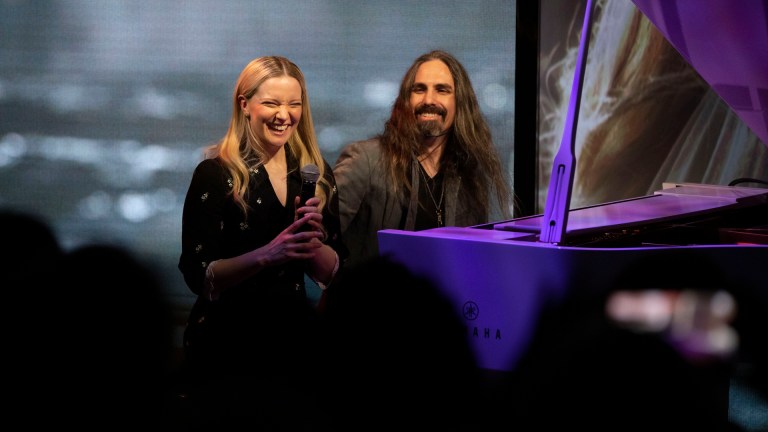
The line between the musical world and the cinematic world has always been blurry for Bear McCreary. The celebrated composer behind scores spanning a plethora of mediums has an oeuvre rich with grandeur and storytelling.
At San Diego Comic-Con 2026, McCreary sat down with Den of Geek to discuss his newest album, The Singularity: Ekleipsis, as well as his work on Prime Video’s The Lord of the Rings: The Rings of Power, his upbringing in the peak cinema scores, and more.
Den of Geek: Your music is an integral part of the worldbuilding for many of the projects that you’ve worked on. How do you go about shaping your music to kind of mirror those universes that it exists in?
Bear McCreary: The lucky thing about my job is that I get to take part in universes that already have so much detail filled out whether we’re talking about a film, a television show, a video game. So I try to find an in, something like God of War, or, I did a pirate drama called Black Sails. If there’s a historical or geographic component, well, that’s a great place to start.
Things like The Walking Dead or Battlestar Galactica, it’s more of a challenge because you could do anything. So I try to find a way to create a voice for a project, a musical voice that is memorable and stands out.
I probably learned this from my mentor Elmer Bernstein, who was my mentor for like the last 10 years of his life. One of the things he taught me was you have a few seconds to grab an audience’s attention. Now, in his experience, he’s talking about the opening logos of a film. If you go look at his opening logos and main titles for To Kill a Mockingbird, it’s this gentle little piano played by one finger as if a child is playing it. It tells you a lot about the movie you’re about to see. In Magnificent Seven, you see this vista and the magnificent orchestra blast coming in. But what I took away from that is, you only have two seconds to get someone’s attention and teach them. A lot of what I’ve done to help build musical worlds, it can be boiled down to something you hear in two seconds.
The Walking Dead main title is maybe my most famous two seconds ever written. You know the sound of a nyckelharpa in God of War, the sound of a taiko drum in Battlestar Galactica. So it’s, it’s almost like boiling it down to a haiku, like the shortest, most essential piece of information. Once you figure that out and it’s clear and it fits, then you can grow everything out of that.
I love the haiku comparison.
I gotta give credit, that one is from Rob Minkoff, director of The Lion King. Rob Minkoff, he and I did an animated movie that Mel Brooks produced called Paws of Fury. He talked about how, in animation, there’s no wasted frame. There’s no, “We’ll see what happens at the end of that take.” You only animate what you need to, and he says you’re trying to be the most efficient storyteller you can. It’s like a haiku.
That clicked. That’s not just animation. That is the art of storytelling as concisely and clearly as it can be. That’s where you put your best ideas. My agent had another way of describing it. He called it the 24-second rule. What does that mean? He’ll listen to something for 24 seconds and refuses to listen beyond. So aspiring composers send him music. He’ll literally, even if they’re in the room, stop and go, “I don’t like it.” “But you haven’t gotten to the good part!” “I don’t care. I gave you 24 seconds. That’s, as far as I’m concerned, twice as much time as you need to impress me.”
All of this is circling that same thing about being clear and direct, both with your creative partners, but also with the audience, right? Like, be clear in what you’re trying to say, and then the audience will trust that they’re in good hands.
You said in an interview pretty recently that you think very melodically. Since you were talking about storytelling, how do you bridge that gap between thinking melodically and then thinking in terms of an arc and a narrative structure?
The thing about melody is that it’s memorable, and it’s got this sticky glue-like quality. It will associate itself with things that you experience. I can listen to a song that I haven’t heard in 30 years and suddenly I’m 16-and-a-half, I just got my driver’s permit, and I’m driving down the street with the sunroof open in a car listening to that song. It’s incredible the power that music has and melody is a big part of how that works.
So you make those assignments. Look at the God of War scores. When that first was unveiled to the world in 2016, Kratos walks into the screen and you hear “bom bom bom.” To the point of almost being a joke, like, literally every time he walks in a room, I do that. I am not subtle about it, right?
It’s conditioning. That melody teaches you something about him. It sticks to him, and then you can use it in other contexts because you’ll always have all those memories. So I think that I try to be thoughtful about how I assign a melody to a certain aspect of a story.
Similarly, your work on The Rings of Power score is really, I think, pretty awesome. There’s already a lot of storytelling and a lot of feeling, especially that comes with anything associated with Tolkien in The Lord of the Rings. Was there a lot of pressure for you when you were going through that process of making that music?
The short answer is, I didn’t feel any significant increase in pressure, but only because I really just couldn’t allow myself to. It is not useful. Scoring a project is already very difficult. You need to be in a childlike state of wonder and look at this footage and think, what would 13-year-old me want from this footage?
If I added to that, “Oh, also, you’re going to be compared to one of the greatest works of cinematic writing and scoring in history, so be good like that,” I wouldn’t even get out of bed, man. I would just pull the covers over and, and shiver in the fetal position.
So, no, I just wrote the score that I wanted to write. The pressure was definitely internal. This story means a lot to me. These characters mean a lot. These magical species mean a lot to me. I want to write music for the people of Númenor, for the Harfoots, for Sauron, for Gandalf, and I want to write music that is meaningful to me, that lives up to my standard and makes me feel something. And, if I do that, I feel confident it will make other people feel something, but I have to put blinders on to the rest.
You mentioned in that answer, “13-year-old you, what would he want to hear?” If I’m doing my math right, you grew up in the ‘80s, ‘90s, correct?
Yeah, (it was) so great.
OK, good. I’m not great at math, but I try my best.
Bro, I’m February 1979. I am technically a child of the 1970s.
Well, you grew up then in a really great time for film scores and just music in general.
The best. Yeah, I know that “Old man yells at cloud,” nostalgia goggles, but I literally grew up in the greatest era of film music since sound joined film. I was born two years after Star Wars came out. So we’re already seeing that ripple effect.
Every weekend, I went to the movies. There was no internet, so I didn’t know what I would go see. I just went to the movies and I would hear new music by Jerry Goldsmith, John Williams, John Berry, Elmer Bernstein, Alan Silvestri, Danny Elfman, Basil Poledouris, Shirley Walker, John Carpenter.
I mean, even the bad movies. I went and saw The Shadow three nights in a row. Three nights in a row! And on the third night I went, “I don’t like this movie.” But it’s that Goldsmith score, because Jerry Goldsmith was like, “I see you, Danny Elfman. I got you. You do Batman. I’m going to do The Shadow, here it comes,” and it’s incredible. Incredible score. And that was what ignited my imagination. I’m sorry, did you have a question?
Yes, I know, that’s actually perfect because while you’re doing that, you also have Guns N’ Roses and a lot of huge, huge bands. And you have a rock album coming out.
Yes, ‘80s rock music.
I think that’s super interesting that you grew up in a time where there was a huge peak for film music, but then also a huge peak for rock music. So how are you bridging that together in your latest album?
It’s a great question. I definitely viewed them as the same. I was immersed in film music. I didn’t listen to pop music. I didn’t listen to rock music. As I got a little older, got into high school, it was through film and film music that I started discovering other things. I saw Highlander on VHS. And I was like, excited because of the music, because there’s a Michael Kamen score in there. Michael Kamen’s score is going to be great.
And then I go, “Wait, what’s this band Queen? These songs are pretty good.” I saw The Wall. “Wait a minute. Music can do this, rock music can do this.” I was a huge and remain a huge James Cameron fan. I saw Terminator 2, and there’s this Guns N’ Roses song in the end credits. And I go, “I’m a hop, skip, and a jump away from that song to November Rain.” I hear November Rain and I go, this is film music. This is film music. That’s what this is. It’s emotional. It’s wearing its heart on its sleeve.
I discovered that rock and metal to me sound like John Williams. It triggers the same thing. So you fast forward a couple of decades and, after I did a lot of work in film and TV, I decided to make a rock record and that first one came out in 2024 and had Slash on it. My new one that comes out on July 31 pairs up Slash with Duff McKagan from Guns N’ Roses, Chad Smith from Red Hot Chili Peppers. I’ve got Stewart Copeland from The Police. I’ve got Joe Dulantier from Gojira, Claudio Sanchez from Coheed and Cambria.
I mean, so many great cinematic rock artists Steve Vai, Tim Henson, Guthrie Govan all have guitar solos. Oh, Patrick Stump from Fall Out Boy. I can’t even stop myself. It’s so many great collaborations that got to take place, and I feel like with every one of these artists I get to explore the kind of cinematic side of their personalities.
I’m a big fan of this French metal band Gojira, and I thought when I got in touch with the lead singer, I pitched him and said, “Hey, let’s write a metal song and combine you with the National Bulgarian Women’s Choir. Does that sound like fun?” Because I also thought, “Look, if this doesn’t sound like fun, then we’re just not going to be friends, right?” If you’re like, “Bear, that sounds awful,” then we’re not a good fit. But needless to say that worked out.
So obviously you’re pretty open to new ideas and definitely through a lot of very human innovation. With the rise of generative AI, do you fear that that’s hindering where the music film industry is going in terms of scoring?
Fear is a strong word. I’m very hesitant about it. I personally have no interest in it. I can say definitively I have never seen a piece of AI footage that held my interest for more than 15-20 seconds. I think it’s detrimental to creativity. I think that the pieces of art that we remember are the ones that only a human being could have come up with.
William Friedkin looking at his [Exorcist] footage and deciding not only should tubular bells be this music but he’s going to take Lalo Schifrin’s score, one of the great composers of the ‘70s, pull it up off the tape machine and throw it in the street. Because tubular bells is what belongs in The Exorcist. No AI would have ever done that.
AI emulates his idea, right? There have been 10,000 killer shark movies (I’ve even got one coming out July 27) but with Jaws, John Williams remembered this Dvorak symphony. Spoiler alert: it starts off with a hal- step moving up in the low strings, but it’s like that was his experience, right?
So while I don’t think generative AI is a threat, I think it’s a crutch, and you don’t use a crutch unless you can’t walk, right? So for me, I am very excited to look at a drawing on the back of a napkin. I’ll listen to your poem. I’ll listen to your song that you sing into your iPhone.
Personally, I have no interest in using AI or in really even consuming it – other than recognizing it speeds up certain workflows, and I’m not naive enough to say that’s a bad thing. Peter Jackson and his team were famously involved with a piece of software called Massive for Lord of the Rings so they could generate 10,000 Orcs.
It’s the same thing, right? Nobody goes, “Well, Peter Jackson destroyed art with his Lord of the Rings film.” So obviously, there’s a gray area I recognize. I can just say, as a consumer, I’m waiting for that [AI] film that resonates with people. Haven’t seen it yet. I’m waiting for that [AI] song that really resonates with people. Hasn’t happened yet. I’m just sort of waiting.
Bear McCreary’s album The Singularity: Ekleipsis is available for purchase now on digital, CD, and vinyl. From Sept. 8 – 18, McCreary will be on a West Coast tour performing music from God of War, Battlestar Galactica, The Lord of the Rings: The Rings of Power, and his album.