Star Trek: Lower Decks’ Carol Freeman Is the Franchise’s Most Competent Captain
She may not always do it with a smile, and she may not be doing it while saving the world, but Captain Freeman did her job better than anyone else in Star Trek history.

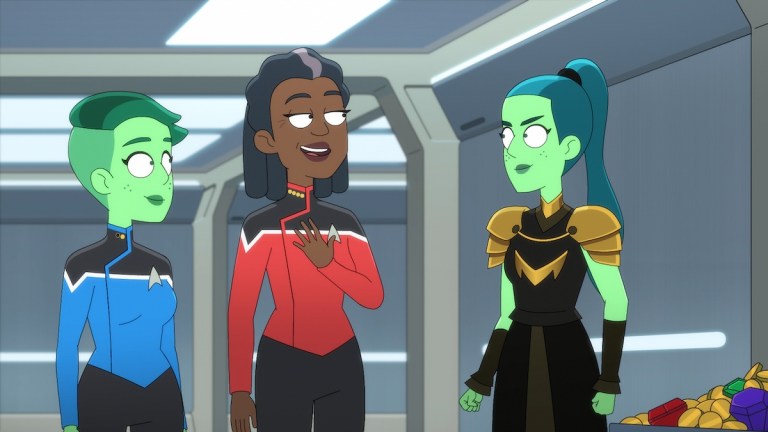
When one thinks of the canonical heroes of Star Trek, the names Kirk, Picard, Sisko, and Janeway leap to mind. Each of these captains went on fantastical adventures, inspired the loyalty of their crews, and broke Starfleet protocol more than a few times along the way. Looking at The Original Series, The Next Generation, and most other Star Trek shows, one gets the sense that being a captain is all about following your gut and trusting your instinct, even if that means you make giant messes that you’ll have to clean up later.
And that’s exactly why Carol Freeman is the greatest captain in Star Trek history. Commanding the USS Cerritos on Lower Decks, Freeman had to deal with the least glamorous missions. The biggest threats that her crew faced involved cast-offs from other shows, the hapless Pakleds or embittered Nicholas Locarno. But those low stakes just meant that Captain Freeman could spend time delegating tasks, guiding her crew, and doing the work of the United Federation of Planets… you know, the stuff Starfleet captains are actually supposed to be doing. And she did it better than anyone else.
At the beginning of Lower Decks‘ third season, Captain Freeman’s daughter Beckett Mariner embarks on a Search for Spock-style plan. At the end of season 2, Starfleet officers arrested Freeman for destroying the Pakled planet, possibly in retaliation for their attempts to kill her in earlier episodes. Convinced that her mother could do no such thing, Mariner gathers her fellow lower deckers and launch an invasion on Starfleet headquarters… only to discover Freeman herself, walking free.
How did Freeman escape without Mariner’s help? By trusting in the system. Turns out, a Starfleet investigation found Freeman innocent of all charges. Instead, they discovered that the Pakleds blew themselves up, all part of yet another scheme for power amongst the oft-squabbling people. Thus, all of Mariner’s scheming, all the classic Star Trek intrigue and adventuring she planned was unnecessary. Freeman followed the rules, and everything worked out in the end.
Which is exactly how it should be. While modern viewers, well aware of the injustice and bureaucratic blocks that exist in our current system, understand Mariner’s motivations, we also have to remember that Star Trek takes place in a utopian future. Things have gotten much better by the 24th century, and institutions like Starfleet and the Federation are beacons of civilization, not oppressive forces that require resistance. For that reason, the most heroic thing that a captain can do is to just do her job.
Which is exactly what Carol Freeman does. Throughout the five seasons of Lower Decks, she receives her orders and completes them admirably. She doesn’t always like the job handed to her, nor does she always do them with great magnanimity. Take the mission she’s given to negotiate peace with the Pakleds earlier in season 2. Freeman gets the job because she dealt with the aliens in season 1, but she takes it mostly because she hopes that pulling off the assignment will get her a promotion to a better ship. She doesn’t go about it by following her instincts, like Kirk, or by giving some grand speech, like Picard. She goes about it like a regular human, completing the task given to her.
Freeman exhibited a similar mindset in the season 5 episode “Upper Decks,” when she and the Cerritos‘ senior crew encountered the insectoid species called the Clickets. Freeman accidentally allows a Clicket disguised as a scientist to board her ship and bring him closer to the peaceful Bughoon to steal their cloaking abilities. Moreover, she initially forgets about the culture of the Clickets, despite having encountered them before. However, she does eventually remember that Clickets hate compliments, and she arms her crew with that knowledge, allowing them to fight back.
One might point to Freeman’s career-building approach to negotiating peace with the Pakleds or her getting duped by the Clicket as signs of weakness. Surely, Kirk would never allow himself to be tricked in such a way, nor would Picard treat the job so callously. But that’s because Kirk, Picard, and most of the other captains put their own ambitions and feelings and aspirations over the job itself. They were too busy valorizing the duties of Starfleet Officers or holding grudges against Klingons or talking to wormhole gods or doing whatever the heck Janeway wanted to do to think about the job itself.
But not Carol Freeman. Captain Freeman does the job, because she believes in the job. And that’s the entire point of Star Trek. Star Trek takes place in a world where humanity has matured and created institutions that better their conditions. As much as other captains say they believe those institutions, too many of their stories are about them defying those institutions and their rules (what’s the Prime Directive again?). The way those guys talk, no one should be surprised when admirals advocate for space genocide on a regular basis.
By doing her job well, but not spectacularly, by following orders, even if that means getting it wrong from time to time, Captain Freeman reveals faith in Starfleet and, by extension, faith in the future. More than any other captain, she shows that humanity can actually improve and that we can move out of our infancy, no longer acting like egoistic little adolescents who steal ships and fly them into black holes, but like people who have a job to do and do it for the good of everyone.