Lanterns Episode 7 Review: A Hal-o-Gram Adventure
Lanterns gets deep while staying fun in a magical hour of television.

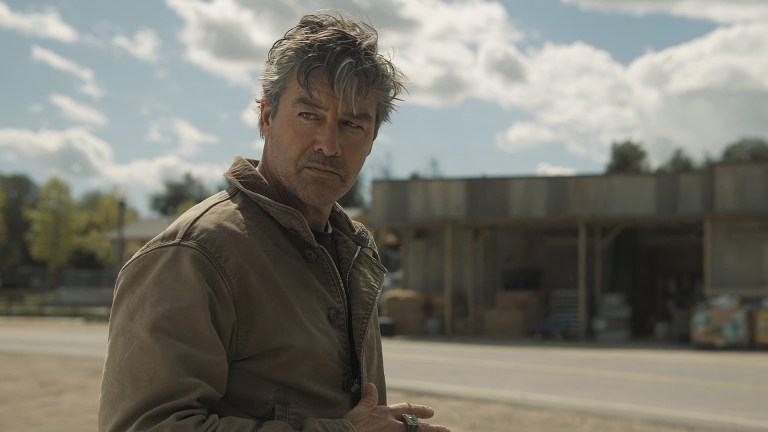
This article contains spoilers for Lanterns season 1 episode 7.
When Martin Nodell set out to create Green Lantern with Bill Finger for 1940’s All-American Comics #16, he wasn’t thinking about space cops or test pilots. He was thinking about magic. The Golden Age Green Lantern Alan Scott formed his ring and lantern from a magic meteor that slammed into the Earth, destroying the train he was on but imbuing him with power. Dressed in a flowing red shirt and a purple cape, Scott—whom Nodell wanted to name Alan Ladd, to more openly riff on Aladdin—used his wishing ring to fight crime as he saw fit, no Guardians of the Universe or Corps to get in his way.
Thus far, neither Lanterns nor the wider DCU has made reference to Alan Scott. But Lanterns does have a fair bit of magic, at least in its construction. Take the latest episode, “The Jordan Boys,” directed by Alik Sakharov and written by Damon Lindelof and Tom King. Where the previous two episodes seemed to take a downward turn and remove Hal Jordan from the equation, “The Jordan Boys” embraces the buddy cop dynamic it’s been toying with all season long, teaming the now-established, older John with the Hal-o-Gram he resurrected last episode. Moreover, it returns to the themes of legacy and fearfulness that the show has been exploring, reframing them by approaching them from Jordan’s perspective.
The preceding six episodes of Lanterns have established a clear dynamic between its leads. Hal is the cocky and charming one, the guy whose gut is never wrong, while John carries the trauma of decades of expectation. Even though we viewers recognize his actions in episode five as pretty dumb, the series treats even that as less a mistake and more an unfortunate event for which Hal took too much personal responsibility before he died. The series has spent plenty of time showing how John buckles under the weight of his parents’ expectations, particularly in light of the shame surrounding his father’s moment of fear, but Jordan hasn’t received the same examination.
Right off the bat, “The Jordan Boys” works to address that admission and restructure the show. We open in 1975, where a young Hal (Henry Samiri) has angered his baseball coach by refusing to give up his pitching position amidst a no-hitter. His father Martin (Jake B. Miller) arrives to back up his son by fighting with the coach, and then taking him to an airfield to share a few life lessons. Although slightly overcooked (that coach is way too angry, even by the standards of television depictions of ’70s gym teachers), the scene elegantly demonstrates how Hal inherited the charms and struggles of his father. Furthermore, Hal inherited the ability to use the former to hide the latter.
As the Hal-o-Gram travels through Rushville with John and realizes the foibles of his older self, that lesson becomes increasingly clear. It leads to the revelation that Hal makes late in the episode, after John has already been exposed to the fear toxin that killed Antaan’s people. Not only does Hal admit that Martin committed suicide, but that his lack of fear is in fact a deep-seated terror that he too will succumb to the legacy left by the men in his life.
Put another way, Hal recognizes that what people understand as heroic bravery is in fact cowardice on a profound level, one that refuses to acknowledge desperate vulnerabilities. That revelation pairs with the way the show has been building John’s fearlessness, the result of trauma that his father passed on to atone for a moment of human vulnerability. The series understands bravery as a refusal to acknowledge what makes us afraid, not an overcoming of it, and shows how men in particular destroy themselves as a result.
“The Jordan Boys” unfolds makes this point while still telling an entertaining sci-fi story. Not everything works; the Maggie subplot still hasn’t justified its existence and the “hat ceremony” story works only as a rejoinder to Hal and John’s paternal legacies, not as a plot point in its own right.
But everything else in the episode entertains, despite the heavy subject matter. Kelly Macdonald would not be the first actor who leaps to mind when casting the daughter of a Gotham criminal who becomes a no-nonsense small-town sheriff, but she threads the needle between warmth and openness and toughness (when needed). Seeing her response to the Hal-o-Gram should convince viewers that Kerry and Hal had a proper romance, something mentioned but not really proven in the previous episode.
Even better is the space-faring adventure that closes the episode. The planet itself looks a little underdeveloped, even for a landscape after an android genocide, but the concept of traveling across space and time to a mysterious purple factory on a strange island warms the hearts of anyone who loved part three of Twin Peaks: The Return. That’s especially true when Sinestro turned up, paying off hopes that he’d be more than a Hannibal Lecter surrogate. Ulrich Thomsen has certainly made an impression with his limited screen time, but can he sustain that level of menace in the finale?
At this point, I wouldn’t bet against Lanterns. One wobbly episode aside, the series has been consistently surprising and compelling, even as it heads into the finale. Given everything tricky about selling Green Lantern lore to a mass audience, and given the complaints that surrounded the marketing around the show, the excellence of Lanterns has been nothing short of magical.
Lanterns airs new episodes every Sunday at 9pm EST on HBO and HBO Max.
Green Lantern Illuminations
- As with John, Lanterns rewrites Hal Jordan’s family history. In the comics, Hal had two brothers, Jim and Jack, who regularly show up to bust his chops and partake in his adventures. Eventually, they get killed while Hal was the Spectre, an upsetting ending to what was a charming part of Green Lantern comics.
- The idea of Hal killing himself isn’t entirely new to Green Lantern, at least not when Tom King is involved. In a chilling scene from Batman #45 (2018), penciled by Tony S. Daniel, we see an alternate reality in which a Joker-infected Jordan uses his ring to shoot himself in the head.
- I’ve been praising this show for its deep-cut Silver Age pulls, but even I was shocked to see the black hole transportation device used to visit the Anti-Matter Universe way back in 1960’s Green Lantern #2 by John Broome and Gil Kane. In early comics, Hal would use that hole to get to Qward, the planet where the Weaponeers made Sinestro’s yellow ring. So does that mean that they’re on Qward? And that Antaan is a Weaponeer, and not someone from Sector 666? Given Sinestro’s arrival at the end, it would make a lot of sense.