How Coyote vs. Acme Became a Real-Life David vs. Goliath Hollywood Saga
Exclusive: Director Dave Green takes us inside the Acme vault to reveal the story of a movie they didn't want you to see. Let the court now recognize Coyote vs. Acme...

This article appears in the new issue of DEN OF GEEK magazine. Find out how you can subscribe to get the full physical copy right here!
Sitting in a darkened room, talking to director Dave Green about a movie we never thought we’d see, and he never thought anyone could see, is a surreal thing. That goes double for the folks who worked on Coyote vs. Acme. “It’s an absolute miracle,” Green shares. “We honestly have the fans and every single person in the world who spoke up on behalf of the movie to thank.”
Green is referring to the strange irony of how Coyote vs. Acme became a Hollywood legend in only a handful of years. It’s the movie that was apparently so amazing, so groundbreaking, that, due to real-life industry situations that mirror the film, it almost didn’t get released. And its escape from a fate in a deep, dank Warner Bros. vault occurred only because of public support and passionate testimonials from filmmakers and Hollywood insiders who were able to see the film—and their own industry reflected back in it.
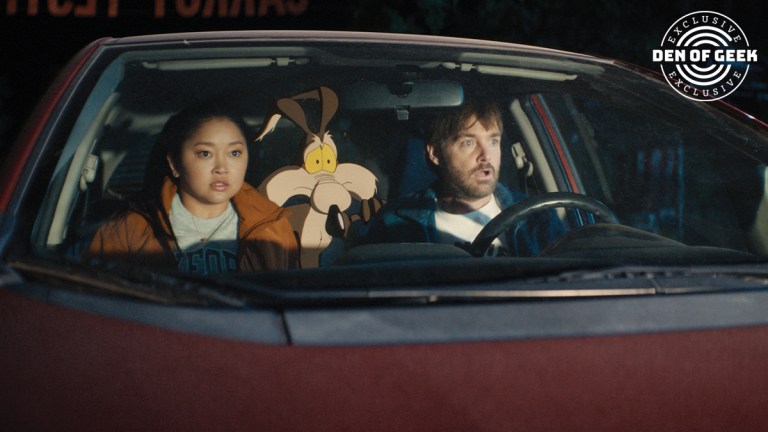
Telling the story of a David vs. Goliath legal battle, Coyote vs. Acme is inspired by the satirical 1990 New Yorker article of the same name that producer James Gunn (yes, that one) discovered years ago and has been trying to adapt ever since. When the titular Wile E. Coyote decides to sue Acme for their years of dodgy products, he and local billboard attorney Kevin Avery (Will Forte) and his eager, idealistic assistant/niece Paige Avery (Lana Condor) uncover a shocking conspiracy that goes all the way to the top. Just like Who Framed Roger Rabbit? before it, the film balances live-action performances with fully animated characters in a beautiful dance that instantly takes you back to the feeling of being an awe-inspired child at the movie theater.
“Roger Rabbit is the gold standard. It’s a masterpiece. So we don’t take it for granted anytime someone mentions us in the same sentence,” Green says.
The movie feels like the sort that doesn’t get made anymore, and that’s something Green and his collaborators instantly recognized.
“When I first started showing the movie to filmmaker friends, they would tell me, ‘I can’t believe you got away with this. I can’t believe you got away with making a Looney Tunes movie that is also a courtroom thriller; it feels like you robbed the bank!’” Green laughs. It wasn’t just Roger Rabbit’s game-changing combo of animation and live action that inspired the film, however.
“I think the thing that made Roger Rabbit so special was those counterweights of tone. It was very stupid, and it was very serious,” Green observes. “It was the noir universe of that movie that grounded all of the cartoon antics. So in the earliest days of putting this movie together, that was a tonal north star: How can we take this very silly idea, which is Wile E. Coyote suing Acme, and ground it in a reality and give it emotion?”
Luckily, that was all in the source material. The New Yorker article by Ian Frazier was a fictional court report of Wile E. Coyote’s legal filings against Acme. But how do you adapt an article into an epic animated legal dramedy that also features cartoon characters?
“I think the goal and the challenge at the same time was keeping the flame alive from what made the original stuff so special, and Ian Frazier really picked up on the subversiveness and the intelligence of what made Looney Tunes work,” explains the director. “Looney Tunes was always the subversive, wicked stepchild to Silly Symphonies and what Disney was doing. It was punk. It was making jokes on moments in pop culture in the ‘40s, and that was something Disney would never do. It was like the original Simpsons of its time.”
Green and the team were inspired not only by that history and Frazier’s article but also all the other incredible creatives who have shaped the cartoons over their many decades on screen.
Says the filmmaker, “As one of many custodians of the IP and the brand—and there will be many more, I hope—my goal was to try to foster an environment that was filled with as many people who understood that ethos, that sense of humor, that irreverence, that sarcasm, and that outlook that made Looney Tunes work since the beginning.” That included finding a leading man who can play both the seriousness of the legal drama and corporate nightmare, and the comedy of starring alongside the Looney Tunes’ most famous fall guy.
That man was Will Forte.
“Will is a brilliant comedic talent; he can make anything he says hilarious, he is so honest and straightforward,” Green marvels. “I think what was really important to us in the casting process was finding someone who had honesty and earnestness, and was also not ever going to be saccharine. What is brilliant about Will is he’s able to play Kevin Avery in a way that makes his shagginess and his laziness affable and likable. He’s not a cold, dismissive cynic in any way. He also, as a writer and performer, constantly understands how every single comedic beat is supposed to work, and from take to take can just give you so many detailed colors and adjustments and changes that you are just overburdened with great choices.”
The film is also filled with easter eggs and deep cuts from the immense archive of WB animation, something that was another delicate balance for the filmmakers. “I think from the beginning we were kind of allergic to jumping on pop culture trends from now, if that makes sense,” Green says. Even so, the film does reflect our current timeline while still having some blasts from the past, including a very cool riff on Peter Lorre. That makes sense, though, as Lorre himself made a huge impact on Green as a child.
“I became aware of animated Peter Lorre before I even knew who real Peter Lorre was,” says the director. “Like I was just a ‘90s baby watching Tiny Toons, Pinky and the Brain, and Looney Tunes shorts. But you start to see this character who speaks kind of weird and think ‘who is that guy?’ And I just thought he was an animated character at first, and then learned that he was a real actor and a real weird guy.”
If Coyote vs. Acme hits as hard as we hope it will, it’ll also likely be some other kid’s introduction to Peter Lorre and the wild history of Hollywood animation! That’s miracle work.
Coyote vs. Acme opens Aug. 28.