Backrooms Kids: Now’s the Time to Watch Twin Peaks
Follow the Backrooms into the Black Lodge.

This article contains light spoilers for Backrooms.
For everything that Backrooms does right, there is one accolade that doesn’t quite fit. No, Backrooms may not be based on a major IP, but it isn’t entirely accurate to say that it’s an original film, owing as it does to not just director Kane Parson’s YouTube videos, but also to the creepypasta 4chan and Reddit posts that made liminal spaces into a legitimate horror genre.
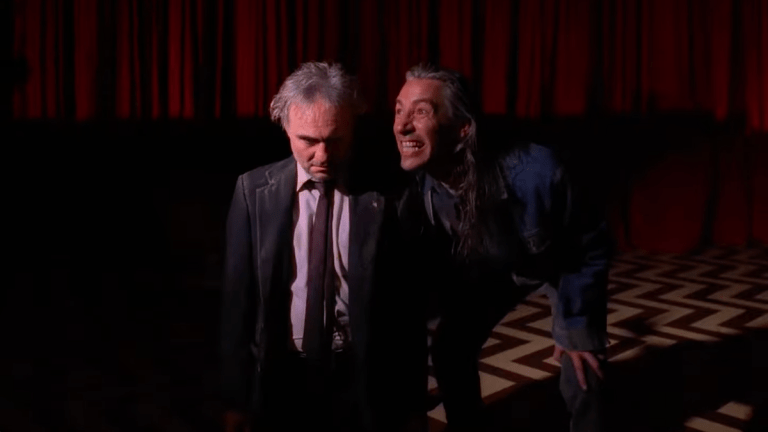
For Parsons, the debt goes back even deeper. Speaking to Collider about the influence of David Lynch on his work, Parsons revealed that after his parents’ separation, his father “decorated the entirety of the interior of this space in the house he was renting with those red curtains [and] the zigzag carpet [from] Twin Peaks.” Parsons goes on to downplay the influence of Lynch on his work, calling the space “the dreamscape sort of environment” instead of the Black Lodge and dismissing the experience of anecdotal, the connection is there.
And that’s good for people who grew up watching Parsons’ videos, because it means that it’s time for Backrooms fans to check out Twin Peaks.
Entering the Black Lodge
Even if you have never seen the series, you probably know what Parsons means when he talks about his dad’s place. A room with thick red curtains, zigzag walls, and a small man who speaks backwards and does a dance. The imagery has been repeated and homaged time and again (perhaps Parsons fans best know it from an episode of Scooby-Doo! Mystery Incorporated).
The specific name of that space changes over the course of Twin Peaks‘s three seasons, two aired between 1990 and 1991 and a revival series in 2017, and the 1992 prequel movie Twin Peaks: Fire Walk With Me. Generally, however, it’s called the Black Lodge, an ethereal space that FBI Special Agent Dale Cooper (Kyle MacLachlan) visits while investigating the murder of high school sweetheart Laura Palmer (Sheryl Lee).
That last point cannot be understated for those coming to Twin Peaks for the first time. While the surreal imagery of the Black Lodge absolutely matters, it is not the driving focus of the show, especially in its original seasons. Instead, the series is about the investigation into Laura Palmer’s death.
The show begins with kindly Pete Martell (Jack Nance) discovering the body of Laura Palmer, wrapped in plastic. A homecoming queen beloved for her acts of service, Laura’s death affects everyone in the town, from Sheriff Truman (Michael Ontkean) and his deputies Hawk (Michael Horse) and Andy (Harry Goaz), to workers at the lumber mill owned by Josie Packard (Joan Chen) and operated by Pete’s wife Catherine (Piper Laurie), to Laura’s main boyfriend Bobby (Dana Ashbrook) and secret boyfriend James (James Marshall). Hit worst of all are Laura’s parents, Leland (Ray Wise) and Sarah (Grace Zabriskie).
Eventually, the FBI gets involved in the case, sending Agent Cooper to investigate. A clean-cut G-man with indefatigable optimism, Cooper combines traditional detective work with more surreal techniques, including using dream logic. As he and Truman work together to uncover the clues, they discover a deep sadness and strangeness in the small town, leading to moments of comedy, soap operatic romance, character-driven drama, and sublime horror.
A Place Both Wonderful and Strange
Those conflicting qualities are both the chief appeal and greatest stumbling block for people coming to Twin Peaks. Anyone new to the show in 2026 probably knows about the Black Lodge and its imagery. But they may not realize how soapy and silly the show gets. Created by Lynch and Mark Frost, a veteran TV writer, Twin Peaks was originally a network television show as it was a weird horror series.
Sometimes, that means it parodies soap opera tropes, as seen with the fake TV show “Invitation to Love” that the townspeople watch. Sometimes, it plays the cheesy stuff straight, as when James sings a corny love song with Laura’s best friend Donna (Lara Flynn Boyle) and Laura’s cousin Maddy (also portrayed by Lee). The series features some horrific images of the supernatural evil Bob (Frank Silva) menacing the camera, but also gives space for Deputy Andy to do a silly walk after being bumped in the head.
Network TV problems famously dogged the original seasons of Twin Peaks, with ABC forcing Lynch and Frost to reveal Laura’s killer early in season 2 and driving the creators away. Without Lynch and Frost driving things, the series becomes a parody of itself, all cooky characters with none of the depth.
Lynch does return for an absolutely mesmerizing final episode of the original series, and he makes the prequel movie Fire Walk With Me without Frost. The story of the final week in the life of Laura Palmer, Fire Walk With Me alienated fans and critics at the time, as it eschewed all the wackiness of the show to take seriously a teen girl’s rape and murder.
Today, the movie is recognized as a classic, especially after the 2017 revival series, completely made by Lynch and Frost. Twin Peaks: The Return does indeed do what you’d expect from a revival show, bringing back most of the main cast and finishing dangling plot lines from the original show, including the disappearance of Agent Cooper and various romantic entanglements. But it does so by frustrating expectations, leaving major characters off screen for long stretches and replacing them with weirdos that many viewers neither expected nor wanted.
However, that approach allowed Lynch and Frost to create a powerful work about aging and nostalgia. Twin Peaks: The Return is in no hurry for Cooper to finish his long, circuitous journey back to Twin Peaks, and all of the digressions explore concepts of identity and expectation. The sometimes glacial pace forces viewers to think about what they expected and remembered, and how those expectations can make us miss something beautiful or terrifying.
Before the Backrooms
So why should Backrooms fans check out Twin Peaks? The most obvious answer is the thing that Parsons identifies, the Black Lodge. The Black Lodge is a liminal space, a weird non-reality that people visit through cracks in reality, where they deal with inverted doppelgängers and upsetting deviations from the real world. The doors in the furniture store, the misshapen figures in the hallways, even the confused scientists all are of a piece with Twin Peaks.
However, Twin Peaks goes further to deal with themes that Backrooms only touches upon. Backrooms protagonists Clark (Chiwetel Ejiofor) and Mary(Renate Reinsve) are indeed stuck in their memories and expectations, which get visualized in the terrors of the backrooms. But as evocative as the images are, Parsons and screenwriter Will Soodik too often rely on characters declaring their themes and feelings. Whatever the film has to say about memory and trauma, it says so loudly and thinly.
That’s not the case with Twin Peaks. Cheesy as it can sometimes be, with Agent Cooper gushing about damn good coffee or two longtime unrequited lovers finally coming together in The Return, Twin Peaks understands that small acts of kindness and cruelty have cosmic reverberation, coming back to us in forms that are sometimes unspeakably beautiful and sometimes sublimely terrifying. Moreover, The Return in particular knows that memories can be as debilitating as they are comforting, and can open the door for something horrible.
Again, Backrooms does touch on these themes. But for those who were compelled by the way an up-and-comer tackled those ideas and want to see what a cinematic great can do with them, it’s time to enter the Black Lodge and watch Twin Peaks.
Backrooms is now playing in theaters worldwide. Twin Peaks is streaming on Paramount+.