Avengers: Doomsday is Getting One Thing Right About Doctor Doom (But Maybe Only One Thing)
Doom is a Gothic villain, but Doom does not need a relatable backstory.

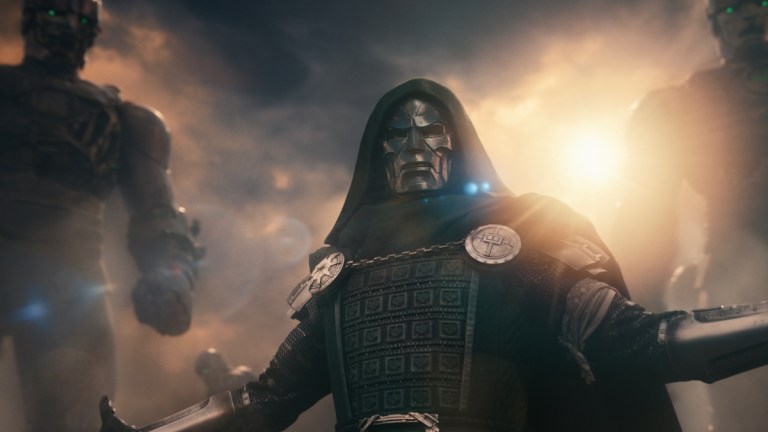
How do you solve a problem like Victor Von Doom? Don’t ask the producers of the previous two live-action outings of Doctor Doom. The 2005 Fantastic Four movie and its 2007 sequel asked the late Julian McMahon to stay in Nip/Tuck mode, playing Doom as a petulant rich kid running a Fortune 500 company. The 2015 film was even worse, casting Toby Kebbell as Doom a pouty computer nerd who later developed the power to make people’s heads explode. This is a guy who speaks in the third person and wears a green tunic over his metallic armor, a master of the scientific and mystic arts. So why is everyone trying to make him realistic?
Thankfully, Joe and Anthony Russo don’t seem to be taking that direction for Robert Downey Jr.‘s version of Doom in Avengers: Doomsday. “Doom is a Gothic character,” Joe Russo told Empire Magazine, describing him as someone who’s “not above selling his soul to get what he wants.” But as much as it sounds like the Russos are finally doing right by Doom, they then go onto self report a fundamental mistake about the character.
First, let’s talk about what they get right: Doctor Doom is absolutely a Gothic character. Since his first appearance in 1962’s Fantastic Four #5, by Jack Kirby and Stan Lee, Doom has gone over-the-top. In that first story, Doom’s plot involved sending the FF back to the 18th century, where the Thing becomes the new Blackbeard the Pirate.
Modern incarnations of the character have fleshed him out, but never backed away from his over-the-top audacity. In the 2003 Fantastic Four arc, Unthinkable, by Mark Waid and Mike Wieringo, Doom sells the soul of his beloved Valeria to the devil, so he can gain the power to destroy the FF for good. In 2015’s Secret Wars, by Jonathan Hickman and Esad Ribić, Doom makes himself into the God Emperor of a Marvel Universe that he rebuilt in his image. He conquered the planet in last year’s One World Under Doom, by Ryan North and R. B. Silva, and he became the King of Hell in the recent Captain America comics by Chip Zdarsky and Valerio Schiti.
Simply put, Doom is imperious and ambitious, to a degree that would be absurd if he didn’t take it all so deadly seriously, resulting in a character who is thrillingly operatic. According to most versions of his origin, Doom was the son of Romani peasants living in Latveria. Made arrogant by his scientific genius, Doom went to America, where he studied alongside Reed Richards. So bold was Doom that he refused to listen when Reed pointed out an error in the calculations used for a device he built, and when the machine exploded, he blamed Reed and not himself for the failure.
That explosion did something to Doom’s face. It may have completely disfigured him, or it may have left a small scar. But that was enough for Doom to hide his face forever behind steel when he returned to Latveria and began studying magic. Having mastered both magic and science, Doom overthrew the Latverian government and established himself as a benevolent dictator, loved by his people and overseeing a functioning country. So successful is Latveria, and so prideful is Doom, that he has tried to conquer the world time and again, not because of a mere lust for power, but because he believes that the would genuinely benefit from his rule.
Obviously, Doom is not a snarky CEO or a snotty computer genius as he’s been portrayed before. Thus, Anthony Russo was correct when he told Empire, “Doom is much more ego-driven than Thanos, [because] Thanos believed he was serving a greater good.” Doom serves only himself, which he believes is better for everyone else.
But in that same interview, the Russos reveal something about their version of Doom that clangs with depictions we’ve seen elsewhere. As Sue Storm explains in the most recent trailer for Doomsday, the MCU Doom used to be a good, kind man, but he has been driven mad by the loss of his family. Joe Russo doubles down on that interpretation while talking to Empire, calling Doom “a father who’s a victim of trauma. He has lost a child.”
In reality, we understand that the loss of a child could drive one to make terrible decisions. That’s a grounded, believable motivation, one that we regular people can understand. But Doom isn’t regular people and his motivations shouldn’t be understandable. In the comics, Doom’s entire turn toward villainy came because he was too arrogant to accept that Reed Richards did math better than him one time in college. Since then, he’s become a dictator and a god and the rule of Hell all because he can’t get over that fact.
So as much as the Russos correctly identify the scariness of Doom, one can’t help but fear that they’re still not quite getting what makes him the best villain in all of fiction. One cannot help but worry that they’re repeating the mistake they already made with Baron Zemo in Captain America: Civil War, taking a flamboyant and cartoonish baddie and making him into another sad family man.
Doom is not a sad family man, and Doom is certainly not Zemo. Doctor Doom is the type of person who challenges both God and the Devil to conquer the world, and remains confident that he deserves the position. If Doomsday wants to succeed where previous depictions have failed, it must embrace the nonsensical extremes of Doom’s backstory.
Avengers: Doomsday arrives in theaters on December 18, 2026.