The Elder Scrolls 6’s Long Wait Explained
An official title and sandy teaser have fans buzzing. Here’s how The Elder Scrolls 6 got stuck in development limbo, and what to expect from Sentinel.

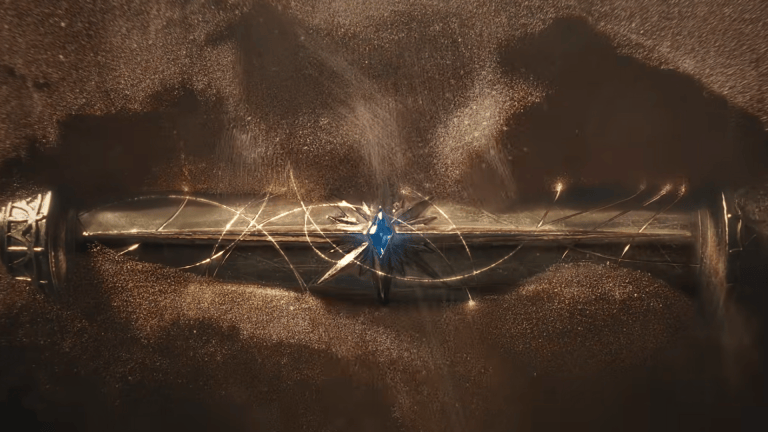
After eight long years of waiting, Elder Scrolls fans were rewarded for their patience with a minute-long teaser of a windswept sandscape and a blue-gemmed scroll gleaming in the dunes.
The full title of the game, The Elder Scrolls VI: Sentinel, was revealed by Bethesda Game Studios via X/Twitter on Nov. 3, as part of a video celebrating the studio’s 40th anniversary. The company thanked fans for years of “shared memories” and said it “feels great to finally reveal the name and location” of the long-awaited game.
Elder Scrolls 6 was first teased at E3 (Electronic Entertainment Expo) in 2018, but development didn’t begin in earnest until 2023. In its anniversary Twitter post, Bethesda added that “development continues,” a reminder that the game is still unfinished, and warned that “it’ll be some time” before they share any further information, much to the dismay of fans who hoped for more.
With no new details coming anytime soon, the natural question is how a game announced pre-COVID ended up this far from release. For those uninitiated or those who have waited for so long you can’t exactly remember why, let’s break down what the hold-up has been all these years.
It all started with a premature announcement. Bethesda’s director, Todd Howard, delivered a now-notorious quote regarding the game in an IGN interview in March, where he joked, “Just pretend we didn’t announce it. Doesn’t exist,” when asked about the status of Elder Scrolls 6. When IGN pushed him to comment further on where the game actually stood, Howard interrupted with a resolute “Nothing.” Howard has famously expressed regrets about how the game was announced, too, which makes sense considering it was mostly to soften the blow of Fallout 76’s rocky launch.
Then there’s how Bethesda traditionally functions. The studio has historically focused on one big game at a time, alternating between Elder Scrolls and Fallout. The Elder Scrolls V: Skyrim came out in 2011 and Fallout 4 followed in 2015, which should have put Elder Scrolls 6 next in line. Kurt Kuhlmann, a longtime Bethesda veteran and Skyrim co-lead, certainly thought so: “Why wouldn’t it be? That’s what we did, and that was kind of the expectation,” he said, calling it the natural next step given how the studio had always worked. Instead, Starfield, a brand-new space-faring IP that Todd Howard had long wanted to make, jumped the queue and broke the studio’s usual rhythm.
On top of that, there were also staffing problems. Kuhlmann himself left the studio in 2023 after more than 20 years at Bethesda. An ever bigger blow came this summer, when Microsoft’s Xbox layoffs hit the studio, with staff telling IGN that more than 50 employees were cut, including veterans who had worked on major title games. Developers warned the cuts would have “substantial and cascading effects” on the game, and fans feared yet another extensive delay. Bethesda insists the roadmap for Elder Scrolls 6 is “unaffected,” however, and says the game is now a primary focus, with a majority of staff working on it. Still, losing that much experience on a project this size is unlikely to speed anything up.
So where is all that effort headed?
The game’s teaser points to Hammerfell, a desert province on Tamriel, the continent where the Elder Scrolls series takes place. Sentinel is one of Hammerfell’s major cities and the capital of the Alik’r Desert region, home of the playable race called the Redguards. Hammerfell also happens to be one of Tamriel’s largest regions, a mix of barren desert, coastal trading, and rugged highlands. It’s best known to Skyrim players as the province that broke away from the Empire during the Great War, a conflict that Skyrim’s story often references.
The teaser itself is short on details, showing a metallic scroll being unearthed from the sand, along with an in-world passage attributed to Yazar, a Moth Priest to the High Queen of Hammerfell. In the lore, Moth Priests are the scholars who read the Elder Scrolls, the ancient artifacts the series is named after. The passage is dated 4E 206, which would place the game roughly five years after Skyrim.
Longtime fans already know a fair amount about Hammerfell, the area having appeared in The Elder Scrolls II: Daggerfall (1996), The Elder Scrolls Adventures: Redguard (1998), and The Elder Scrolls Online (2014), which gives Bethesda plenty of established culture, politics, and geography to draw on. The big question is whether Hammerfell can support the kind of sprawling, varied open world Skyrim delivered on. The 2011 game was set in a snowy northern province, so a desert setting will be a big change in look and feel for the series. How Bethesda keeps it interesting across a map that size is still anyone’s guess.
The same goes for the release date. The hopeful estimate is 2028 or 2029, but there’s really no telling. Bethesda hasn’t offered an official date either, or even a window, so for now fans can only keep waiting.