Gravity Falls Is the Perfect Gateway to Horror
Want something scary, but not traumatizing for a kid? Check out this Disney animated classic.

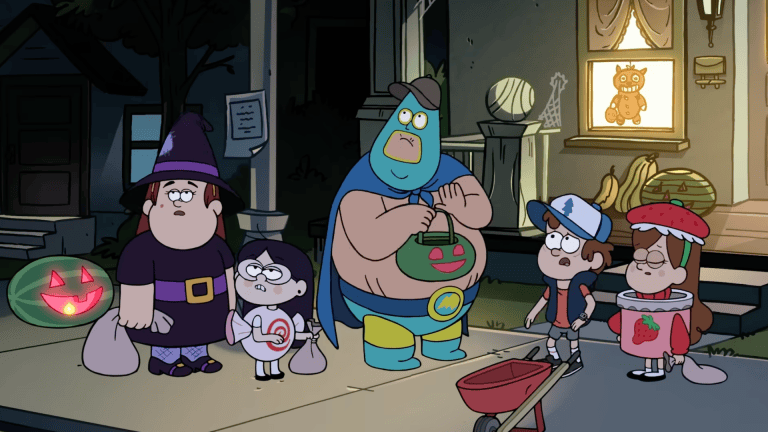
Halloween is fundamentally a kid’s holiday, a day for youngsters to dress up as their favorite characters and gather candy from their neighbors. But for those older kids and preteens, Halloween can be frustrating too. They’re edging out of the age for trick-or-treating, and want to indulge in some of the more grown-up stuff, even if they aren’t quite ready for the terror and disturbing content of a horror movie.
Those kids may relate the plight of one Dipper Pines, a preteen who wants to spend Summerween—his town’s extra Halloween celebration, made to go trick-or-treating while on vacation—at a party with his older crush Wendy instead of doing a themed costume with his twin sister Mabel. Even better, those kids may get a genuine thrill from watching Mabel and Dipper run from the Summerween Trickster, a spindly ghoul voiced by B-movie legend Jeffrey Combs, who brings all of his scary movie skills to the part. At once frightening, funny, and moving, “Summerween” is a perfect example of how the animated series Gravity Falls prepares the next generation of horror fans.
Welcome to Gravity Falls
Created by Alex Hirsch, Gravity Falls ran for two seasons on the Disney Channel and Disney XD between 2012 and 2016. It stars Jason Ritter and Kristen Schaal as Dipper and Mabel Pines, twins who spend one summer living with their Great Uncle (“Grunkle”) Stanley Pines (one of the many characters voiced by Hirsh), who runs a tourist trap/grift called the Mystery Spot in the Pacific Northwest. With the help of cool girl Wendy (Linda Cardellini) and Mystery Spot handyman Soos (Hirsch), Dipper and Mabel encounter all manner of supernatural happenings, addressing them in ways that are at once heartwarming, absurd, and often surprisingly scary.
The season one episode “Summerween” is a perfect example of this dynamic. Even beyond the central, silly idea of celebrating a second Halloween in the summer, the episode features lots of goofy set-pieces. It begins with the Pines family visiting a Spirit Halloween-style store, and sees Soos irritating everyone by pressing the button on a talking candy dish and guffawing at its lame jokes. A B-plot in the episode involves Grunkle Stan trying to prove that he’s still got it by scaring the kids who come to his door, kids who dismiss his attempts as lame and outdated—until he comes to the door late at night in his muscle shirt and boxer shorts, terrifying them with his hairy body.
Around the shenanigans, “Summerween” finds space for heart and horror. The former arrives in the form of the tension between Dipper and Mabel, as Dipper feels that he and his 12-year-old sister can finally put childish things behind them (especially with the opportunity to spend time with Wendy on the table), but Mabel wants to commemorate one last session before the two of them become official teenagers.
The horror comes with everything else. With his lanky, spider-like limbs and whispering voice, the Summerween Trickster unsettles even seasoned horror fans. Despite his yellow smiling face, the Trickster seethes with menace, and even appears to devour a random child called Gordie. He tells the kids that they must gather a certain amount of candy before the last Summerween candled gets blown out, and we believe that terrible things will happen if they fail.
Of course, it turns out that the Trickster is the embodiment of candy corn, Smarties, and other little-loved candies. So when the kids fail to meet the Trickster’s challenge, Soos simply eats the creature (freeing poor Gordie in the process, he gleefully declares, “I’m traumatized!”). Even better, the Summerween Trickster accepts his fate, relieved that finally, somebody likes his candy. The episode closes by giving the audience a good scare and then a wholesome ending, reminding them that everything is okay in the end… just like a good kid’s scary story should.
Weirdness and Wonder
“Summerween” is a stand-alone episode, one that ends with the Trickster threat thwarted, Dipper and Mabel reunited, and Grunkle Stan pleased that he can still scare a kid. However, the two seasons of Gravity Falls do tell a surprisingly complex larger story, one that rivals other famous shows that involve the Pacific Northwest, namely The X-Files and Twin Peaks. In fact, Hirsch pays homage to the latter show by getting Kyle MacLachlan to do a voice cameo in the final episode and by the David Lynch impression that Hirsch does to voice the show’s big bad, Bill Cipher.
Over the course of the seasons, we learn about the threat of Bill Cypher. A one-eyed, pyramid-shaped creature who speaks in an unsettlingly chipper voice, Bill Cipher comes from another dimension and threatens to unleash a hellscape onto our world via a portal in Gravity Falls. For years, the one defense our world had was Grunkle Stan’s twin brother, Stanford (J. K. Simmons). An intelligent and dutiful child, Stanford devoted himself to science, and after, encountering Bill Cipher during one of his experiments, to defending the world against his threat.
Stanley grew up in Stanford’s shadow, forever jealous of his brother’s success. Yet, when Stanford disappeared, Stanley stood in the gap in his own way, creating the Mystery Shop as a way to monitor strange happenings (and, it must be said, make money).
The entire story comes together in a three-part climax called “Weirdmageddon,” in which Bill Cipher finally invades our world and enslaves the townspeople, leaving Dipper and Mabel as the one last defense—if they can only work together. The “Weirdmageddon” invasions include plenty of unsettling creatures (one of whom was originally voiced by comedian Louis C.K., but has since been overdubbed by Hirsch, who did the same with a character voiced by T.J. Miller) and horrific images. For example, when local rich guy Preston Northwest (Nathan Fillion) tries to appease Bill, he gets his face rearranged into something shocking for a kid’s cartoon.
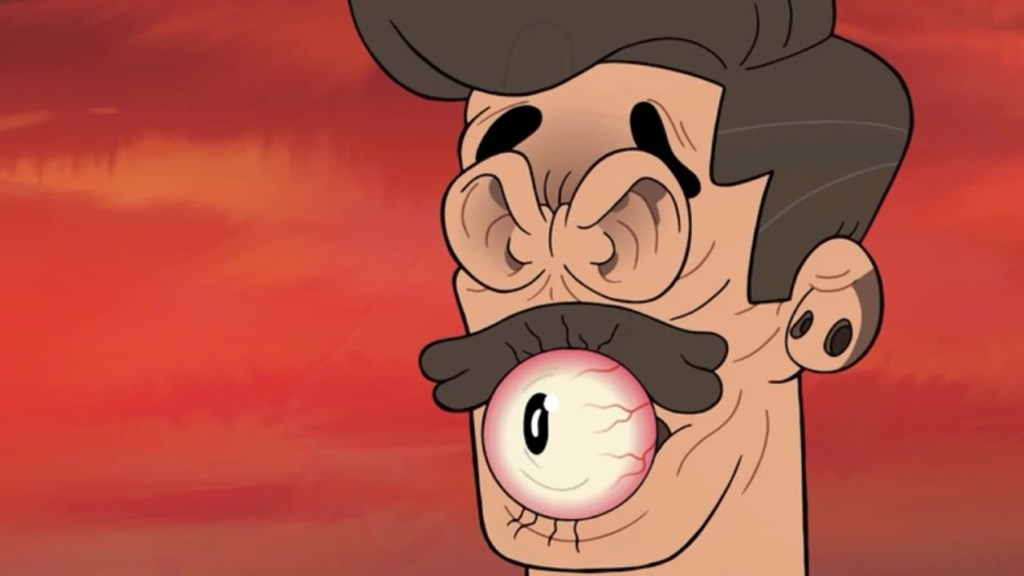
Yet, as shocking as it is, “Weirdmageddon” builds to a wholesome climax, one that gets to the show’s basic principles: the world is scary and unknown, but you can get through it with the help of others.
At this point, one might point out that no matter how weird Gravity Falls gets, it is still a Disney cartoon aimed at children. In other words, it prompts more laughs than scares, its pre-adolescents get the most attention, and everything works out alright in the end. And that’s okay, because the scares are real enough, as are the complex emotions that the characters experience.
Which is an important lesson for anyone to learn when they’re getting into horror: as scared as you might feel, as upsetting as the material may be, even the gnarliest horror movie is just a trick, and that itself should be a treat. Gravity Falls understands this just as well as Scream, Friday the 13th, or any other scary classic.