Why Robert Pattinson Needed Lord of the Rings and Sauron to Understand Chris Hansen
Exclusive: Director Lance Oppenheim explains how Chris Hansen is as much a meme as a man in pop culture, and how he and Robert Pattinson tackled that in Primetime.

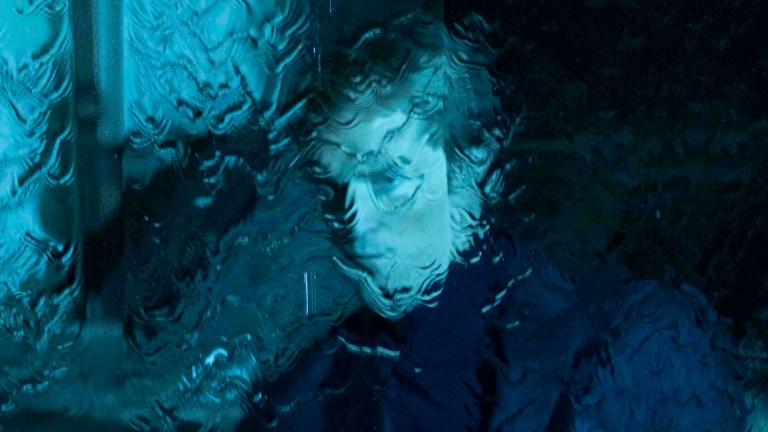
In the minds of director Lance Oppenheim and star Robert Pattinson, Primetime was always as much about the idea of Chris Hansen as it was the man. The film they made is certainly based on a real figure, specifically in regard to the most controversial segment of Hansen’s To Catch a Predator as relayed in a 2007 Esquire article about the day a man died while filming the program.
But even in the hands of a documentarian like Oppenheim, the aim was to find something more aloof and otherworldly about how Hansen has come to dominate popular culture. Here is a figure who has lived on for decades in true crime television, YouTube videos, and even internet memes as a figure with a preternatural, almost Dracula-like quality that compels everyone to stare into his eyes, take a seat, and spill their guts. Even about often heinous and monstrous things imaginable.
“Rob would always bring up Lord of the Rings,” Oppenheim tells us of the atmosphere he and Pattinson cultivated on set. “I would ask, ‘What do you mean by that?’ And he’d say, ‘It’s the Rings of Power!’ You’re in the hot seat, and you sort of see it with [Skyler Gisondo’s] Decoy Dan later. You have this guy who, when the cameras are on you, there’s this effect—this feeling that’s almost indescribable, this power over them.”
By design, Pattinson’s version of Hansen is both a man and a persona he wears, a larger-than-life figure who simultaneously straddles the worlds of reality TV and superhero theatrics. And the movie is as much about what it’s like to be given that kind of power, by the One Ring or otherwise, and using it to draw out someone’s guilt or acquiescence. At the same time, though, it is still a movie that tracks the rise and fall of To Catch a Predator, culminating in a sequence that Oppenheim muses takes on the heightened madness of “storming through the Gates of Mordor.”
Face to Face with the Real Hansen
Only 30 years old, Oppenheim was still a youth when To Catch a Predator ran its course between 2004 and 2007, and even then he didn’t discover it until the series was already gone, passing on to that nether-realm of MSNBC reruns and pop culture punchlines. Yet it’s that same pop culture afterlife which caught his imagination, with Oppenheim first discovering the spoofs and caricatures of Hansen on South Park and Mad TV, and on vintage 2000s websites like eBaum’s World, before sitting down to watch the real thing.
“Even though I didn’t understand what they were satirizing or parodying, I just thought the concept of adult actors pretending to be children and in this sort of constructed reality was really interesting,” the director recalls. It began a fascination that eventually led to a deep dive into the real thing’s catalog of work.
“I was amazed, because Chris Hansen to me felt exactly how he was portrayed to be in some of the sketches. He was this mythological being with this almost superhuman ability to make a guy sit down in a seat… He reminded me of Tony Montana a little bit, he was kind of a badass.”
Those fond childhood memories survived long before Primetime came along, as well, with Oppenheim’s wife paying the real-life Hansen to record a Cameo—an online service where famous celebrities or personalities agree to make specialized video recordings for fans—in time for Lance’s birthday. In the video message, the real Hansen (perhaps) jokingly suggested Oppenheim could make a movie about him after complimenting the director’s second documentary feature, Spermworld. Hansen also spoke of his various current off-shoots of To Catch a Predator, like the “Have a Seat with Chris Hansen” YouTube channel.
Says Oppenheim, “I was just like, ‘Wow, this guy I grew up with, who was this sort of crusading journalist, is also this self-aware entertainer now, and you could pay him $30 and he’ll pretend, essentially, that you’re a potential predator and wish you a happy birthday.”
Man or Meme?
The Cameo encounter raised an intriguing question: how do you continue to do these investigations into probably one of the darkest subjects known to humankind, but also make it commercial with catchy one-liners that folks want to come back to time and again? It’s a query that became all the more fascinating when industry acquaintance and admirer Robert Pattinson brought him a screenplay by Ajon Singh about Hansen. Pattinson and fellow producers apparently thought it would appeal to the director of the Ren Faire—the documentary series on HBO about another cult of personality figure who spent decades bending reality and people to his will at the United States’ oldest running Renaissance Fair in rural Texas.
Of course Hansen deals in real, often horrifying realities. To this day, he lures real, probable (and in many cases, later convicted) child predators into situations where they believe they will be meeting with underage children alone in a house. But it’s, again, the effect Hansen’s allure had on the media that drives the Primetime filmmakers.
“This is an internet figure,” Oppenheim considers. “He was a television news figure and he was very popular on television news, but his popularity only surged when he was on early YouTube, and it continued to grow and adapt.” Indeed, Pattinson similarly only discovered Hansen online at friends’ insistence when he first moved to the States back in 2008. “Everybody I know has a relationship to Chris Hansen, at least in America, but they only discovered him through one of these after images of him.”
Says the director, “I don’t know if it’s possible to actually make a proper depiction of the real person when the real person has fully subsumed himself into the meme and all of the serious work he does is sort of absorbed into this persona that has grown on the internet over decades. I want to adapt that. I want to adapt the persona of him.”
With that said, the goal, at least according to the director, was never to depict Hansen as a kind of monster—although Dracula has also been name-dropped as reference point and the real Hansen has made clear to the press his unhappiness with the film—but to study a character who lived life at the center of one of the 2000s’ most lurid media circuses.
“[When Ajon and I tried] to convince Rob to play the part, not just produce the movie, it was this idea that drew us in: When you get so close to the darkness, how does that affect you? I talked about this with Rob all the time, and I wasn’t sure how he was going to perform it, and what he did was so different than what I had expected… it was almost like channeling PTSD or these effects of having spent more time with predators than your own family, and the family that this kind of troupe of people that go from city to city become. They resemble more of a family than your own.”
In the film, Pattinson depicts interactions in the Hansen household between father and sons, and husband and wife, as frosty. Stilted. Alien. He seems more at home, if not necessarily more human, when taking on a paternal relationship with “Decoy Dan,” Gisondo’s 24-year-old actor hired to pretend he’s a prepubescent boy online. There is, in other words, an unknowable mystery about the figure.
From Chris Hansen to Elizabeth Holmes
That aloof unreality is something Oppenheim will be exploring for the foreseeable future. While the director claims he does not see any similarities between Primetime and his other A24 release taking the fall festivals by storm—the Nathan Fielder co-directed You Can See Everything—it is another film about a media-transfixing figure who had a penchant for getting folks to “join the circus” in her cult of personality. And as teased by the ominous teaser trailer for the film, this includes when the disgraced and soon-to-be-incarcerated Theranos founder speaks with Fielder on-camera.
“I will say this,” Oppenheim allows, “I made this film with the same crew as I did with You Can See Everything: same cinematographer David Bolen, same composer Ari Balouzian, a lot of the same producers, Christian Vazquez, Abigail Rowe. The movies were happening concurrently for a long time.”
He also concedes that there is a certain symmetry with Hansen’s popularity in 2006 echoing Network, the 1976 satire on where the commercialization of news media as entertainment is going, and now in 2026 how Holmes is herself a national figure in both the news and entertainment space.
Says Oppenheim, “To put it in perspective today, I feel like everything feels haunted, everything feels unreal, everything feels governed by the laws of reality television, and nothing makes sense anymore. Everything is colorless and bland looking.” With Primetime, he wanted to bring back the bright, even garish colors of the 2000s, which curiously seemed far more ubiquitous in a pre-iPhone world.
“Things looked more colorful, almost to the point of making you nauseous, like cotton candy colors,” he continues, “so I wanted to just bring people back into that. Not to just do some sort of lazy, nostalgia-baiting of that time period, but really get people to consider where we were then and how we are now. In 2006, we were in a war that was very confusing and many people didn’t know why we were in there, and there’s a lot of rage, and people were looking for a receptacle to put that rage; we’re in another war that’s really confusing right now and people still have the same rage. So there’s a lot of things going on that I feel like are still with us. If anything, they’ve metastasized and boiled over even more.”
The goal is to make something as elusive as the appeal of Hansen and media of that era. “This should have been the movie that everyone wanted to see then.” A film as grand, and leering, as Hansen staring directly into the camera and commanding you with all the powers of Mordor to take a seat.
Primetime is in theaters on Friday, Sept. 25.