Resident Evil: The Biggest Changes from the Game Make for a Better Movie
We look at a few of the biggest departures from the original Raccoon City trilogy in Zach Cregger’s Resident Evil, and how those deviations make it a more faithful adaptation of the game-playing experience.

This article contains Resident Evil movie spoilers.
One of the greatest jump scares in all of video game history occurred during the early movements of the original 1996 Resident Evil classic. As either Jill Valentine or Chris Redfield, players would wander tentatively and fitfully through a big spooky mansion where they know the animated remains of human corpses are slowly shuffling about. What most gamers back then did not realize though is that humans weren’t the only danger.
It is thus the perfect jump scare when a dog pounces with extreme speed and agility through a window, shattering glass everywhere and causing the sound design to spike so high that many a ‘90s kid will swear they might have had flickers of cardiac arrest on their first playthrough. The medium had never seen something so cinematic before, particularly in a horror scenario. How do you possibly recreate that kind of jolt in film 30 years later?
Well, if you’re Zach Cregger, the answer is by ignoring what fans think they know are “the rules” for your Resident Evil reboot in 2026 and go plain hog wild with the lore. So it is when Austin Abrams’ medical courier in the new movie escapes the clutches of a dog that seems very much alive when it chases the poor bastard across a frozen tundra near the start of the new movie. Man and beast alike are sandwiched into a barn where Abrams’ Bryan has trapped the pooch on the lower level while he escaped out of the hay-loft door up top.
Yet, much to Bryan and even the audience’s surprise, the dog not only is able to smash its head through the wall, but it then unleashes a tentacled nightmare from its mouth, wrapping around Bryan’s leg and dragging him ever closer to its mutated canine clutches!
This for the record is nothing like the zombie dogs you might remember from the original trilogy of ‘90s Resident Evil games, or like those encountered in the 2002 and 2004 movies that similarly saw Milla Jovovich scuttle around a Raccoon City biohazard disaster. The undead dogs of Raccoon City are… undead. Reanimated un-good boys. But the beastie in Cregger’s film? He looks more like those infected by the “Las Plagas” parasite from Resident Evil 4 and Resident Evil 5.
At the risk of going deep on the nerdiness, the Las Plagas parasite and the T-virus are entirely separate things, and exactly the type of deep-cut distinctions that will most assuredly ruffle some fans’ feathers. Whereas the T-virus that makes zombies possible is designed by the Umbrella Corporation, the evil conglomerate responsible for the biohazard nightmares of the ‘90s games, Las Plagas is less George Romero-coded; it’s in fact a Resident Evil 4 conceit that let Capcom game designers turn every human, or indeed dog, salamander, cockroach, or whatever else into pure nightmare fuel. This includes creatures who have tentacles and other monstrosities sprout from their head after you blow their head off.
It’s quite clear that Cregger is a fan of Resident Evil 4 since he plays fast and loose with that iconography in his new film, even though he’s technically set “before” the discovery of the Las Plagas parasite by a cult of European Napoleon enthusiasts and Dracula fetishists. But the director’s also a fan of… just doing his own thing altogether. Hence the even more shocking revelation: after you blow off the head of a zombie or two, as Bryan does at the same farmhouse, they not only grow tentacles from the neck stumps… but they can actually combine and merge bodily forms. In fact, they seem to prefer it!
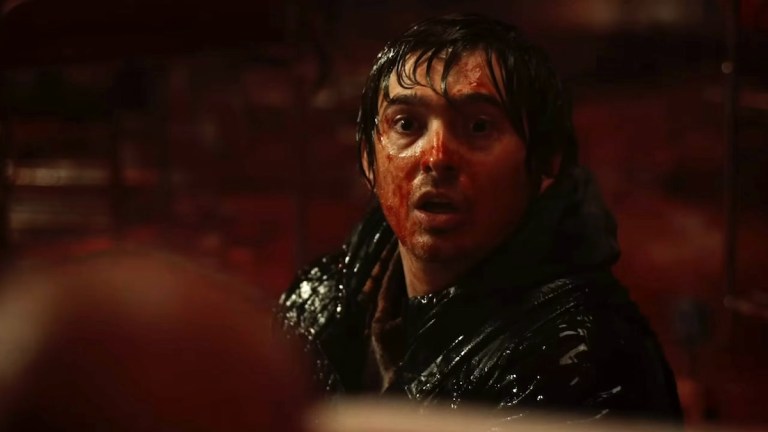
As the movie unfurls, it seems the ultimate form of Cregger’s take on the T-virus (assuming it is even called that in his movie) is not a zombie, Nemesis, or anything else we’ve seen in the games: it’s a Cronenbergian hodgepodge of body horror terror in which mutilated corpses (assuming they’re even… dead?!) form into giant piles of heat-seeking disease that chases you throughout the city. In fact, (MAJOR SPOILER), as the ending reveals, the final form for this even befalls poor, poor doomed Bryan.
In the movie’s closing moments, he grows the giant familiar eye we associate with William Birkin from the Resident Evil 2 video game (which by the by is a byproduct of the G-virus for anyone who cares). Now Bryan seems to need to spread his infection by mingling his flesh with the bodies of everyone around him, including the last scientist trying to “cure” him, if only to save his own skin. Tough luck buddy, you’re going in the body pile!
The iconography definitely riffs on Resident Evil video game visions of mutated fantasias, but in function and detail it’s a Cregger-original nightmare. Some fans will take umbrage over this riffing on Resident Evil video game lore. That would be their loss.
Cregger’s movie is a classic example of a film that is not close to the letter of its source material, but one that captures its spirit far better than any key-jangling film that might feature a miniskirt-clad Jill Valentine and sunglasses-adorned Albert Wesker, which is what passed for “fan service” in the previous big screen Resident Evil abominations helmed and/or written by Paul W.S. Anderson.
To be sure, those movies featured a lot more characters and incidents from the video games—Jill Valentine appears, miniskirt in the second film as played by Sienna Guillory and Chris Redfield eventually makes a glorified cameo in Resident Evil: Afterlife (movie four) as played by Wentworth Miller, and they even eventually get around to Albert Wesker’s sunglasses. But those tokens of “service” are obligatory, hastily thrown together to get applause from the lowest common denominator.
Admittedly, there is a way to adapt those same elements that feels true to the tone and vibe of the games. But Cregger chose another path, but in so doing he played to the cinematic medium’s strengths while still getting the general direction of most installments in the game: we follow an everyman (or woman) as they slowly discover they’re in a life-or-death situation where their supplies and ammunition is limited, and the further they attempt to retreat to institutional safety, the freakier the monsters become. As does the corporate conspiracy responsible for unleashing them.
Like any number of Resident Evil video games made in the 2010s or 2020s, Cregger elected to adapt that formula with new characters and his own spin on the concept. The details are different, but the bones are the same. It feels like Resident Evil. In a franchise as long, eclectic, and varied as this series with its many protagonists, side characters, and subplots, creating his own little corner is more than welcome. And whether it’s a T-virus doggo or Las Plagas parasite, it’s got teeth.
Resident Evil is in theaters now.