The Invite Review: Olivia Wilde’s Beguiling Sex Comedy Is the Event of Summer
Olivia Wilde, Seth Rogen, Penelope Cruz, and Edward Norton make for a swinging, and surprisingly tender, time in A24’s The Invite.

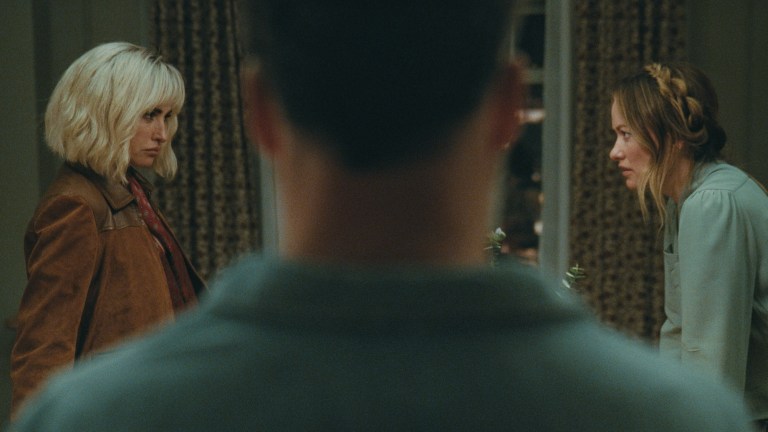
I’m not going to begin by stating emphatically that Penelope Cruz and Edward Norton play sexy-time ghosts in Olivia Wilde’s The Invite… but what if they might be ghosts, who happen to be sexy? I’m kind of joking, but also stay with me for a minute.
Still high off its buzzy premiere at Sundance, The Invite walks, blurs, and utterly dissolves all manner of boundaries and bougie festival taboos. Floating with an ethereal mystique that borders on the otherworldly, as well as a painfully hilarious naturalism, this is a movie orbiting around a marriage in midlife catastrophe to the point of dizziness—an even more impressive feat after the film was marketed with such deceptive seduction. To be sure, Cruz and Norton are quite appealing, the seemingly perfect couple upstairs in a posh, if ancient, New York City tenement building. They initiate friendly conversation in the elevator, look gorgeous while making preternatural eye contact with neighbors, and apparently have passionate, earth-shattering sex after midnight each evening.
Angela and Joe (Wilde and Seth Rogen) should know. They hear it every night through their ceiling, along with a 12-year-old daughter who is never seen in the film. There is something just inexplicable about Piña and Hawk (Cruz and Norton). And it leaves our central couple so resentful and envious that the movie begins with an insert card of an Oscar Wilde quote: the eternal harbinger of doom for any romantic sentimentality beyond skin-deep nihilism.
So when Joe and Angela invite Piña and Hawk over for a couple’s dinner, something aloof is in the air. Joe thinks it’s tension, as he is more than ready, eager even, to complain about the animal sounds through the floorboards. But for our spirited guests, the tension could have an entirely different flavor, one of suspense as they are here to—eventually—propose the downstairs stuffed shirts join them in a shared sexual experience.
They want to swing by switching spouses for the night.
The ghostly element I mentioned earlier is a bit of a come-on, but not by much. While the film quotes Wilde, Oscar, there’s more than a touch of Dickens and his descendants about the way Piña and Hawk float into our unhappy protagonists’ lives. They’re kinky Jacob Marleys, freaky Clarences, the angel of mercy in It’s a Wonderful Life who’s come to grant Jimmy Stewart a second chance at life after decades of disappointment by getting frisky in the kitchen. Even the audience is tempted into thinking they’re watching one kind of beguiling sex comedy, which we sorta get, even as we’re really being lured into a far more existential exploration of love and marriage after the romance has died. Are things not already in the Twilight Zone when an orgy offer from strangers amounts to the closest thing to high romance Joe or Angela’s heard in years?
The trick of Olivia Wilde’s film and its luminious screenplay by Rashida Jones and Will McCormack is its structure. Based on the Spanish film The People Upstairs, Wilde’s picture borrows the original’s real-time setting of an unwieldy night of collapsing inhibitions and glasses of wine giving way to low-lit confessions in a cozy apartment’s corners. Among Jones and McCormack’s many scripted innovations, however, is the sensation that this is occurring in a bit of a theater workshop. This isn’t a knock at the performances, which are excellent, but at the sense we are sitting with a group of professionals, also over wine, as they psychoanalyze and deconstruct a messy, impermanent thing: the marriage of two people who care for each other but lost love a long time ago.
Wilde shoots the film almost wholly in steadicam and in an underlit setting wherein the decorative paint colors and apartment accoutrements that Angela distracts herself with are indistinguishable. She isn’t wrong to note Joe is checked out when she talks about “finishing” the bedroom several years on, but Wilde the filmmaker cannot let her character hide behind minutiae. She drowns Angela and Joe’s faux domesticity into an inviting yet gloomy shadow world.
Similarly, the helmer constantly films Rogen’s Joe as a domineering force in the life of his wife, towering over the frame and captured in harsh low light like a Halloween fright mask. At other times, the pair are caught in line of sight of each other in their horseshoe-shaped apartment, with the duo able to simply look up across the way and see one another in parallel windows. Yet they never do. It would make eye contact and break the spell of mutually agreed upon isolation.
At its core, though, one does not cast a talent like Rogen, or for that matter Wilde at her most mischievous, and not revel in the humor. Rogen accentuates a new note of tired resignation to his likable, schlubby everyman persona, but there’s a lot more bitterness to Joe than Matt Remick in The Studio, as well as more pathos. This is a sad sack too self-involved to recognize he’s dragging his marriage down, but his unhappiness is not unsympathetic to anyone who reached a certain point in life where they realized they did not become the person they dreamed about when they were 20. It also makes his acerbic digs at Piña and Hawk, particularly for the latter’s clearly self-chosen name, all the more biting.
Meanwhile Cruz delights in her role that purposefully walks a line between the ethereal and earthy. For much of the film, she might be a cipher, or certainly a projection of Joe and even Angela’s desires, albeit in very different contexts, but Cruz plays it with a rueful self-awareness. She’s the cat plucking at a pair of wounded canaries’ wings. The scene where she specifically attempts to uncoil Joe out of his wound-up funk to Sade’s now 26-year-old(!) “By Your Side” is a harmonious car crash; a collision of sweetness and cringe, reverie and gallows humor despair. And I haven’t even mentioned his dance moves.
The Invite is a shimmering dramedy for adults of a certain age, and perhaps a sobering epiphany that this can now be so acutely tailored to elder Millennials and younger Gen-Xers at that. The film is genuinely sexy but in the awkward and disarming way of clumsy foreplay. It stumbles and stammers, with its proverbial pants caught around the ankles before the whole thing tonally keels over. Yet for all the screenplay’s verbose intellectualization about sensuality, and Wilde’s obvious preoccupation with it as a storyteller, the main event is something more intimate and unspoken. It’s a lament about the passage of time, milestones left discarded, and maybe even marriages that also have outlived their shelflife.
One might even call it haunting, complete with the mysterious good-looking specters descending from above.
The Invite opens in select locations on June 26 and in wide release on July 10.